I have been fascinated by, if not the greatest practitioner of tarot since I was a teenager.
My love of astrology has generally kept me from continually using tarot over the last thirty years or so. This is no excuse, as both methods of divination are generally complementary.
For a time, somewhere in the 1980s, I did use a deck called ‘astro tarot’, which I think you can still buy, but I ‘lost’ these years ago.
In more recent times, particularly over the last few years, I have been drawn more fully into the mysterious and magical world of tarot, its practise and its disputed history.
Most particularly I have learned to respect and invariably use Tarot de Marseille (TDM), rather than the more well known Rider-Waite style tarot decks.
I much prefer the ‘unillustrated’ pip cards of TDM; I don’t like my intuition being influenced too much by the more illustrative and suggestive Rider-Waite, particularly in the swords suit, where, for example, if one draws the Nine of Swords, this can leave people quite worried!
No, I much prefer to stick to basics: swords is the mind, our thoughts and 9 is attainment. It is up to the tarot reader to interpret this. But more of this in another piece some other time.
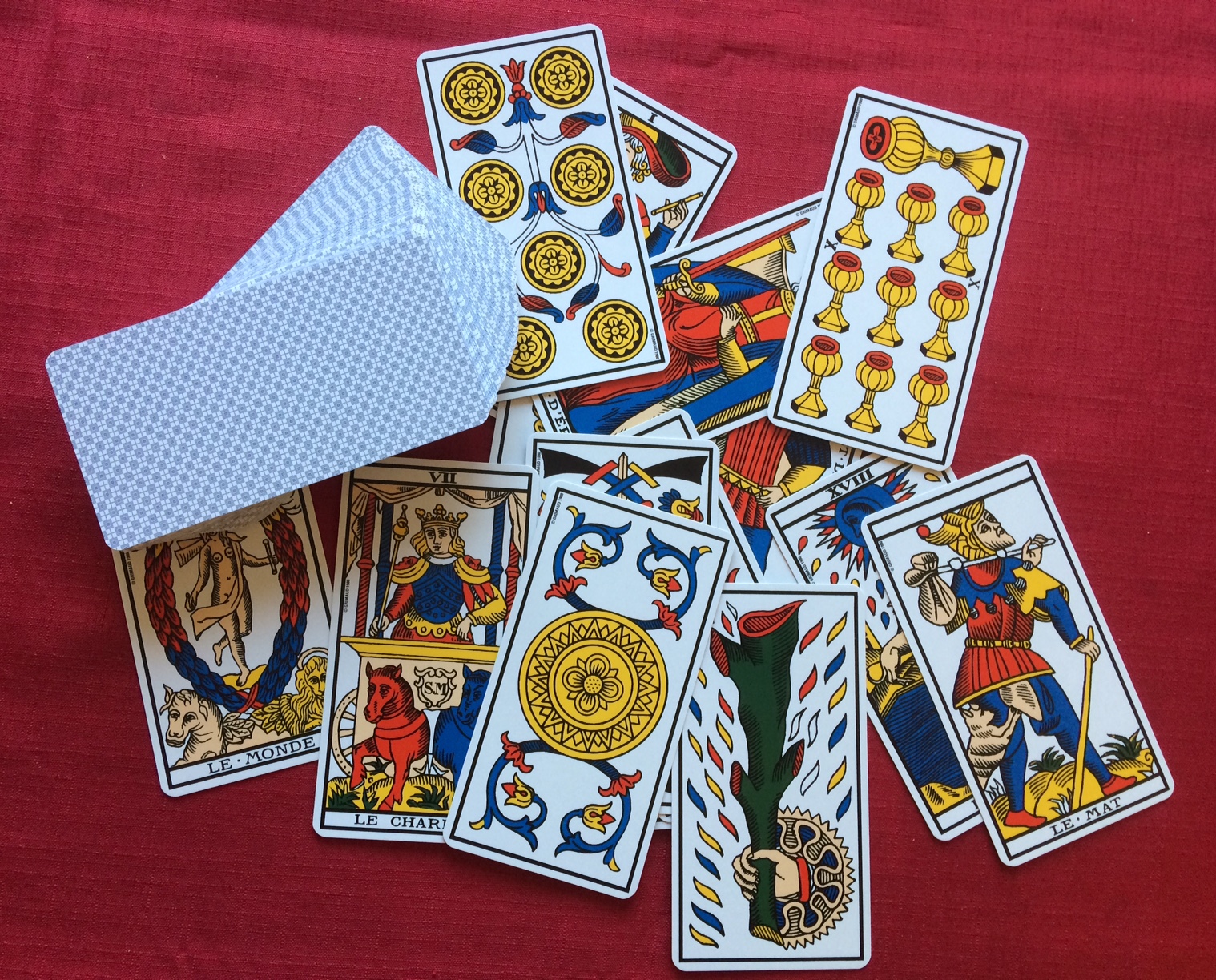
One particular deck I’ve enjoyed for some time is the Grimaud Cartomancie TDM, ‘Ancien Tarot de Marseille’. It comes in a beautifully presented, sturdy box, with the usual mini-book with basic interpretive ideas – in French.
The illustrations are very clear and basic, with strong colours and bold black linework. The word is emphatic, which I like. The card stock is likewise quite sturdy with a grey-blue patterning on the reverse.
The history of TDM, like all tarot, is complex. There are many variations of TDM but this overall style developed, as the name suggests, in the south of France, but also has strong links to northern Italy, Switzerland and even southern Germany over the years.
In other words, this card style does not owe everything to the city of Marseilles, which could be regarded as a name of convenience – and it sounds good too, doesn’t it? After developing from the seventeenth century onwards, it was in 1930 when Paul Marteau of the Grimaud family truly established and perpetuated this particular artistic style of TDM.
I am very glad that he did, as these cards are a particular favourite of mine and I would very much recommend them.
Today’s Moon: The Moon is in Capricorn. There is no void Moon period today. The Moon is waxing and in its Waxing Crescent phase. The New Moon occurred on November 4th in the sign of Scorpio. 35 more words
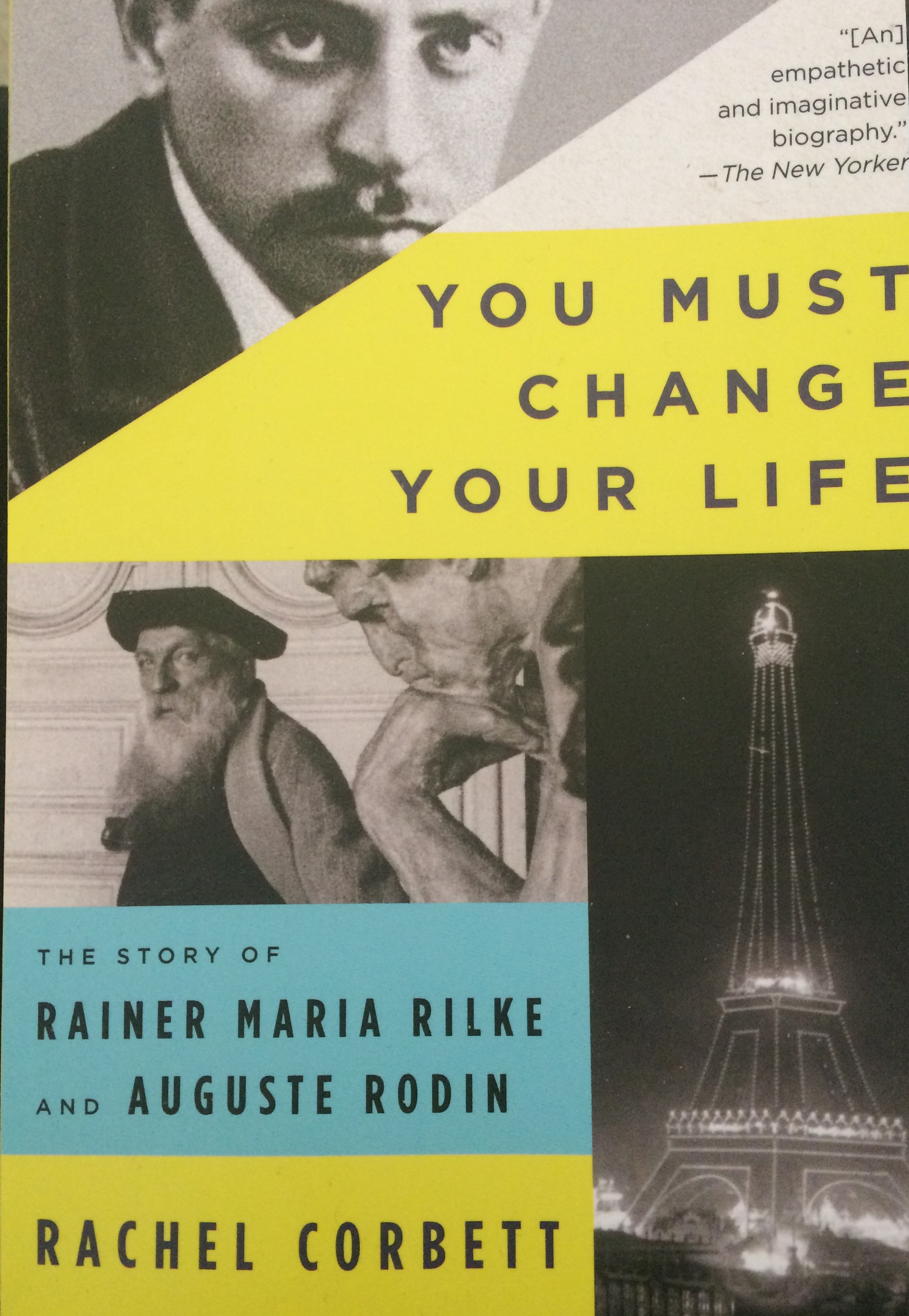
It is Rilke’s short collection, ‘Letters to a Young Poet’, which has inspired many people of all ages for around a century.
His messages to this one individual, Franz Xaver Kappus, now immortalised in print, convey the need to go deep within, to accept the human condition of loneliness and isolation and to absorb it. His most famous works included ‘The Book of Hours’, ‘The Book of Images’, ‘The Duino Elegies’ and ‘Songs to Orpheus’.
What kind of man was this? And how has such a message, seemingly contrary to the accepted ‘wisdom’ of our times, found such favour?
Dressed as a girl
Rainer Maria Rilke was born in Prague in late 1875, a member of the German speaking ruling classes of the disparate empire of Austria-Hungary in central Europe. He was always conscious of this and never entirely happy being within it. In his latter years, he would reject it entirely whilst living in Switzerland, where he composed solely in French.
His early situation was not helped by the fact that he had an older sibling, a girl, who died a year before he was born. When he arrived, his mother appears to have wanted another girl and Rainer, or René Karl Wilhelm Johann Josef Maria Rilke, as he was originally christened, was dressed in girls’ clothing during his formative years. This would have had a profound early psychological impact upon him.
Acceptance of Czech and Slavic culture
He was later sent to a military academy, which he despised, yet he looked back on it as a formative and even necessary experience. Unlike his mother, he always had a sneaking admiration for the Czech/Slavic majority culture, even though it was deemed lower class in comparison to the ruling Germanic. He had Czech girlfriends and got know an uncle of one who had visited Russia and knew Russian literature.
Then his life changed profoundly when he met Lou Andreas Salome, a married Russian aristocrat significantly older than him. Despite her marital status he accompanied her and her husband to Russia first in 1899 and again with her alone the following year, 1900. Here he met the Russian literati, including Tolstoy and Pasternak.
Mother Russia — his spiritual home, or ‘heimat’
But it was his experiences with the simple Russian and Ukrainian folk that had the deepest impact upon him; their complete involvement with the Orthodox culture, full of ancient tradition and festivities. This plus the largely unspoiled Russian countryside, the steppe and its agricultural calendar, opened his eyes to a God essentially created by Man, at least within his own existential thinking. And of course, this was the inspiration for all his later work, beginning most especially with ‘The Book of Hours’.
He would spend several years living and working with the sculptor Rodin in Paris too, another period of change which took him another step forward. In fact, he was restless, always travelling, searching outwardly, and most especially inwardly — the isolation of the individual, his self, which he cherished the most and encouraged others to learn to accept.
No pain killers
Rilke lived his philosophy to the end, too. When he knew he was dying, he was reluctant to take pain killers — they might have detracted from the profundity of the experience. So can a look at his astrological chart, as given, reveal what was going on within his psyche?
He has Virgo rising, showing an analytical and critical approach to life. The midheaven and 10th house in Gemini points towards a career involving communication and much coming and going. Both Virgo and Gemini are ruled by Mercury, who is found in Scorpio in the 3rd house of the mind, challenged by Mars in Aquarius in the 6th house. Scorpio is deep and penetrating, investigative. Here was no whimsy, but someone who dwelt upon issues, but who could also get highly irritable, agitated, to the point where it could affect his health.
A wanderer in body and mind
His Sagittarian sun of self and uniting Venus are in the 4th house of the home, family, ancestors. Sagittarius is another mutable or changeful sign, imbued with a wanderlust, particularly for longer distances. Sagittarius is noted for going far and wide. However, although this is true of Rilke, who travelled extensively in Russia, Europe and north Africa, it was always in search of something inside, his ‘heimat’, or true spiritual home. He was to find this in the much maligned old Russia prior to the revolution and was to carry this realisation always.
His 4th house Venus is supported by being trine Neptune and sextile Mars, indicating his spiritual and passionate yearning for the numinous, ultimately for God, although even with the best aspects Neptune is illusory. His attitude towards relationship (he had many) is typically idealistic, in which he sees each partner upholding the space between them, like guardians of their separate, lonely selves. So love was always going to be a very difficult thing for him, holding up such ideals, perhaps indicated by Neptune’s aspect here.
His sun ruler, Jupiter, is also in Scorpio, just like his chart ruler Mercury. So we have both planets associated with the mind in deep, penetrating Scorpio, in the house of the mind. Rilke gave a new meaning to deep, passionate thought.
Bearing his cross
Dominating his chart is a loose grand cross in fixed signs and cadent houses. This could be seen as the cross he bore throughout his life. The Moon conjunct Saturn in Aquarius in the 6th house in itself suggests a difficult, restrictive, isolated childhood with illnesses, plus a trying relationship to the mother; so much so the health is also likely to be affected. He seems to have carried this sense of loneliness with him all his life, perhaps the major astrological indication of his philosophy of solitude.
Endless flux of life
This conjunction is opposite the rebellious Uranus in the 12 house of the inner life; sudden, deeper psychological issues are highlighted here, eruptions perhaps from problems stemming from his restrained childhood. Undermining Pluto is opposite Jupiter from the 9th house of travel and the higher mind, which may indicate issues like falling out completely with Rodin and the many new starts he had while abroad. This grand cross represents the continual flux he experienced in life, his difficulties and the existential challenge which he took up.
Finally, the north node of the Moon in the 8th house indicates he was born karmically with deep personal security issues. Individuals born with this tendency need to explore more deeply (8th house/Scorpio) through involvement in deeper, more profound psychological areas to do with security. Rilke appears to have instinctively understood this challenge and taken it up.





 Ciscography