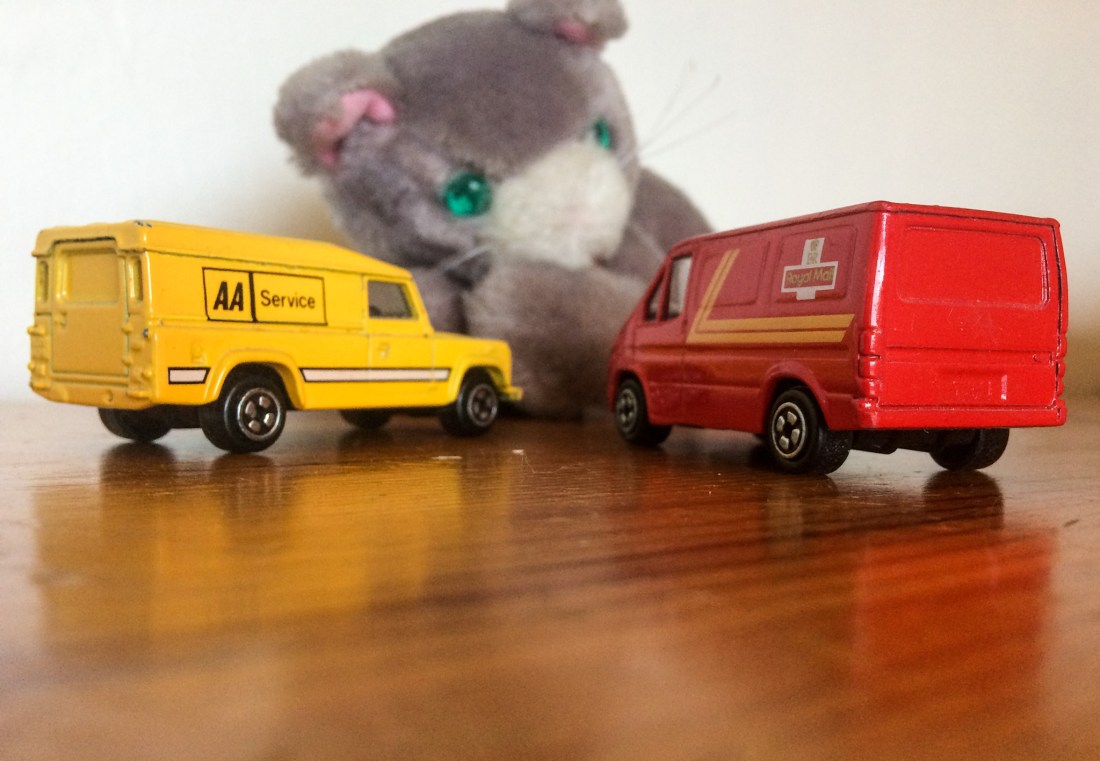
The AA and The Royal Mail are two mainstays of British cultural life, services that, generally speaking, can be relied upon.
We still belong to the AA and the number of times they have ‘dug us out of a hole’ are too many to count. Yes, it is perhaps fairly expensive if you go for bells and whistles membership, but is it worth it? Yes, I think it is. I love the emphatic yellow of the organisation and particular that of this toy.
If anything The Royal Mail is just as iconic and with that special monarchical and historic link, coloured by a similarly strident red. I think the two vans go well together.
He had been king for less than a year and hadn’t had a coronation.
Edward VIII officially gave up his kingship, his rule over an empire which spanned the earth, on which the sun never set. All because, we are famously told, for his love of an American divorcee, Wallis Simpson, a situation which could not be tolerated by the highly conservative establishment of the time. But of course it was a bit more complicated than that.
Like quite a few Britons at the time, Edward was an admirer of certain European dictators. After the abdication he became more than a mere acquaintance of one of them, something which didn’t go down too well in certain parts of the British establishment, as Europe and the world was led inexorably towards war.
As Prince of Wales he had been quite popular with his people back home and throughout the Empire and Commonwealth. He was able to relate to them despite the most privileged upbringing one could get. He was, however, quite shy and perhaps felt somewhat unworthy of the role fate had given him, something which led to several bouts of depression.
For these reasons and perhaps others too, he probably never felt he was not cut out for being a monarch of a vast and populous empire.
Falling in love with Mrs Simpson was only one reason among several which made him feel incapable of carrying on as king, a heavy responsibility which in the end he was forced to leave behind.
On July 17 1453, the same year that Constantinople and the Byzantine Empire fell, England and English influence was effectively kicked out of France for good following the decisive Battle of Castillon.
It was another example of the see-saw, in-out relationship the island of Great Britain (in this case the major part of it called England) has had with the continent for a long time.
Ever since 1066, when William of Normandy conquered England and became its king, there had been strong ties to France. However, when Normandy was lost in 1204 during the reign of King John, successive English kings had hankered for its return; they were after all directly descended from the conqueror.
English invasion and victory
By the late 1330s King Edward III, who was himself largely of French ancestry, was in a position to invade France following a dispute about the long held English territory of Gascony in SW France.
In June 1340 Edward III won a decisive naval victory against the French at the Battle of Sluys, which marked the beginning of the so called Hundred Years War. By the end of the decade, following even more crushing victories at the Battles of Crecy and Poitiers, Edward was in control of large parts of France and even had the French king John II as a prisoner.
Then the so called ‘Black Death’ intervened in 1348/9. The treaty of Bretigny was eventually signed in 1360, leaving England in full charge of an expanded area in SW France. This marked the end of the first phase of the war, an often punctuated stalemate lasting fifty years, which saw France regain the upper hand diplomatically and make incursions into English territory.
The English conquest of France
Then in 1415, just two years after ascending the English throne, King Henry V re-ignited the conflict with his invasion of France. Following an unlikely victory at Agincourt that October, Henry went on, over the next couple of years, to re-conquer Normandy and push on from there to take large areas of northern France to add to those in the SW. Henry had become the undisputed master of France and heir to the French throne, once Charles VI had died. Unfortunately for Henry he was to die six weeks before Charles, leaving the throne of both England and France to his year old son, Henry VI in 1422.
Although the English held on to many of their French possessions for another generation, the loss of Burgundian support and the weakness of character of Henry VI, ensured their eventual defeat and removal from France and the continent of Europe, leaving only little Calais an English possession until 1558.
Out of Europe once again
So England and Great Britain had exited militarily and politically once again, though the monarchs of England would retain their claim on the French throne for several centuries after the defeat. England became more insular after this point, and following the disastrous Wars of the Roses which occurred immediately after the loss of France, the country became more obviously a nation with a nationalistic outlook.
The underrated King Edward IV, one of the Yorkist kings of England, attained enough stability in his kingdom to successfully invade France once more in 1475. However, he was in turn bought off by the French king Louis XI with a huge ‘bribe’ in the Treaty of Picquigny and returned home with his army.
Only the spiritual and ecclesiastical links remained across Europe and Great Britain, the power of the Roman Catholic Church. But even this, as it turned out, was not sacrosanct – but that’s another story in the list of this island’s fractious in-out relationship with Europe.
Prince Arthur was Henry VII’s eldest son and heir to the throne of England. Sadly, he was to die aged only 15 in the year 1502, just months after marrying Catherine of Aragon and taking up residence at Ludlow Castle as Prince of Wales.
If his birth data is accurate, and I have no reason to doubt it, I think England might well have missed out on a new golden age, something which his father the king had truly hoped for, which is why he had his eldest son christened after the legendary British ruler, Arthur.
Lots of Potential
Why do I say this? The personality of rulers, especially monarchs who wielded virtual absolute power, would obviously affect the destiny of the nations over which they ruled. So what does Prince Arthur’s birth chart reveal? He was apparently born a month premature but there are not many indications that he was at all sickly at birth, or during his short life.
He was born with Royal Leo rising with his ruler, the Sun, in Libra in house 3 in good aspect to Saturn in Sagittarius in house 5, in challenging aspect to Jupiter in Capricorn in house 6. Venus is also in Leo in house 1 of personality, in good aspect to Mercury and Mars.
Attractive Personality
Dying so young, Arthur’s character would not have been fully developed, but this suggests an attractive, strong, generous, confident, courteous, diplomatic and responsible person with plenty of charm and probable wit. In what records we do have of him, he was described as very tall, handsome, amiable and gentle.
What is more, his Moon in Gemini in house 11 loosely conjunct Mars, would only strengthen his sociable and witty tendencies. He would have been great company, I feel. However, the Moon is opposite Uranus in Sagittarius, indicating that he could have a sudden, fragile, perhaps nervous temperament, too, which could have seriously affected his friendships.
A Glittering Royal Court in Waiting?
Looking at his mental potential, is seems to have been excellent, boding well for his future royal court, which might have become legendary, in a similar manner in which we talk of Richard II’s or even Louis XIV’s of France in a future age.
Libra is on house 3 cusp and Aries on house 9. These house rulers, Venus and Mars, are in good aspect to each other in ‘positive’ signs and houses, both in good aspect to Mercury in Libra in house 3. Add his Libran Sun in house 3 and it doesn’t get much better than this, the only things missing being Jupiter (higher mind), who is not exactly in this mix, in Capricorn in house 6.
Kingly Ambitions
I am quite certain that he would have been as adept in languages as his brother Henry VIII and Elizabeth I, and probably would have exceeded them. He would have been a patron of the arts and literature too, one of the prime considerations when we are talking about cultural significance.
His ambitions as king look equally well starred because Venus and Mars rule the 10th house and MC respectively. I think he would have been a great success in foreign diplomatic matters – he’d already had the good fortune to marry Catherine of Aragon, an important diplomatic move for the English crown and would have surely been the bedrock of his career as King of England.
What might have been
However, his tendency to overreach himself, as shown by the Sun’s square aspect to Jupiter, perhaps through overconfidence at times, might have presented some problems, especially in military matters.
However, with Saturn in good aspect to the Sun and in mutual reception to Jupiter in Capricorn, this might have somewhat stemmed his potential for over confidence.
Had he lived, I am certain that we are looking here at a great historic personality who would have been much loved by his people, the kind of person who could have introduced a new golden age to England, set the country on a very different course from the one his brother, the future Henry VIII.
*If you are interested in getting your own astrological report, or would like one created for a loved one or a friend, please contact me at leoftanner@gmail.com.



 Ciscography