Tarot Cards Review: ‘Ancien Tarot de Marseille’, Grimaud Cartomancie

I have been fascinated by, if not the greatest practitioner of tarot since I was a teenager.

My love of astrology has generally kept me from continually using tarot over the last thirty years or so. This is no excuse, as both methods of divination are generally complementary.

For a time, somewhere in the 1980s, I did use a deck called ‘astro tarot’, which I think you can still buy, but I ‘lost’ these years ago.

In more recent times, particularly over the last few years, I have been drawn more fully into the mysterious and magical world of tarot, its practise and its disputed history.

Most particularly I have learned to respect and invariably use Tarot de Marseille (TDM), rather than the more well known Rider-Waite style tarot decks.
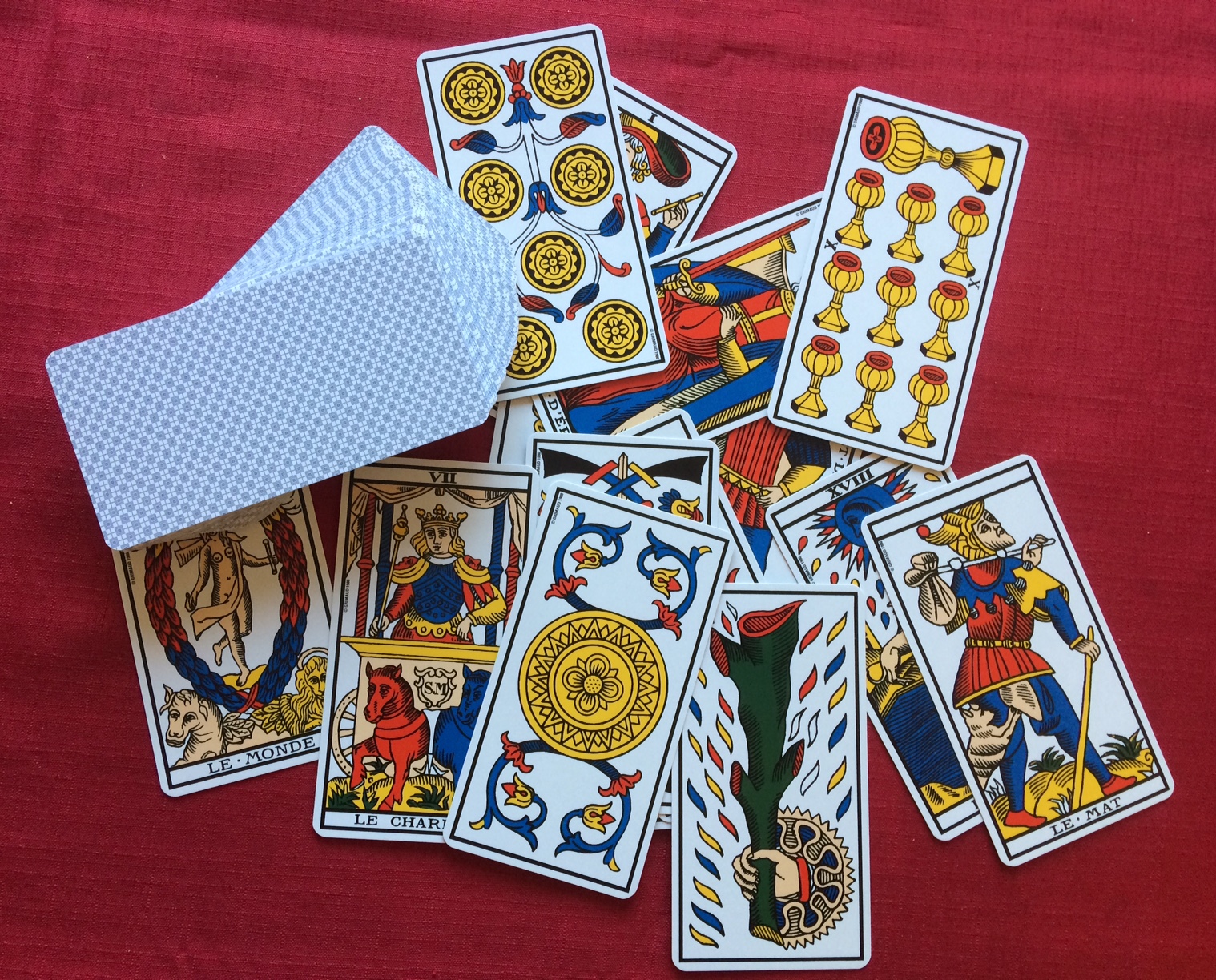
I much prefer the ‘unillustrated’ pip cards of TDM; I don’t like my intuition being influenced too much by the more illustrative and suggestive Rider-Waite, particularly in the swords suit, where, for example, if one draws the Nine of Swords, this can leave people quite worried!

No, I much prefer to stick to basics: swords is the mind, our thoughts and 9 is attainment. It is up to the tarot reader to interpret this. But more of this in another piece some other time.

One particular deck I’ve enjoyed for some time is the Grimaud Cartomancie TDM, ‘Ancien Tarot de Marseille’. It comes in a beautifully presented, sturdy box, with the usual mini-book with basic interpretive ideas – in French.

The illustrations are very clear and basic, with strong colours and bold black linework. The word is emphatic, which I like. The card stock is likewise quite sturdy with a grey-blue patterning on the reverse.

The history of TDM, like all tarot, is complex. There are many variations of TDM but this overall style developed, as the name suggests, in the south of France, but also has strong links to northern Italy, Switzerland and even southern Germany over the years.

In other words, this card style does not owe everything to the city of Marseilles, which could be regarded as a name of convenience – and it sounds good too, doesn’t it? After developing from the seventeenth century onwards, it was in 1930 when Paul Marteau of the Grimaud family truly established and perpetuated this particular artistic style of TDM.

I am very glad that he did, as these cards are a particular favourite of mine and I would very much recommend them.

Copyright Francis 2021

White Hat

Photo by Ron Lach on Pexels.com

The lies you spin with laughter,

feeding me popcorn and hopium to fill my acquiescence.

Now you expect me to believe

I am watching a movie,

that I should drop everything to follow

your vacuous manifesto

stuffed with vapid statistics and your promises.

You can take off that white hat

and throw it in the dirt; many more after me

will gladly stamp on it in the mud.

And let me see the face, that plastic smile,

the burgeoning billions in your bank balance,

swollen to kingdom come which never came.

My time may be done, but in the end

who is going to save you?

Copyright Francis 2021

Astrology of Today – Monday, November 8, 2021 — Astrology Cafe (Reblog)

Today’s Moon: The Moon is in Capricorn. There is no void Moon period today. The Moon is waxing and in its Waxing Crescent phase. The New Moon occurred on November 4th in the sign of Scorpio. 35 more words

Astrology of Today – Monday, November 8, 2021 — Astrology Cafe

An Account of Fascinating Friendships with Hesse and Jung

Miguel Serrano, a Chilean diplomat and writer was certainly a man with some controversial opinions.

However, I didn’t let that stop me from reading this rather charming yet deep little book documenting his friendship with two 20th century European notables, namely the writer, poet and painter Herman Hesse and psychologist Carl Jung, who both lived in Switzerland.

Serrano didn’t get to know them well until they were in their final years. He includes correspondence with both of them. Herman Hesse was a highly influential author of books like ‘Steppenwolf’ and ‘Siddartha’. His main concern was for the individual to find himself by breaking established rules. Serrano is clearly enchanted by Hesse’s sensitivity.

But it is perhaps Serrano’s late relationship with Carl Jung which is the most significant of the two. Serrano is completely in awe of Jung’s towering intellect and spirituality, and with good reason. Jung is perhaps the nearest anyone has come to achieving a true scientific spirituality by utilising hitherto controversial methods (to some), such as astrology, to gain insight into an individual’s psyche. Bearing this in mind, the lightning bolt which struck Jung’s favourite tree on the day he died seems to gain in significance.

In just over a hundred pages, the author has managed to convey the essence of these two important minds, and he seems to have been blessed with genuine affability to allow him to form deep, significant friendships. Our overall understanding of these two men is all the better for it. I would certainly recommend this book.

Copyright Francis 2021

History should be Factual and Serious

I have a lot of respect for David Starkey.

I don’t necessarily agree with everything he says, but he presents his subject peerlessly, as factually as he can. That can’t be said for all historians.

I admire his forthright, independent approach, his certainty and his passion.

Copyright Francis 2021