Let’s Celebrate Lincolnshire Churches Festival – Nettleham

IMG_1258

Every May in north Lincolnshire in the east of England there is the West Lindsey Churches Festival, ‘A Celebration of Open Churches in West Lindsey’.

The idea is to raise interest and money for the upkeep of these historic buildings, icons of English cultural and Christian heritage.

To be honest, I’m not sure if we’d ever heard of it. The link only came up last week from the web, so I thought it would be worth a visit. We were very glad we came.
IMG_1261
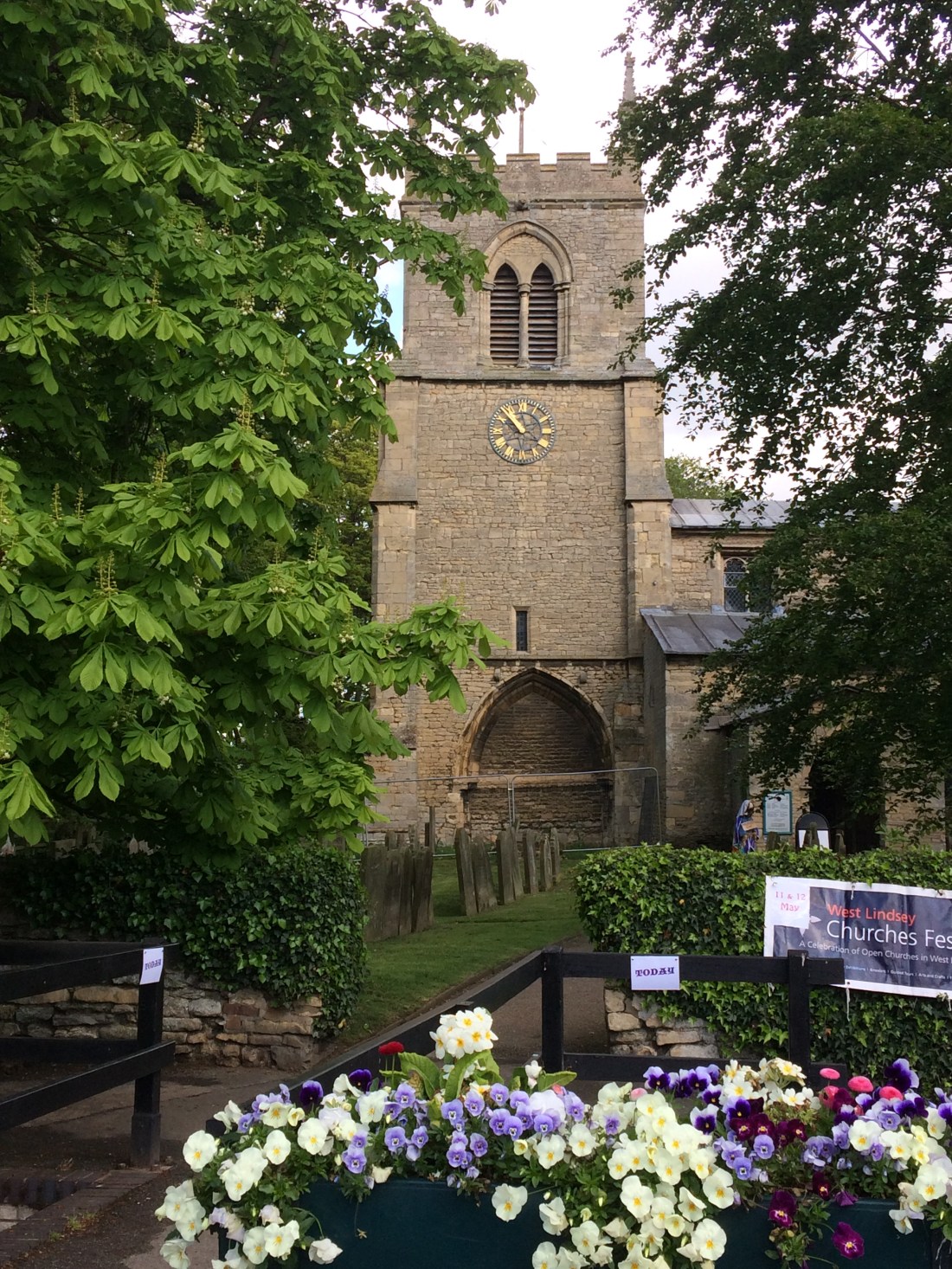
All Saints Church, Nettleham.

Our first stop was at the pretty village of Nettleham, at the Church of All Saints just a few miles north east of the magnificent city of Lincoln.

Nettleham is a large, seemingly thriving village of around three and half thousand souls with lots of local stores and some pubs, a heartening sight if there ever was. Inside the church we were greeted very courteously by the volunteers manning their stalls of old books, games, crafts, or selling food and drink. They were all very helpful, keen to tell us about the church and the village.

IMG_1250
The locals are friendly! We were greeted outside, even before we went in…

Sadly, in the 1960s there was a serious fire at All Saints, the result of arson. Since then the church has been restored very well, notable features being the new stained glass window at the east end and the roof.
IMG_1253
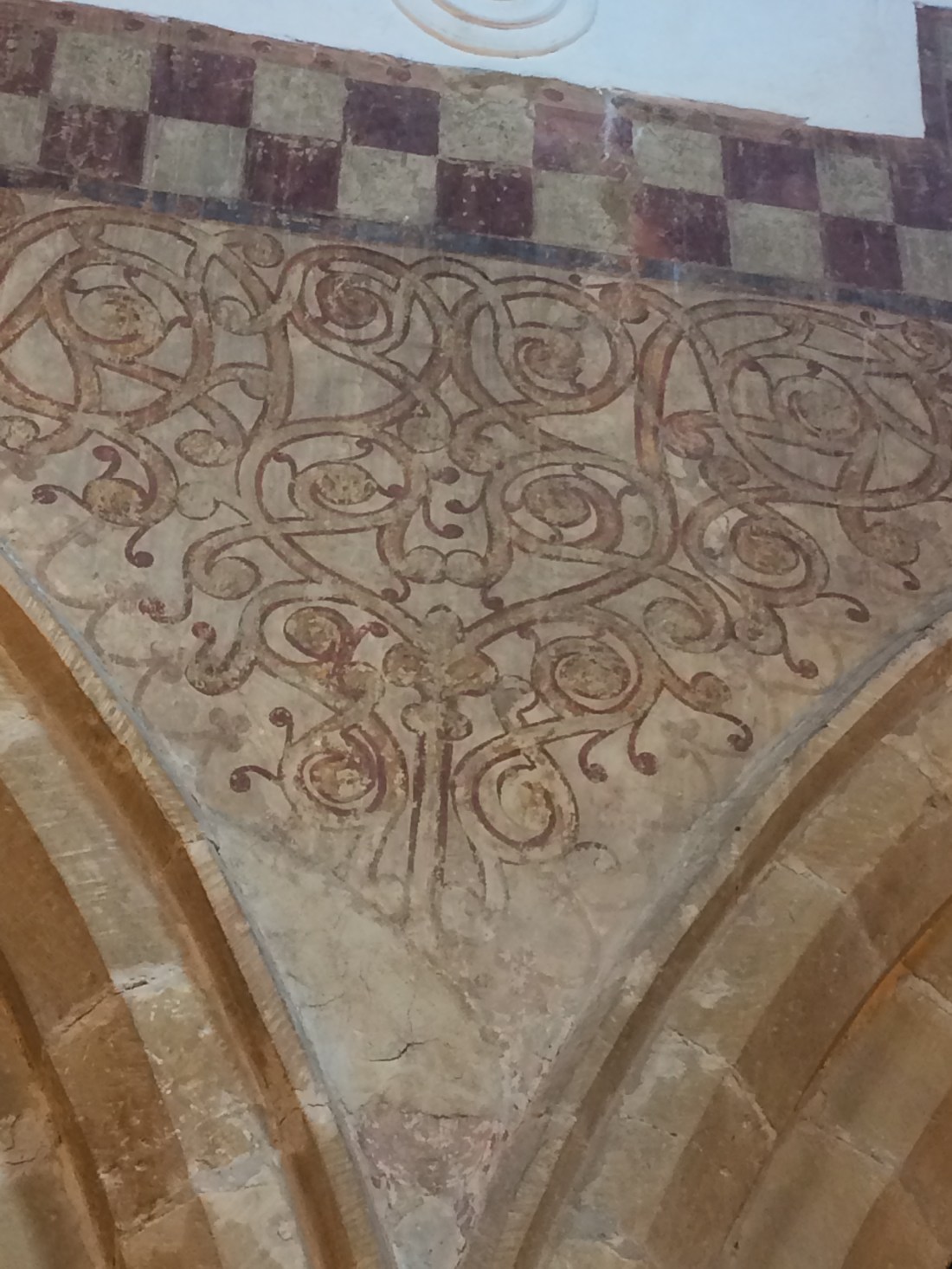
Medieval wall illustrations were revealed after the fire in the 1960s.


IMG_1254
Modern stained glass from the late 1960s.

IMG_1252

Of course, there are no benefits from fires, but one of the things revealed by the tragedy was a series of medieval wall pattern illustrations, of the type which used to bedeck all churches before the Reformation, after which nearly all were whitewashed over.

PHOTO-2019-05-11-16-35-16 (1)
Carrot cake and apple cake, what is there not to like?

Naturally, one of the benefits of going to these events is sampling the local cakes. We got a piece of carrot cake and apple cake, washed down by the proverbial cup of tea. The prices too, are very reasonable. We even took away a whole lemon drizzle cake!

Yes, it’s all very English and a jolly good thing to. I can’t speak highly enough of everyone inside, they made us very welcome.

IMG_1260

The village of Nettleham is also very pretty and worth exploring, with a running stream making lovely feature.

And a little history

Incidentally, Lindsey, in which Nettleham lies, is not merely a division or riding of historic Lincolnshire, along with Kesteven and Holland; Lindsey was once a kingdom in its own right, ruled from Lincoln around thirteen hundred years ago, before it was swallowed up by the much larger Mercia.

After that there was a manor house here, called the Bishop’s Manor House, as it eventually became a possession of the Bishops of Lincoln. Sadly this is now demolished.

But it’s not all about the past. There is very much to see and enjoy here today, not just at the Churches Festival – it’s well worth a visit at any time if you’re nearby.

copyright Leofwine Tanner 2019
The fate of the popular pub on the A46 near Lincoln has been decided — News Archives Uk

The fate of the popular pub on the A46 near Lincoln was decided after the West Lindsey District Council rejected plans to convert it into apartments. Rob Wilkinson submitted proposals for the former Brown Cow Inn in Nettleham, which would have led to eight new houses on the site. The outline documents showed designs for…

via The fate of the popular pub on the A46 near Lincoln has been decided — News Archives Uk

Discover Spalding’s Ayscoughfee Hall No.1

IMG_1273

So how do you pronounce that?

Visitors to Spalding in south Lincolnshire usually do a double take when they see the name, ‘Ayscoughfee’, relating to the wonderful late medieval building in the town centre.

Locals naturally all know it’s pronounced ‘Ascoffey’!

Once you get over that hurdle, there is much to admire in this Lincolnshire gem. There are wonderful gardens, monuments, an aviary, a museum and a cafe.

More pictures will follow soon.


The Hiring Fair Statue, Spalding, Lincolnshire

IMG_1280

A statue celebrating the history of hiring fairs has recently been erected in the Lincolnshire agricultural town of Spalding.

Also called statue, or mop fairs, they were first introduced by King Edward the Third of England after the Black Death as a means of regulating labour due to the extreme shortage in the workforce.

They soon became widespread all over Great Britain and Ireland, the practice continuing up until the Second World War.

Spalding, centre of the south eastern riding of Lincolnshire called Holland, was, and still is, the hub of a rich and diverse agricultural community.

Musings on Pluto’s Mask of Invisibility

Pluto_in_True_Color_-_High-Res
By NASA/Johns Hopkins University Applied Physics Laboratory/Southwest Research Institute/Alex Parker – Public Domain, https://commons.wikimedia.org/w/index.php?curid=71082408

I have done a little research on and off for a few years now regarding the ‘outer planet’ Pluto and his supposed effects. Put it this way, I have not been satisfied with terms like ‘transformation’.

I shall not go into it too much here as it is ongoing, but suffice it to say that I find I’m in agreement with many these days who think that Uranus, Neptune and Pluto, the so-called outer planets, only really come into serious play by their placement, their relationship if you will, by either being angular or in close aspect to the true planets, or both. I don’t believe (yes, it is a belief) that Pluto rules Scorpio, for instance.

Demotion

Of course Pluto was demoted from planet status several years ago, it being essentially classed a kind of minor binary system involving a sibling called Charon (the ferryman of Hades in myth), with whom Pluto does this merry dance in the remote, dark reaches of this solar system. Yet, despite this, there doesn’t seem to be any lack of interest in him in astrological circles.

Pluto was first discovered officially in 1930 and many have attributed the dark, ‘underground’, extreme forces that were appearing in the world at the time to the planet’s arrival in the mainstream.

Does he have a name?

Then of course we have the name of the planet. I mean why call him Pluto? The work of Percival Lowell led to the discovery of Pluto, and of course his initials are the first two letters of the name. Then of course we have Mickey Mouse’s dog, Pluto, named after him.

So the question is, did the recognition of each ‘outer planet’ reflect the time of its discovery?

I have seen it said that Uranus, discovered in the late 18th century, coincided with the American and French revolutions, plus the beginning of the Industrial Revolution. Well, I suppose Uranus has a reputation for turning things over.

Neptune was discovered in the mid 19th century, though it is far less clear what was going on then (spiritualism?) which we could call Neptunian – but maybe that’s just Neptune being Neptune, hard to make out really.

Synchronicity

And then Pluto around 1930 and the rise of fascism, communism: I get the point. Pluto is the Roman name for the Greek Hades, king of the Underworld. In mythology Hades had a helm, cap, or mask, which reputedly made him invisible, sometimes also called the Helm of Darkness. All these are what we might associate with Pluto. Either way, the mask allowed the wearer to disappear, or be undetectable, a bit like Pluto on his 248 year travail around us. I’m not sure I believe in synchronicity.

But the mask of invisibility only belongs to Pluto/Hades, others wore it to become undetectable, it is not Pluto himself. So maybe, to conjecture, in astrological terms Pluto by close aspect lends secrecy to whomever he is masking/aspecting? I don’t know, it’s something I’m looking at.

Can you keep a secret?

Nevertheless, we all know how dangerous and devastating secrecy can be, hiding true intent, a bit like the cloaking device used by the Klingons in Star Trek, or even like a ‘bird of prey’ using extreme speed (peregrine falcon for example) to disguise its final, devastating kill.

As an example, take a native with Mars closely conjunct Pluto, might the interpretation be that the Martian energy has the potential to be hidden, yet also potentially more focused and dangerous as a result? And if that energy is hidden, suppressed even, then there may be deep psychological implications too. If Neptune were conjunct Mars we might expect dissipation of that force; with Uranus we could see sudden, violent outbursts of energy.

I will leave the musings there but I intend to try and use living examples in later posts. I’m trying to keep an open mind, with the understanding that the whole truth can never be known. Thanks for your patience – these are just my musings.