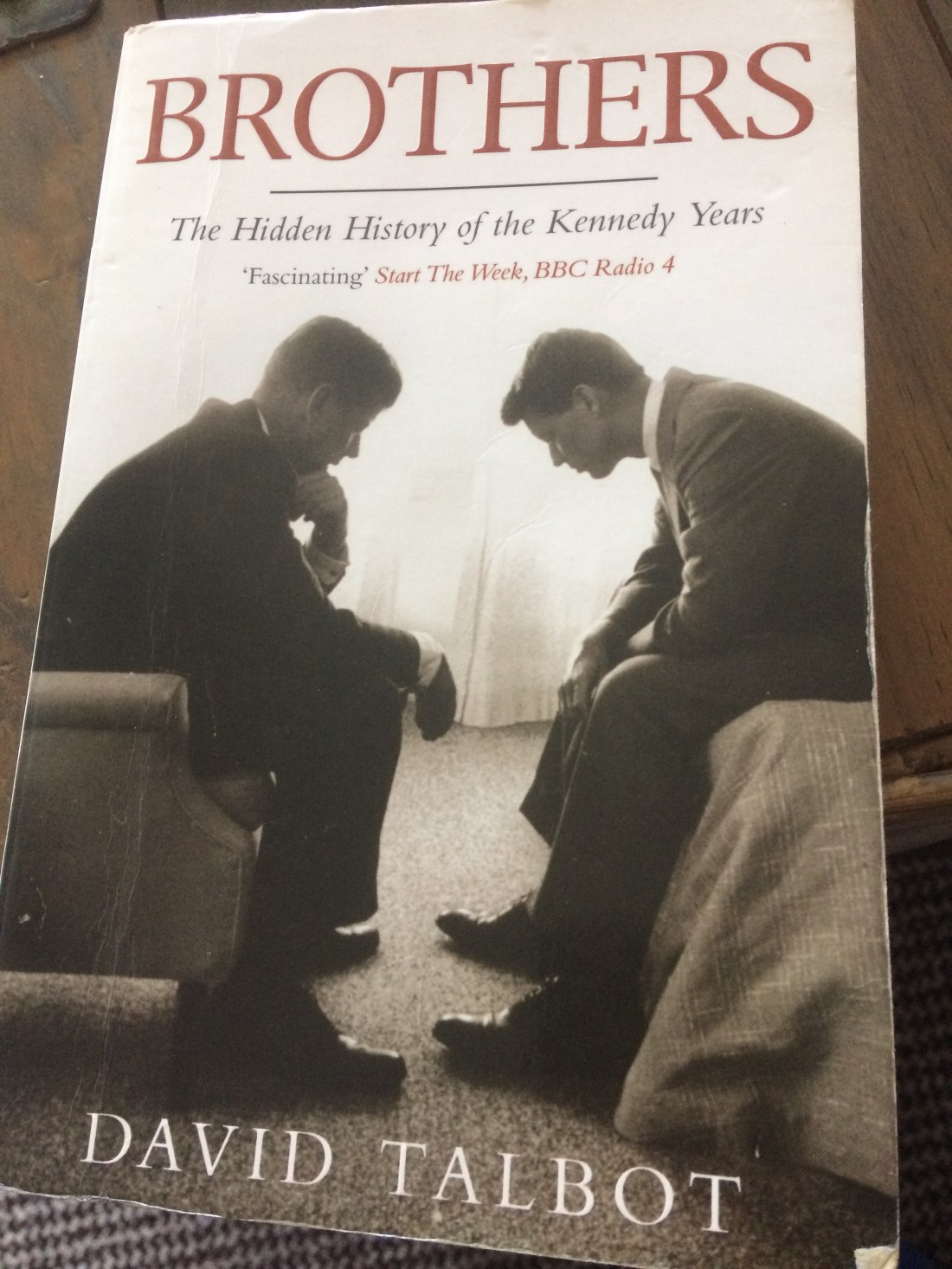
JFK and RFK: ‘The Brothers’ by David Talbot – Book Review

IMG_3070

There have been many books written about John Fitzgerald Kennedy and his brother, Robert Francis Kennedy, both victims of assassination. In my opinion this is one of the best.

Impeccably researched, this book, ‘The Brothers’ (Pocket Books/Simon & Schuster), written by David Talbot, roughly covers that roller coaster period from JFK‘s inauguration on January 20 1961 to the assassination of RFK on June 6 1968. It was a relatively short period of nearly seven and a half years, yet the whole world had been transformed — and mostly not for the better in my opinion.

Disaster and Tragedy

For me what makes this book stand out is the sheer number of interviews (150+) the author has carried out, with people who were there and in the know. For example, leaders like Fidel Castro of Cuba and Che Guevara seem to emerge like more rounded figures, not merely the one dimensional characters often portrayed in most media over the last sixty years.

More than this, the author tells is it how it was: from the disaster of the Bay of Pigs in 1961 and the sheer hatred generated among those who felt the newly elected president had let their side down by refusing to provide air cover, to the short, fraught, heroic, yet ultimately ill-fated and tragic presidential campaign of Robert Kennedy in the early summer of 1968.

IMG_3071

Conspiracies Galore

The author does not hold back on analysing the myriad conspiracy theories either, which began to emerge largely as a result of the voluminous criticism which gradually amassed after the publication of the Warren Commission Report in September 1964. And there were other doubters from the word go.

Most intriguing of all is his description of the torture Robert Kennedy went through following his brother’s death. Attorney General to JFK, he remained in his position until August 1964 when he decided to run for Senator of New York. It’s possible that RFK may have thought he was somehow responsible for not protecting his brother more during his presidency.

Treading a Very Fine Line

What is more, for the next four and a half years, up until his own death, Bobby too harboured strong suspicions that the whole truth about his brother’s death had not yet been told.

Nevertheless, in public he always retained a consistent front in support of the conclusions of the Warren Report. He was, in effect, seemingly keeping his powder dry until such a time he could investigate further from a position of strength – namely as President of the United States.

We all know this was not to be, that the so-called ‘Kennedy Curse’ was to strike once again. However, this is a very fine book and I was left feeling that a lot more light had been cast on those often dark, crazy, tempestuous, tortuous years into which I too had been thrown.

Copyright Francis Barker 2020

The clown always wins — Björn Rudbergs writings (Reblog)

I carry blades behind my bogus acts; my buffoonery barely shadows serpents and a smile as soft as scissors. I am the corpse invitedto your children’s playground,the grin of palest riders,the scent of rotting teeth,and the bramble-buried bones behind your dreams.I am your choking laughter,your falsehoods and the pestilence of putrid pride.You might call me […]

The clown always wins — Björn Rudbergs writings

***Love this poem. And I don’t think I’m the only one who finds characters like clowns spooky.

Haiku: New Beginnings

Photo by Yoal Desurmont

A new beginning.

Copyright Francis Barker 2020

‘The Hanged Cow’ Quirky Crime Fiction

s-l300

When Mike Malone is called to investigate the murder of a cow, which has been hanged from tree, he hopes that this is just a prank that has gone seriously wrong.

However, when the mutilated body of a young girl is found , he knows that once again he will have to drag the crime-board up from the basement and put his powers of deduction to work as the riddle of the nursery rhyme proves difficult to understand.

Light Hearted Romp

This novel, which is the third in the Mike Malone series, is once again a light-heated romp through rural Lincolnshire and many of the familiar faces from the previous novels return.

DS Alan Shepherd faithfully assists his boss in finding the serial killer behind the deaths of cows and girls but this time without the aid of custard creams.

Copyright Francis Barker 2020

So Who Did Write Shakespeare Then? Favoured Books

IMG_3066

‘Who Wrote Shakespeare?’ by John Michell (Thames & Hudson) is, in my opinion, probably the best book of introduction to the ‘Shakespeare AuthorshipQuestion. However, this book is not so easy to find these days.

I have been fascinated by this Shakespeare puzzle for several years now, though I am still a long way short of doing enough research, and even further away from coming to a firm answer which sits well in my mind. It is an enigma which has occupied many individuals their whole lifetime over the last two hundred years, or more.

So why is there any doubt that the man of Stratford Upon Avon in central England is the true author of the plays which bear the name William Shakespeare? The chief problem is that the known life of William Shakespeare, or Shakspere (the spelling of his name is a subject unto itself), does not appear to be that of the greatest writer of all time.

Where is Will?

To cut a long story short, there are around half a dozen known signatures purportedly of this man, but they are all poorly written. Some say that is because all those that survive are from when he was ill at the end of his fifty two year old lifespan.

More than this, out of around seventy or so pieces of other documentary evidence, none refer to anything to do with literature, or books.

What the records do seem to show are the dealings of a business man, with a keen interest in litigation. This man does appear to be in London at the right time and involved in the theatre, though not as a writer, but as a minor player – at best. His dealings with the London stage scene of the late Elizabethan and early Jacobean times all centre around business.

Shadowy Aristocrats

These are the prime reasons for doubt. But who might have written the plays and the poems?

John Michell, who had a very find mind and wrote some fascinating, enlightening books, put the arguments across superbly. He has chapters for the prime candidates, including Shakspere (the spelling of his name is a subject unto itself) of Stratford. First comes Francis Bacon, a known intellectual of the period, a writer and philosopher with all the prerequisite knowledge and library of books to have written the works – if not the genius.

Then comes the 17th Earl of Oxford, Edward de Vere, who has consistently been the favourite candidate for around a century, even though he died in 1604 and the plays of Shakespeare are thought to have been written as late as 1611 with The Tempest. There is much to link his life to the works of Shakespeare, even down to a broad knowledge of Italy and other European areas which feature so prominently in Shakespeare.

Two other earls appear in Michell’s list, namely William Stanley the 6th Earl of Derby and Roger Manners the 5th Earl of Rutland. They both have intriguing links to the mystery, though we still apparently lack definitive and documentary evidence. Why are there so many aristocrats here? The primary reason is that when one looks at Shakespeare’s works as a whole, he does appear to have a deep familiarity with and love of the workings of courtly things and of history. A midlander with barely a grammar school education is far less likely to have been able to write what Shakespeare did. Yes, genius does exist, but even genius needs an education.

Nom de Plume

What is more, in those days it was rather unseemly for high ranking individuals, such as the aristocracy, to publish work in their own name – they would often use a nom de plume for disguise.

Equally intriguing is the case of Christopher Marlowe, born just two months before Stratford Will and the one man whose sheer brilliance as a playwrite and poet can stand alongside the author we know as Shakespeare, creating such masterpieces as ‘Tamburlaine’ and ‘Dr Faustus’.

A Reckoning Over A Bill

However, always a controversial figure, Marlowe’s candidacy is fatally flawed in that he officially died on May 30 1593 at Deptford, London, apparently murdered over a dispute about a bill, or ‘reckoning’. Marlowe was also an intelligence operative and much of his activity is murky. However, some feel that this story and the subsequent inquest are totally unsound, that he somehow survived and continued to write in secret with the nom de plume, William Shake-speare.

There are also proponents who believe that Shakespeare was a collaborative effort, involving two or more of the above. As strange as it sounds, at this point in my research, I tend to favour this, though as to the candidates involved I am not yet certain.

So there it is, a very fine book – if you can find it, whatever you may think of the subject. So who wrote Shakespeare? I don’t know! But I will continue to investigate, little by little. Many still close their ears and shout ‘conspiracy theorist!’ Cognitive dissonance is a feature of our times and is surely something to get over. Do we believe in freedom of thought, or not? That is the question.

IMG_3067

I have only skimmed over the candidates here, but I intend to write some more involved pieces about specific men – and even a couple of women. I will also bring my astrological knowledge into play where I can.

Copyright Francis Barker 2020