Rethinking Astrology: A Yearning for Simplicity

blue-blue-sky-beautiful-sky-puffy-clouds-4423022
Photo by franpics from Pexels

Whilst there are long existing schools of astrology, most astrologers tend to be very individual with their own particular nuances and practices.

I have been fascinated by astrology since my mum brought home a women’s magazine from the sad clear out of grandma’s house back in the 1970s. The publication contained one of those very basic sun sign forecasts which we are all familiar with. The slight difference with this one, was the little write up at the top of the piece regarding ruling planets. From that point I was hooked.

Thanks Grandma

I’ve often thought it was Grandma who led me down this winding path, even if it was through her death. I did go on to study astrology in many varied ways, with two schools and digesting countless books and manuals. However, it is true to say that especially in later years, I too have developed my own approach, which does bear certain similarities to other modern astrological trends.

Firstly, I have become more interested in ‘traditional’ astrology, which is largely based on Hellenistic or Ancient Greek astrology. The reason for this is the often confusing plethora of house systems on offer these days, the use of fixed stars, asteroids etc. I crave simplicity. This is not to say that various house systems don’t have relevance, or that fixed stars and asteroids have no place. All I’m saying is they are not necessarily for me.

Whole Sign System

So today I invariably use the Whole Sign house system, which is in fact pretty much the original house system. This means that if Aries, for instance, is rising, the WHOLE of that sign becomes the first house beginning at 0 degrees. From that point each house proceeds in 30 degree segments. The actual ascending degree, let’s say 15 degrees Aries, remains an important point in the chart within that first house, as will the the other angles in theirs.

Now I did say that I did not utilise asteroids or minor planets. That said, I have come to realise Chiron’s usefulness as the ‘wounded healer’, so I usually use him.

birthcharttemplate (7)

Similarly, the Moon’s nodes certainly are a strong karmic pointer. And I still use Pluto, even though he has been degraded astronomically to the status of minor planet. That said, with the three outer planets, Uranus, Neptune and Pluto, I do not regard them as serious rulers of the signs Aquarius, Pisces and Scorpio. I still tend to favour the traditional rulers, purely because of the beauty of the original system of rulership, from the intimacy of the Moon ruling Cancer, to the far out, impersonal Saturn ruling Capricorn and Aquarius on the outer limits.

Orbs

And as far as the orbs of aspects, I tend to restrict them to a few degrees. For the sun and Moon, no more than five and for the planets no more than three. After all, the tighter the aspect the more powerful and obvious it will be.

I generally use this approach for both individual interpretations and for events, such as general elections and their like. Once again, if other astrologers wish to explore the use of minor planets, fixed stars etc to much greater levels, then so be it.

I also like to produce (although not always) the square ‘medieval’ or Renaissance looking charts. I don’t know why but there is something artistically comforting in displaying the information this way, even though it may not be technically or visually as accurate as a round one.

You see, my own particular Aquarian mind yearns for more simplicity the older it gets, a life that’s stripped down and straight forward. That to me seems like a good pointer to the future.

copyright Francis Barker 2020
Astrological Musings on Mercury – “Stop fidgeting, boy!”

IMG_1309

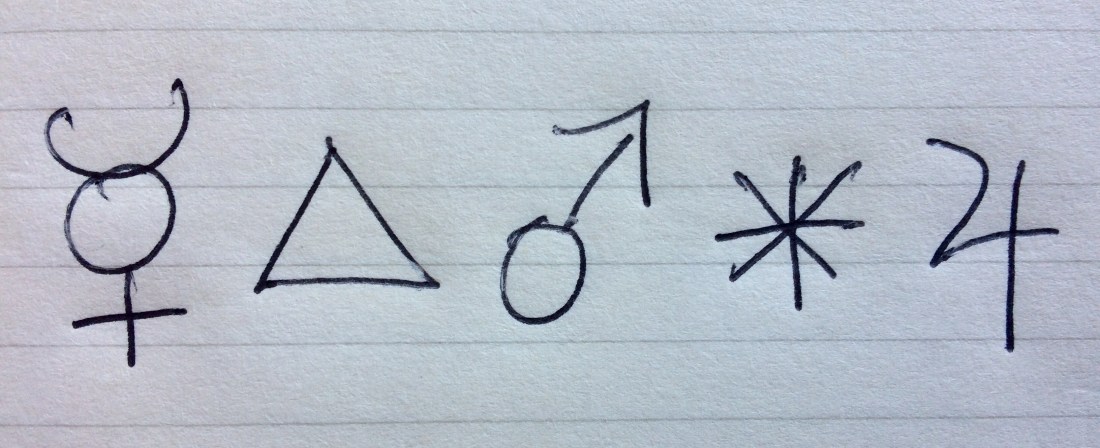
In astrology Mercury is associated with the signs Gemini, Virgo and the corresponding third and sixth houses of a chart.

Mercury, closely following the sun at all times, is said to represent the mind, how we think, communicate, our nervous system, their strengths and weaknesses depending its conditioning.

Take Luke (not his real name which is protected), a former teacher who’d taken early retirement a while ago. He came to me wanting to know why he’d become so restless and nervous. He explained that he’d always been a bit restless, but especially of late. He knew his birth time to within about five minutes, so I calculated his birth chart.

Raised Eyebrows

Immediately, one of the ‘reasons’ he described himself as restless leapt out at me from the computer screen. His Mercury was closely conjunct a Capricorn ascendant, trine Mars in Taurus, sextile Jupiter in Scorpio. There were no so-called difficult or hard aspects, no squares or oppositions to Mercury. He seemed curious as to why my eyebrows were raised. At the time he came to see me, transiting Pluto had been lurking with intent around his native Mercury for a few months.

Over the years I’ve found it remarkable (a lot of the time) how people ‘speak’ their charts. In Luke’s case Mercury here was doing all the talking!

Mercury in Capricorn represents a practical mind, that likes to spend its time productively; teaching would be one good outlet. Close to the ascending degree and energised by Mars and Jupiter, one might expect the native to be a little fidgety – he was, constantly scratching his head, re-arranging his seating position. He just had to be doing something!

Positive Energy

So with all that positive energy from Mars in Taurus, which only increases the pressure to ‘do something’ practical like making money, and from Jupiter in Scorpio, encouraging him to go deep, plumb the depths of knowledge, it’s probably not surprising that Luke was a bundle of unresolved, nervous energy which now ceased to have a proper outlet or channel.

“Can you write?” I asked, rather glibly, picking at Mercury’s communicative qualities.

He nodded. “Yeah, I do it all the time.”

“Professionally?”

He shook his head and laughed. “Just jot things down and scribble, you know.”

But I could see something opening in his eyes, some kind of realisation.

“Don’t get me wrong,” I said, tentatively, “I can’t advise you to do anything but what might help is to find a project, a writing project, to really get your teeth into, to fill the gap that teaching filled. Something like that.”

Second Career

He seemed interested, but with all that earthy mental energy, I figured that creative writing might not be the best outlet for him. “Serious themes, perhaps,” I continued, “history, religion, psychology, geography…”

“Ha!” he exclaimed, “I taught geography for thirty five years!”

“OK, apart from teaching it, have you written about it, expressed our own ideas, opinions? Have you done research, for instance?”

“Not since university.”

Chance Meeting

It was around six months later when I met up with him again by chance, not in my house, but in the high street outside a butcher’s shop of all places.

“You were right about the writing, by the way?” he said, smiling nonchalantly.

“Really?”

“I’m a regular contributor to a science magazine now… and I’ve started giving talks on geography and geology for adult education locally. In fact, I’ve been invited up to Sheffield next week to give a talk.”

I tried to disguise my own smirk. It would seem that his native Mercury, which may have given him the impetus to become a teacher in the first place, had now inspired a second career in his retirement, as a writer and speaker. Pluto’s close proximity to his native Mercury at the time, may just have done a little prodding from behind the scenes.

Ultimately, I think this example also shows a need to look for the obvious, stand out features of a birth chart first. “Keep it simple, boy!”