Musings on Pluto’s Mask of Invisibility

Pluto_in_True_Color_-_High-Res
By NASA/Johns Hopkins University Applied Physics Laboratory/Southwest Research Institute/Alex Parker – Public Domain, https://commons.wikimedia.org/w/index.php?curid=71082408

I have done a little research on and off for a few years now regarding the ‘outer planet’ Pluto and his supposed effects. Put it this way, I have not been satisfied with terms like ‘transformation’.

I shall not go into it too much here as it is ongoing, but suffice it to say that I find I’m in agreement with many these days who think that Uranus, Neptune and Pluto, the so-called outer planets, only really come into serious play by their placement, their relationship if you will, by either being angular or in close aspect to the true planets, or both. I don’t believe (yes, it is a belief) that Pluto rules Scorpio, for instance.

Demotion

Of course Pluto was demoted from planet status several years ago, it being essentially classed a kind of minor binary system involving a sibling called Charon (the ferryman of Hades in myth), with whom Pluto does this merry dance in the remote, dark reaches of this solar system. Yet, despite this, there doesn’t seem to be any lack of interest in him in astrological circles.

Pluto was first discovered officially in 1930 and many have attributed the dark, ‘underground’, extreme forces that were appearing in the world at the time to the planet’s arrival in the mainstream.

Does he have a name?

Then of course we have the name of the planet. I mean why call him Pluto? The work of Percival Lowell led to the discovery of Pluto, and of course his initials are the first two letters of the name. Then of course we have Mickey Mouse’s dog, Pluto, named after him.

So the question is, did the recognition of each ‘outer planet’ reflect the time of its discovery?

I have seen it said that Uranus, discovered in the late 18th century, coincided with the American and French revolutions, plus the beginning of the Industrial Revolution. Well, I suppose Uranus has a reputation for turning things over.

Neptune was discovered in the mid 19th century, though it is far less clear what was going on then (spiritualism?) which we could call Neptunian – but maybe that’s just Neptune being Neptune, hard to make out really.

Synchronicity

And then Pluto around 1930 and the rise of fascism, communism: I get the point. Pluto is the Roman name for the Greek Hades, king of the Underworld. In mythology Hades had a helm, cap, or mask, which reputedly made him invisible, sometimes also called the Helm of Darkness. All these are what we might associate with Pluto. Either way, the mask allowed the wearer to disappear, or be undetectable, a bit like Pluto on his 248 year travail around us. I’m not sure I believe in synchronicity.

But the mask of invisibility only belongs to Pluto/Hades, others wore it to become undetectable, it is not Pluto himself. So maybe, to conjecture, in astrological terms Pluto by close aspect lends secrecy to whomever he is masking/aspecting? I don’t know, it’s something I’m looking at.

Can you keep a secret?

Nevertheless, we all know how dangerous and devastating secrecy can be, hiding true intent, a bit like the cloaking device used by the Klingons in Star Trek, or even like a ‘bird of prey’ using extreme speed (peregrine falcon for example) to disguise its final, devastating kill.

As an example, take a native with Mars closely conjunct Pluto, might the interpretation be that the Martian energy has the potential to be hidden, yet also potentially more focused and dangerous as a result? And if that energy is hidden, suppressed even, then there may be deep psychological implications too. If Neptune were conjunct Mars we might expect dissipation of that force; with Uranus we could see sudden, violent outbursts of energy.

I will leave the musings there but I intend to try and use living examples in later posts. I’m trying to keep an open mind, with the understanding that the whole truth can never be known. Thanks for your patience – these are just my musings.

The Matthew Flinders Connection: May Church Flower Festivals in South Lincolnshire, England

PHOTO-2019-05-10-08-36-28

There used to be an event, commencing in the late 1950s, famously called ‘The Spalding Tulip Parade’ in south Lincolnshire, England.

Every year much time and money was spent on creating a series of floats decorated with tulips to parade around the small Lincolnshire town, sponsored by local and national businesses. Tourists flocked there every year from many parts of the country and beyond.

Sadly those days have long gone now. However a ‘vestige’ of this former glory still remains in the numerous church flower festivals which still take place in early May.

I was particularly impressed this year by Donington’s flower festival. The explorer and cartographer who essentially mapped Australia, Matthew Flinders, was born in Donington in 1774. Recently his remains were discovered and there is a move to bring them back to Donington – you could almost feel the air of anticipation at this prospect.

Strong Links

Today many strong links remain with Australia; there are numerous visits from ‘down under’ too, both sides very keen to keep up and improve the cultural associations.

Let’s hope his remains return home soon and that a tasteful setting is created for the memory and legacy of the great Matthew Flinders of Donington, Lincolnshire.

Toussaint_Antoine_DE_CHAZAL_DE_Chamerel_-_Portrait_of_Captain_Matthew_Flinders,_RN,_1774-1814_-_Google_Art_Project (1)
By Toussaint Antoine DE CHAZAL DE CHAMEREL (1770 – 1822) (Mauritius)Details of artist on Google Art Project – XQFjQ8PX1C_hwA at Google Cultural Institute maximum zoom level, Public Domain, https://commons.wikimedia.org/w/index.php?curid=23601763

Mayflower Blossom Time – in February Temperatures!

IMG_1241

It’s hard to believe that around this time last year we were basking in temperatures around 30 degrees centigrade in ‘dear old Blighty’.

Today it’s about 10 at best and with the lack of sun and the cool wind it feels more like 4!

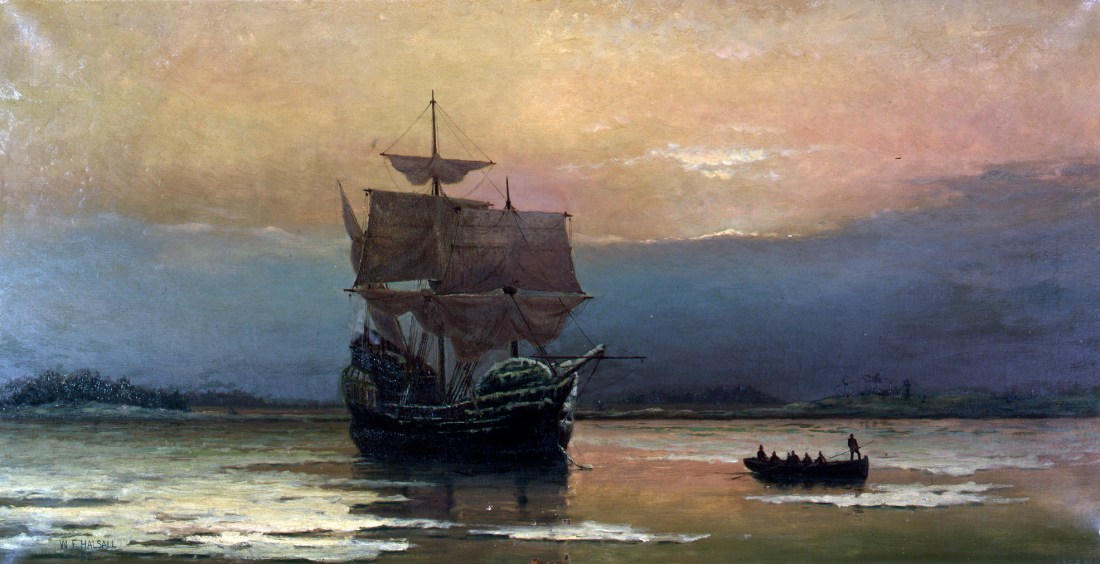
That said it got me wondering, laterally as usual, about why the famous ship the Mayflower was called as such.

According to the sources I came across it’s because the original owner of the ship was Florentine (from Florence, Italy) called Guicciardini; the Mayflower, or ‘Giglio’ in Italian, is the symbol of Florence. And the ship was due to set sail, in May.

Mayflower_in_Plymouth_Harbor,_by_William_Halsall
By William Halsall – Pilgrim Hall Museum, Public Domain. Wikimedia.org

Oh to set sail for pastures new!

So the Mayflower became the symbol of new beginnings in the so-called New World and is still one America’s greatest cultural icons.

I don’t know for sure but there may be other explanations. At least according to the above its naming had little to do with the Pilgrims who sailed on it, nor indeed Plymouth in western England from where they sailed.

Nevertheless it’s fascinating to hear of people in America who can trace their lineage back to the Mayflower. I will have to look out for examples of this, I would love to speak to some of them.

http://www.answers.com

http://www.wikipedia.com

May 1092 Lincoln Cathedral Consecrated

Wenceslas_Hollar_-_Lincoln_Cathedral_from_the_west
By Wenceslaus Hollar – Artwork from University of Toronto Wenceslaus Hollar Digital CollectionScanned by University of TorontoHigh-resolution version extracted using custom tool by User:Dcoetzee, Public Domain, https://commons.wikimedia.org/w/index.php?curid=6241265

One of my favourite places, Lincoln Cathedral, was consecrated this month way back in 1092.

To put that into perspective, King William (Rufus) the Second of that name, son of the mighty Conqueror, had been on the throne since 1087. It was only a quarter of a century after the Normans’ hostile (in fact rather brutal) take over of the board of the richest kingdom in western Europe, but already their introduction of Romanesque architecture was changing the landscape of the country for ever.

However Lincoln Cathedral’s early history was blighted by disasters. A fire destroyed the roof in 1124, an earthquake destroyed most of it in 1185.

Nevertheless despite this the structure was rebuilt in magnificent fashion to become effectively the tallest building in the world, thanks to its huge central spire. The triple spire configuration as it was during the late medieval and early modern period must have been an incredible sight. Then, tragically, in February 1549 the central spire collapsed during a storm. The two smaller spires remained for some time until they were taken down for safety reasons.

Even so, Lincoln Cathedral still remains high on its hill, and is at least to my mind, the best cathedral in England and therefore one of the best anywhere. If you are in the region it’s well worth a visit.

There is much more I could say about the cathedral and the city but I will leave that for future posts.


Painter’s Block?

cropped-rosefieldspinchbeck1.jpg

I used to paint a lot, still have a lot of pictures of my efforts.

They were all of a certain type, landscapes, seascapes. I found I couldn’t really do anything else; I suppose everyone has their niche, or perhaps their penchant.

I don’t really know if I was any good. I mean I used to say a painter is just someone who ‘makes marks’.

I did so many I think I got what could be termed ‘painter’s block’. Anyhow, I’ve been assessing and re-assessing some of the old images and wondering if I’ll every put brush to canvas again.