Poem ‘The Californian’

The Californian

To this day I don’t know for sure
who you were.
You sounded American
and dressed like a Californian,
or that’s how it seemed
to my parochial mind.

I wasn’t used to your friendliness,
being spoken to so kindly
by a complete stranger,
but then, that was the thing —
I felt I knew you.
Why didn’t I ask your name?

The event had brought us together.
Now we waited for the train
to take us back through Cumbria’s
rounded hills, always threatened by rain.
And true to form, despite it being July,
we found ourselves sheltering
in a little cafe, sipping bad coffee
made more palatable with cream.
That’s where I saw you surfing
in my mind’s eye,
feeling that smelting sun sink
beyond an ocean of glass.
We had just enough time
to assess our few days
in the company of a Buddha.
At least that’s what we said, if I recall,
and that we, too, might be Bodhisattvas!
And who’s to say we weren’t right?

Even now, when I play that album,
I keep looking at the picture
of the kind-looking man, all smiles,
with the sweet and beaten guitar.
He still looks an awful lot like you

poem and image © copyright df barker 2012
Number 74!!

Number 74!!.

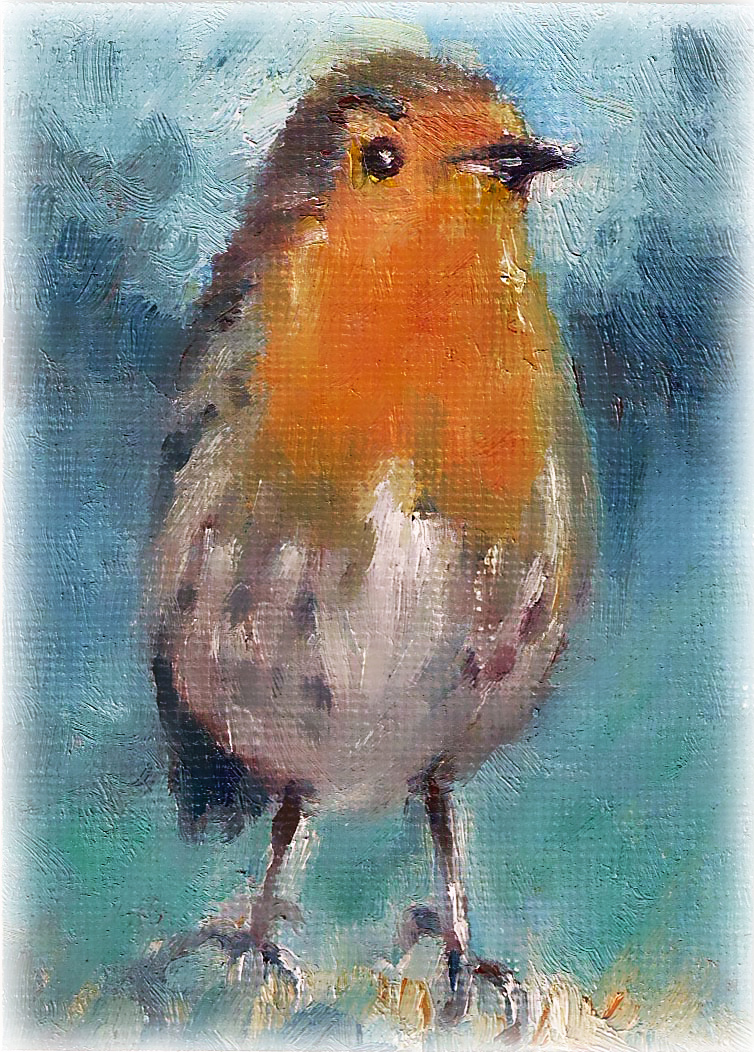
Poem ‘A Robin’s Descent’

A Robin’s Descent

The rain is gone,
though a heaviness remains.

Between this precious repose
and first glimpses of a lighter day,

a robin drops to drenched grass,
almost tame and curious,

the colour of passion,
his peppy, ardent life

among manifold greens.
Then he pops up once more,

daring closer this time,
an upturned table leg his perch,

to peek inside this house
of false comfort,

bringing life to worn out lives

poem and image © copyright df barker 2012

Poem ‘Hitch’

Hitch

A throbbing disco bass
callously pounding my chest,
turning symptoms of flu
into something feeling serious.
I’d dragged myself there
against good advice,
that trashy little down in Drab County
whose only claim to fame
was its fine timber spire,
which made historians
and architects alike, drool;
the sort of town which made
the English feel proud of their past,
even if the present bore no hope,
no prospect of colour. A future

And pride! What was I doing
knocking back gin like tomorrow
did not exist?
Barely able to stand—
but still lord of the dance!
But it was you who held the cards,
the full deck.
You knew what you wanted
and how to get it.
I was the hopeless case,
a clueless pawn in your set up
with worldly guys from the Smoke
who were waiting by the door,
(forever waiting by that door!)
deriding us country boys—

but
this
country boy
knew enough about language
of the body, its gestures.
The cold morning brought eerie clarity,
despite pain in my head
to match the dagger in the heart. Oh—
you could keep your magnanimous lift.
I was hitching back.
The full seventeen miles,
even if only the bravest of drivers
would dare stop to pick up
this jerk
in the sick stained jeans

poem and image © copyright df barker 2012

Poem ‘The Country’ (for England)

“Smile at us, pay us, pass us; but do not quite forget;
For we are the people of England, that never have spoken yet.”

from ‘The Secret People’ by G. K. Chesterton

The Country

It’s all around them, though they never see it,
like Jesus said about the Kingdom of Heaven.

Some, even a poet, say it cannot be defined,
even though they are immersed in it,
like fishes swimming blind to the sea.

They take it for granted, spurn it,
but they are born in it and nurtured by it,
educated and employed by it,
and then nursed to the very end.

They say the language is not ours,
that it belongs to the world,
or to the oppressed,
to anyone with a cause
except our own.

Countless cocks have crowed,
but each time its existence is denied,
its very future put up for discussion
by people who owe it everything –
yet who would rather die than accept it
for what it is.

poem and image © copyright df barker 2012

*** For Saint George’s Day on April 23, patron Saint of England (and other places) for around 700 years, at least. William Shakespeare (1564-1616), a candidate surely for ‘Greatest Ever Englishman’, was born, and apparently died, on this day. This is not meant to be overtly nationalistic, but to simply, starkly, re-iterate that the feeling that poets and people in the past saw as a reality, is still clearly evident today.

* First published, without the quotation, in poetry collection ‘Anonymous Lines’, available at amazon.

**The image is reproduced from a painting based on a scene at Southwold, Suffolk, a quintessentially English seaside town.