Poem ‘The Country’ (for England)

“Smile at us, pay us, pass us; but do not quite forget;
For we are the people of England, that never have spoken yet.”

from ‘The Secret People’ by G. K. Chesterton

The Country

It’s all around them, though they never see it,
like Jesus said about the Kingdom of Heaven.

Some, even a poet, say it cannot be defined,
even though they are immersed in it,
like fishes swimming blind to the sea.

They take it for granted, spurn it,
but they are born in it and nurtured by it,
educated and employed by it,
and then nursed to the very end.

They say the language is not ours,
that it belongs to the world,
or to the oppressed,
to anyone with a cause
except our own.

Countless cocks have crowed,
but each time its existence is denied,
its very future put up for discussion
by people who owe it everything –
yet who would rather die than accept it
for what it is.

poem and image © copyright df barker 2012

*** For Saint George’s Day on April 23, patron Saint of England (and other places) for around 700 years, at least. William Shakespeare (1564-1616), a candidate surely for ‘Greatest Ever Englishman’, was born, and apparently died, on this day. This is not meant to be overtly nationalistic, but to simply, starkly, re-iterate that the feeling that poets and people in the past saw as a reality, is still clearly evident today.

* First published, without the quotation, in poetry collection ‘Anonymous Lines’, available at amazon.

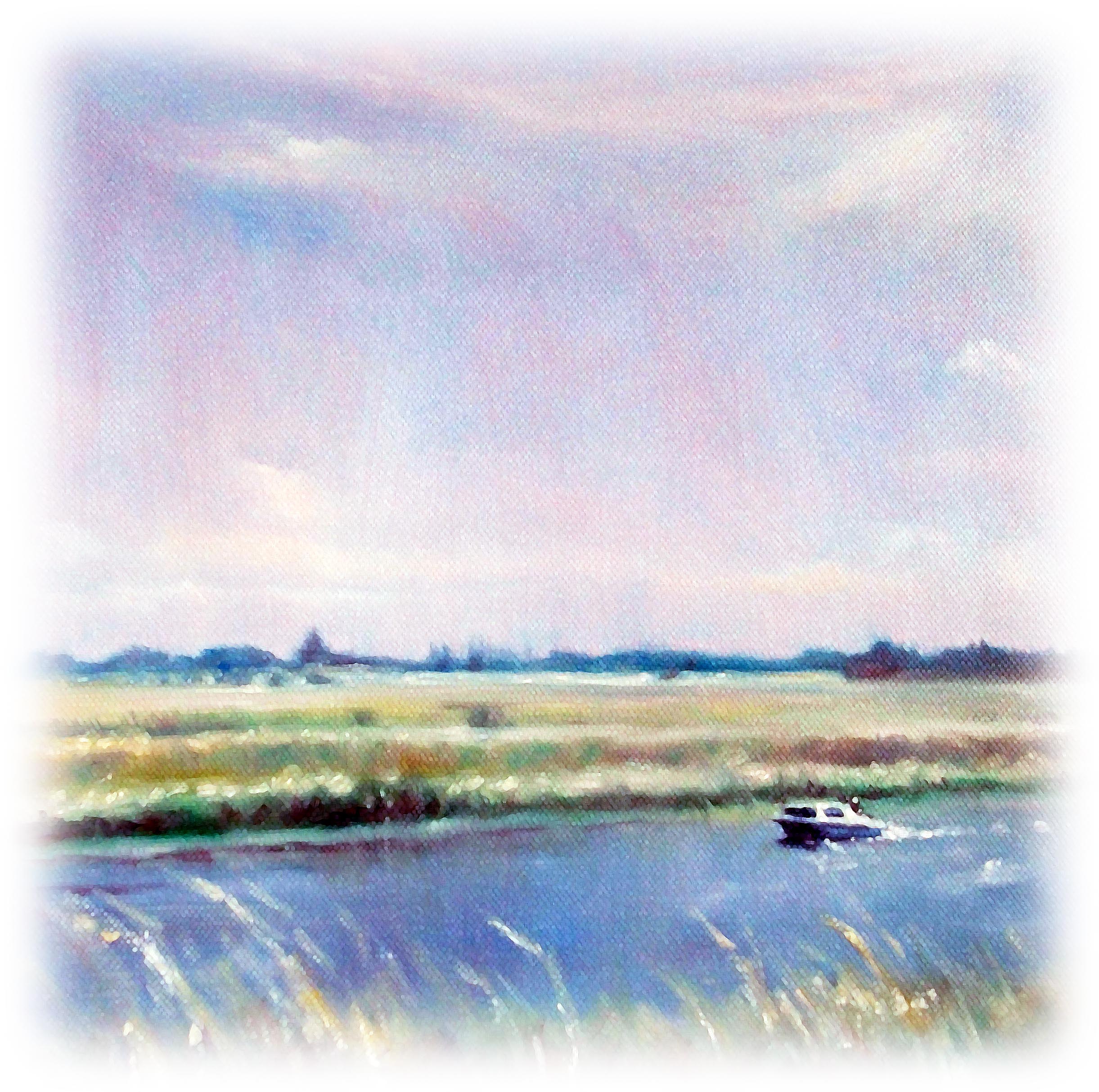
**The image is reproduced from a painting based on a scene at Southwold, Suffolk, a quintessentially English seaside town.
Poem ‘Weapon Take’

Weapon Take

No rusty blade
ever turns up here,
no shadow of a ship
or bejewelled belt;

no iconic helm
to add credence
to our wounded identity.
Not even signs

of a mystery hillock
rising in hugging mists
to excite or intrigue
those metal detector men.

Merely one vast industrial
scar, scoured of feature,
almost of life, tamed,
or destroyed,

depending on your view,
turned inside out
by Angevin priors
and inscrutable Dutchmen.

I come from a long
line of diggers
and dark-eyed women,
grown out of this morass,

hardened to sweat
and pitiless Ural winds.
People who made-do,
though never in

any doubt they
were the subjected
men of their Hundred,
the brave new Wapentake,

where the councillors
still speak in a
double-Dutch behind
tall, timbered walls.

poem and image © copyright dfbarker 2012
*poem first published in collection ‘Anonymous Lines’, available at amazon.

** Wapentake was the Danish word for the English Hundred (a small, political unit, originally meaning a hundred homes). This word is still used in the ‘Danelaw’ counties of eastern England.

Poem ‘English Blue’

English Blue

Walk with me
into the grey breaking dawn

where that sticking ridge of blue –
an English blue

rolls on into soft distances
and strange dancing names

Stand with me
by those set whispering stones

in a steadfast line –
a sore English line

of rasping pipes and howling socks
mouthing our memory

like a warning to tomorrow
a land forlorn to all but itself

Then help me to bury him
not on some crying strand –

in firm English land
where hallows’ calls are grounded

our grief laid open
in the whitening bones of heroes

on this high scoured hill

*First published in ‘Poetry 24’ June 23 2011 and in the collection ‘Anonymous Lines’ available at amazon.co.uk

poem and image © copyright dfbarker 2012

This was initially inspired by the summer solstice at Stonehenge, the large gatherings there.
Then I thought of all the other generations, what they thought of the standing stones, what they meant to them.
This is also a tribute to pre-Norman England, its freedoms that were lost, so almost takes the form of an elegy to a fallen Old English hero.

Today’s Poem – Who was this man?

Corpus Christi
(for Kit Marlowe)

A voice calls from across the cold centuries,
a harsh whisper in my ear.

There is merit in what he says,
enduring years of indoctrination,

speaking out against that which bore him.
The town of empty palaces, of inordinate wealth,

forcing him to re-position,
to consider the advocacy of freedom,

though mere anarchy in the eyes of the state.
But wait, before you all condemn,

just as a spy must provoke and take a stance,
so a playwright may also be a player.

Does he ask, ‘what kind of world could this be?
What pure lives might we lead?’

If only we could accept the sight before us –
the corruptible body of Christ.

© copyright David Francis Barker

A New Poem

Ebbsfleet

So long ago, so near at hand,
such is our English past.

Something in our make up
makes us conspire to deny

our great achievements
hidden from our eye.

And when Hengist came to Ebbsfleet
whether asked or on daring raid,

he set in motion a dogged force
yet to be fully appraised

or to run its full course

© copyright David Francis Barker 2011

Merely to encapsulate my feelings about being English in the 21st century. We are a tolerant nation, we have a culture with a long history but our democratic rights are being denied.