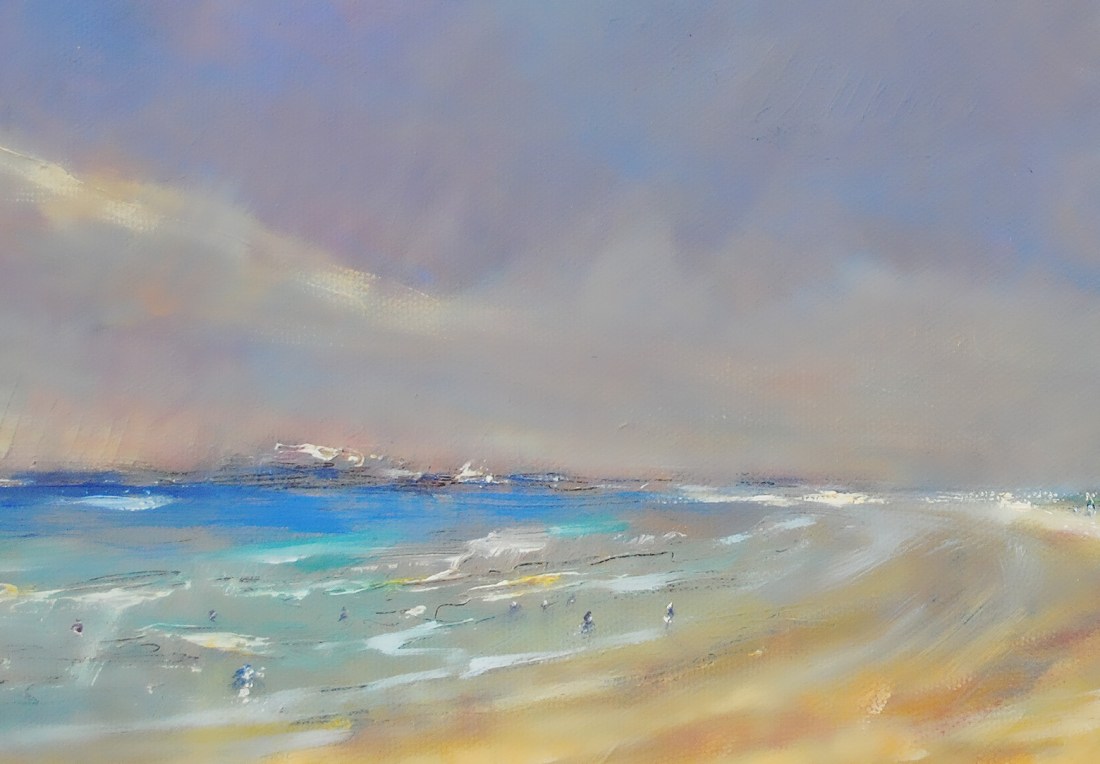
No excuses, just thought I’d share again a couple of my past impressions of one of my favourite places.
Titchwell, North Norfolk
If I ever got serious about oil painting and painting in general again, I think I would have to visit more places abroad. Like the south of France where the light is glorious, so I am told!
Of course North Norfolk’s geographical position is almost unique in England, which gives it its particularly quality of light, strong blues; whereas in the Mediterranean, for example, the brighter colours predominate.
Mid May comes along and it’s time once again for the annual Lincolnshire Churches Festival in eastern England.
Taking place over two weekends in Lincolnshire’s ancient northern riding of Lindsey, the festival is split between the first weekend of the 11th and 12th and the second weekend of the 18th and 19th.
Nearly 100 churches are taking part and a very warm welcome will be had in each one, with food such as cake and scones, plus drinks and some stalls to browse. The proceeds go towards the upkeep of these wonderful buildings.
Over the next two weeks, I shall be writing several pieces about this wonderful event which celebrates Lincolnshire’s fine Christian heritage and the glory of its architectural variety.
A statue celebrating the history of hiring fairs has recently been erected in the Lincolnshire agricultural town of Spalding.
Also called statue, or mop fairs, they were first introduced by King Edward the Third of England after the Black Death as a means of regulating labour due to the extreme shortage in the workforce.
They soon became widespread all over Great Britain and Ireland, the practice continuing up until the Second World War.
Spalding, centre of the south eastern riding of Lincolnshire called Holland, was, and still is, the hub of a rich and diverse agricultural community.
Pizza, pasta, risotto, fine wine, passion, flair, fashion style, not to mention the Romans (and yes, what did they ever do for us?) to name but a few. These are things our lives would be far less rich without.
Well, some say it was around this day in history, May 10 or 11, when someone else Italian set sail on a voyage to what we now term ‘the New World’, namely Amerigo Vespucci.
Born in Florence in 1454, Vespucci is famous for debunking Columbus’ notion that the West Indies and Brazil were in fact the other side of the world, actually the easternmost parts of Asia.
In other words, he envisioned the new discoveries as a completely new, separate landmass from Asia. Originally termed the New World, what the new continent lacked was a proper name. Step up Amerigo Vespucci once again, whose latinised Christian name reads as ‘Americus’.
It was only a small step from there to someone suggesting that this huge piece of earth should be called after him, but with a feminine ending – America – and why not? Are we still grateful to him and Italy?
PS. Of course, we know now that the Vikings founded what they termed ‘Vinland’ in what is now the north eastern seaboard of North America centuries before Columbus, but that’s another story…