Leo’s Book Review: ‘From the Holy Mountain’

IMG_1248

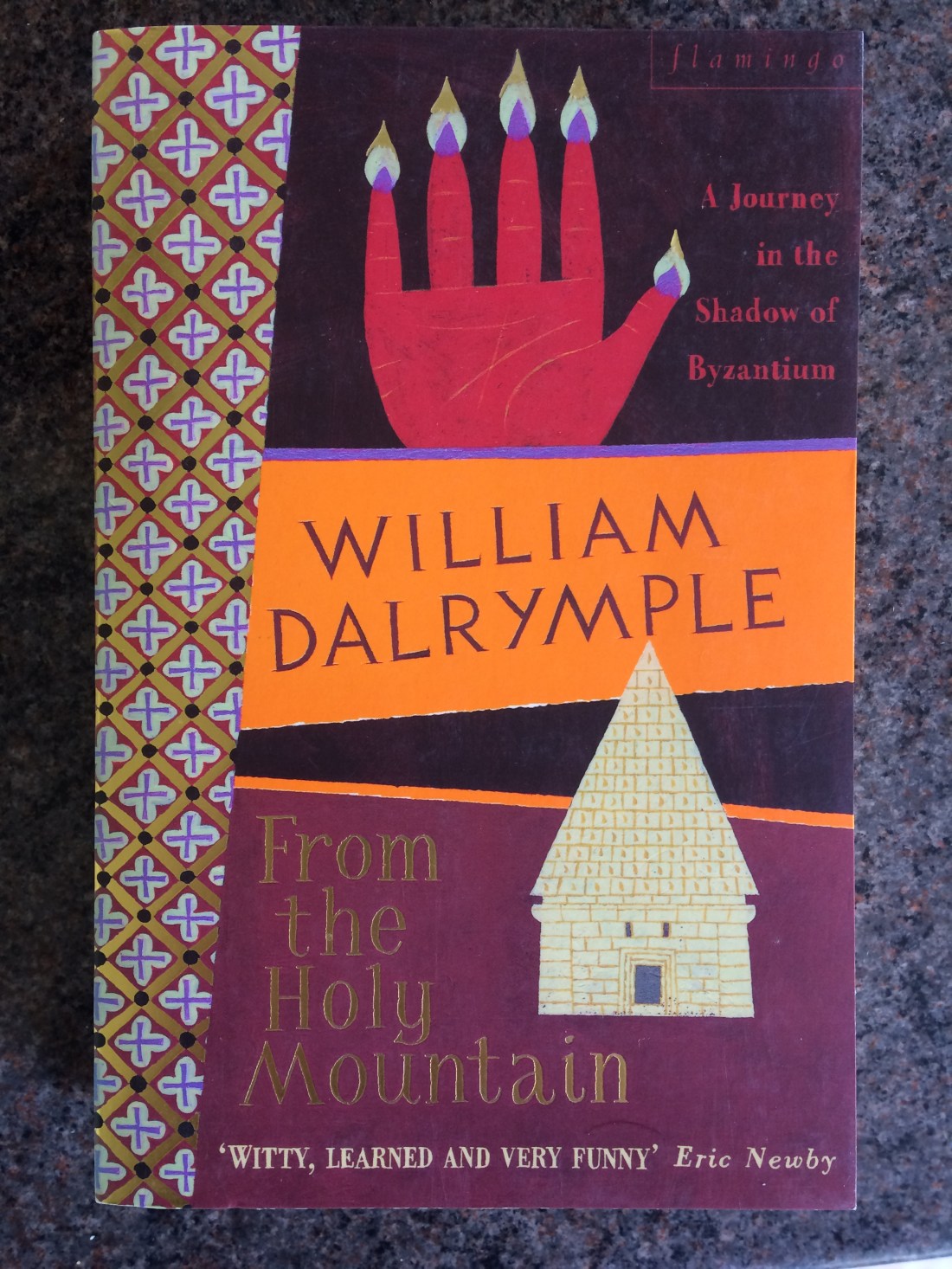
‘A Journey in the Shadow of Byzantium’. By William Dalrymple.

I can’t tell how inspirational I found this book when I first read it.

At the time, around 1997, I was virtually reading nothing new beyond a few books on astrology or Buddhism, two subjects I was heavily into at the time.

Then one chance visit to a bookshop and this title seemed to shout out from the shelves, saying ‘Read Me!’ The cover and illustrations are simply stunning, produced by Dalrymple’s wife, Olivia Fraser. They fit hand in glove with the content in a way which leads you in with all the colourful and sensual allure of a Bazaar… but that would perhaps be an ironic observation, in that this book is a travelogue revealing the long slow demise of Orthodox Christianity in the Middle East.

Essentially the book is based on the journey of a Byzantine monk and historian, John Moschos, in 578 AD along the Silk Route which the author retraces, only to find that much of that culturally rich and colourful Christian soaked world has now gone and in further more rapid decline.

Humour and Grief

There are strong elements of humour, similar to Dalrymple’s earlier work ‘In Xandadu’ (which still leaves me in stitches when I re-read it), but ‘Holy Mountain’ is a much more serious, haunting book, leaving you practically grieving for the lost world of Byzantium, the continuation of the Roman Empire in the East.

From the first sentence, where the author describes in plain yet evocative prose the cell in which he is staying at the start of his journey from Mount Athos in Greece, you are led into another world, not only the rather fraught one of today within the author’s mind, but also this lost, remoter world, which somehow seems much more wholesome and meaningful than our own despite all the technology which allows me to write this.

Similarly his all-round historical knowledge of Byzantine and Islamic culture, plus his understanding of architectural detail are stunning, yet written succinctly in such a way as to not put you off with complication. It is a great gift.

Vestiges

In places he finds these vestiges of Orthodox Christianity, monasteries and churches barely holding on, plus apocalyptically minded priests, and his description of the characters he meets fills you with both hope and resignation too, a feeling that his generation might be the last to witness such places and people.

By the end, the author seems like a forlorn character, reminding me of Paul Morel in DH Lawrence’s ‘Sons and Lovers’, as he walks away after his mother had died. The sense of loss and hopelessness are overbearing at times.

In doing this review I have realised I must re-read this wonderful book once again. It was first published in the mid 1990s; I wonder how much of the world he describes is still there 22 years on?

So I can’t recommend this book enough, it brought back my love of reading.

Inspirational! The North Norfolk Coast

Wells Morning Light
The North Norfolk Coast near Wells Next the Sea.

When I used to paint (I’m hardly picking up a brush these days), I found the North Norfolk coast in eastern England to be most inspirational.

There is something about the quality of the light, perhaps because it is north facing. There is a strong ‘elemental’ feeling to the whole area which is difficult to put into words.

I am not alone in this of course. It is a popular tourist destination, is home to much wildlife and many want to relocate there. The house prices in certain parts have skyrocketed in recent years.

But that can’t stop us visiting. I think I shall have to return soon and who knows – maybe I will be inspired.

Musings on Pluto’s Mask of Invisibility

Pluto_in_True_Color_-_High-Res
By NASA/Johns Hopkins University Applied Physics Laboratory/Southwest Research Institute/Alex Parker – Public Domain, https://commons.wikimedia.org/w/index.php?curid=71082408

I have done a little research on and off for a few years now regarding the ‘outer planet’ Pluto and his supposed effects. Put it this way, I have not been satisfied with terms like ‘transformation’.

I shall not go into it too much here as it is ongoing, but suffice it to say that I find I’m in agreement with many these days who think that Uranus, Neptune and Pluto, the so-called outer planets, only really come into serious play by their placement, their relationship if you will, by either being angular or in close aspect to the true planets, or both. I don’t believe (yes, it is a belief) that Pluto rules Scorpio, for instance.

Demotion

Of course Pluto was demoted from planet status several years ago, it being essentially classed a kind of minor binary system involving a sibling called Charon (the ferryman of Hades in myth), with whom Pluto does this merry dance in the remote, dark reaches of this solar system. Yet, despite this, there doesn’t seem to be any lack of interest in him in astrological circles.

Pluto was first discovered officially in 1930 and many have attributed the dark, ‘underground’, extreme forces that were appearing in the world at the time to the planet’s arrival in the mainstream.

Does he have a name?

Then of course we have the name of the planet. I mean why call him Pluto? The work of Percival Lowell led to the discovery of Pluto, and of course his initials are the first two letters of the name. Then of course we have Mickey Mouse’s dog, Pluto, named after him.

So the question is, did the recognition of each ‘outer planet’ reflect the time of its discovery?

I have seen it said that Uranus, discovered in the late 18th century, coincided with the American and French revolutions, plus the beginning of the Industrial Revolution. Well, I suppose Uranus has a reputation for turning things over.

Neptune was discovered in the mid 19th century, though it is far less clear what was going on then (spiritualism?) which we could call Neptunian – but maybe that’s just Neptune being Neptune, hard to make out really.

Synchronicity

And then Pluto around 1930 and the rise of fascism, communism: I get the point. Pluto is the Roman name for the Greek Hades, king of the Underworld. In mythology Hades had a helm, cap, or mask, which reputedly made him invisible, sometimes also called the Helm of Darkness. All these are what we might associate with Pluto. Either way, the mask allowed the wearer to disappear, or be undetectable, a bit like Pluto on his 248 year travail around us. I’m not sure I believe in synchronicity.

But the mask of invisibility only belongs to Pluto/Hades, others wore it to become undetectable, it is not Pluto himself. So maybe, to conjecture, in astrological terms Pluto by close aspect lends secrecy to whomever he is masking/aspecting? I don’t know, it’s something I’m looking at.

Can you keep a secret?

Nevertheless, we all know how dangerous and devastating secrecy can be, hiding true intent, a bit like the cloaking device used by the Klingons in Star Trek, or even like a ‘bird of prey’ using extreme speed (peregrine falcon for example) to disguise its final, devastating kill.

As an example, take a native with Mars closely conjunct Pluto, might the interpretation be that the Martian energy has the potential to be hidden, yet also potentially more focused and dangerous as a result? And if that energy is hidden, suppressed even, then there may be deep psychological implications too. If Neptune were conjunct Mars we might expect dissipation of that force; with Uranus we could see sudden, violent outbursts of energy.

I will leave the musings there but I intend to try and use living examples in later posts. I’m trying to keep an open mind, with the understanding that the whole truth can never be known. Thanks for your patience – these are just my musings.

The Matthew Flinders Connection: May Church Flower Festivals in South Lincolnshire, England

PHOTO-2019-05-10-08-36-28

There used to be an event, commencing in the late 1950s, famously called ‘The Spalding Tulip Parade’ in south Lincolnshire, England.

Every year much time and money was spent on creating a series of floats decorated with tulips to parade around the small Lincolnshire town, sponsored by local and national businesses. Tourists flocked there every year from many parts of the country and beyond.

Sadly those days have long gone now. However a ‘vestige’ of this former glory still remains in the numerous church flower festivals which still take place in early May.

I was particularly impressed this year by Donington’s flower festival. The explorer and cartographer who essentially mapped Australia, Matthew Flinders, was born in Donington in 1774. Recently his remains were discovered and there is a move to bring them back to Donington – you could almost feel the air of anticipation at this prospect.

Strong Links

Today many strong links remain with Australia; there are numerous visits from ‘down under’ too, both sides very keen to keep up and improve the cultural associations.

Let’s hope his remains return home soon and that a tasteful setting is created for the memory and legacy of the great Matthew Flinders of Donington, Lincolnshire.

Toussaint_Antoine_DE_CHAZAL_DE_Chamerel_-_Portrait_of_Captain_Matthew_Flinders,_RN,_1774-1814_-_Google_Art_Project (1)
By Toussaint Antoine DE CHAZAL DE CHAMEREL (1770 – 1822) (Mauritius)Details of artist on Google Art Project – XQFjQ8PX1C_hwA at Google Cultural Institute maximum zoom level, Public Domain, https://commons.wikimedia.org/w/index.php?curid=23601763

Mayflower Blossom Time – in February Temperatures!

IMG_1241

It’s hard to believe that around this time last year we were basking in temperatures around 30 degrees centigrade in ‘dear old Blighty’.

Today it’s about 10 at best and with the lack of sun and the cool wind it feels more like 4!

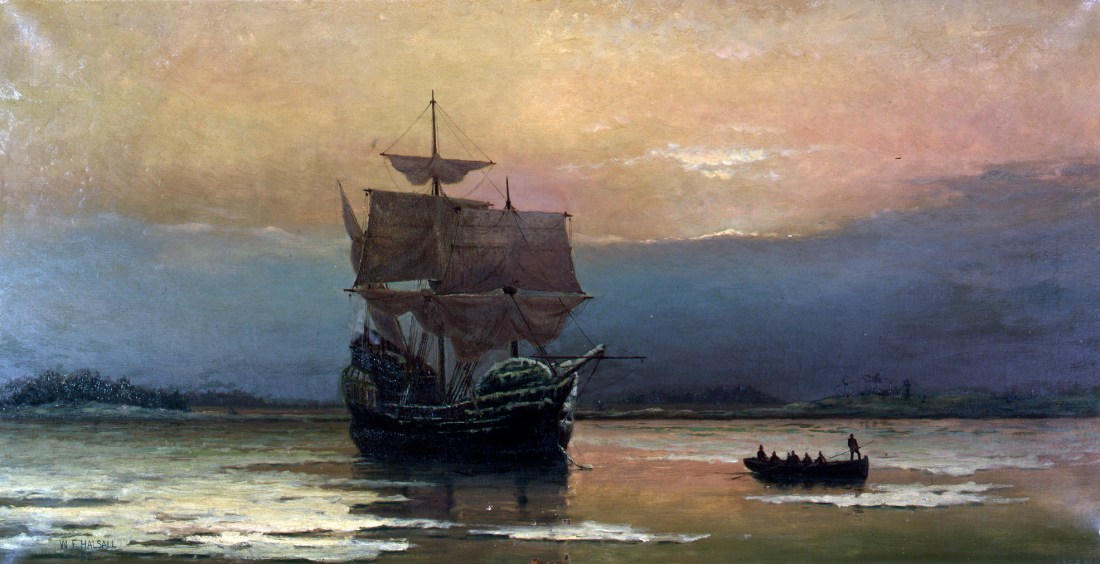
That said it got me wondering, laterally as usual, about why the famous ship the Mayflower was called as such.

According to the sources I came across it’s because the original owner of the ship was Florentine (from Florence, Italy) called Guicciardini; the Mayflower, or ‘Giglio’ in Italian, is the symbol of Florence. And the ship was due to set sail, in May.

Mayflower_in_Plymouth_Harbor,_by_William_Halsall
By William Halsall – Pilgrim Hall Museum, Public Domain. Wikimedia.org

Oh to set sail for pastures new!

So the Mayflower became the symbol of new beginnings in the so-called New World and is still one America’s greatest cultural icons.

I don’t know for sure but there may be other explanations. At least according to the above its naming had little to do with the Pilgrims who sailed on it, nor indeed Plymouth in western England from where they sailed.

Nevertheless it’s fascinating to hear of people in America who can trace their lineage back to the Mayflower. I will have to look out for examples of this, I would love to speak to some of them.

http://www.answers.com

http://www.wikipedia.com