300-Year-Old Farmhouse | Germany — Edge of Humanity Magazine

Photographer Robert Mertl is the Edge of Humanity Magazine contributor of these images. From the ‘An Old Farmhouse’ series. To see Robert’s body of work, click on any photograph. Schwarzer House, Grassemann, Germany. Built in 1698. All images © Robert Mertl […]

via 300-Year-Old Farmhouse | Germany — Edge of Humanity Magazine

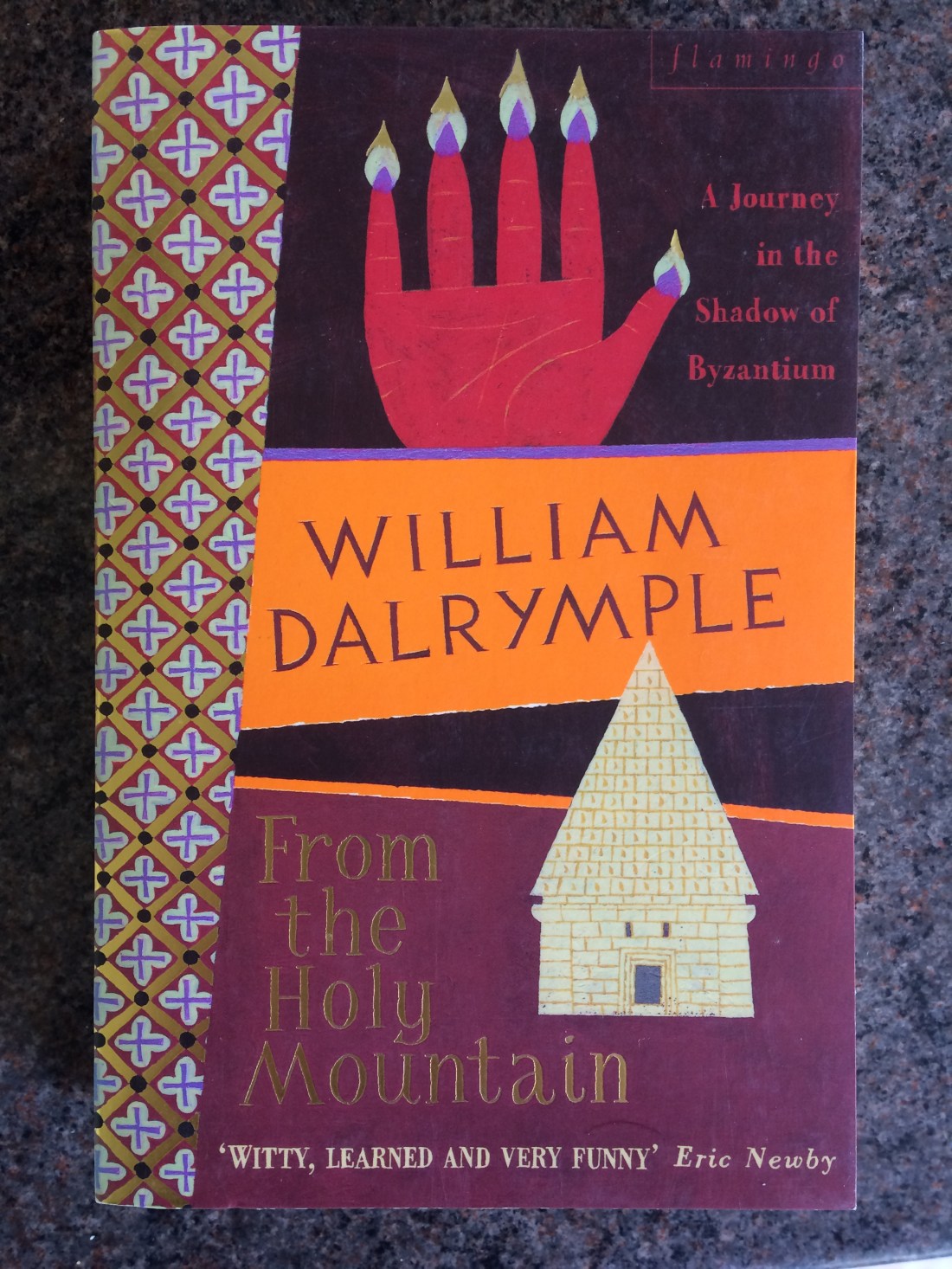
Leo’s Book Review: ‘From the Holy Mountain’

IMG_1248

‘A Journey in the Shadow of Byzantium’. By William Dalrymple.

I can’t tell how inspirational I found this book when I first read it.

At the time, around 1997, I was virtually reading nothing new beyond a few books on astrology or Buddhism, two subjects I was heavily into at the time.

Then one chance visit to a bookshop and this title seemed to shout out from the shelves, saying ‘Read Me!’ The cover and illustrations are simply stunning, produced by Dalrymple’s wife, Olivia Fraser. They fit hand in glove with the content in a way which leads you in with all the colourful and sensual allure of a Bazaar… but that would perhaps be an ironic observation, in that this book is a travelogue revealing the long slow demise of Orthodox Christianity in the Middle East.

Essentially the book is based on the journey of a Byzantine monk and historian, John Moschos, in 578 AD along the Silk Route which the author retraces, only to find that much of that culturally rich and colourful Christian soaked world has now gone and in further more rapid decline.

Humour and Grief

There are strong elements of humour, similar to Dalrymple’s earlier work ‘In Xandadu’ (which still leaves me in stitches when I re-read it), but ‘Holy Mountain’ is a much more serious, haunting book, leaving you practically grieving for the lost world of Byzantium, the continuation of the Roman Empire in the East.

From the first sentence, where the author describes in plain yet evocative prose the cell in which he is staying at the start of his journey from Mount Athos in Greece, you are led into another world, not only the rather fraught one of today within the author’s mind, but also this lost, remoter world, which somehow seems much more wholesome and meaningful than our own despite all the technology which allows me to write this.

Similarly his all-round historical knowledge of Byzantine and Islamic culture, plus his understanding of architectural detail are stunning, yet written succinctly in such a way as to not put you off with complication. It is a great gift.

Vestiges

In places he finds these vestiges of Orthodox Christianity, monasteries and churches barely holding on, plus apocalyptically minded priests, and his description of the characters he meets fills you with both hope and resignation too, a feeling that his generation might be the last to witness such places and people.

By the end, the author seems like a forlorn character, reminding me of Paul Morel in DH Lawrence’s ‘Sons and Lovers’, as he walks away after his mother had died. The sense of loss and hopelessness are overbearing at times.

In doing this review I have realised I must re-read this wonderful book once again. It was first published in the mid 1990s; I wonder how much of the world he describes is still there 22 years on?

So I can’t recommend this book enough, it brought back my love of reading.

Inspirational! The North Norfolk Coast

Wells Morning Light
The North Norfolk Coast near Wells Next the Sea.

When I used to paint (I’m hardly picking up a brush these days), I found the North Norfolk coast in eastern England to be most inspirational.

There is something about the quality of the light, perhaps because it is north facing. There is a strong ‘elemental’ feeling to the whole area which is difficult to put into words.

I am not alone in this of course. It is a popular tourist destination, is home to much wildlife and many want to relocate there. The house prices in certain parts have skyrocketed in recent years.

But that can’t stop us visiting. I think I shall have to return soon and who knows – maybe I will be inspired.

The Matthew Flinders Connection: May Church Flower Festivals in South Lincolnshire, England

PHOTO-2019-05-10-08-36-28

There used to be an event, commencing in the late 1950s, famously called ‘The Spalding Tulip Parade’ in south Lincolnshire, England.

Every year much time and money was spent on creating a series of floats decorated with tulips to parade around the small Lincolnshire town, sponsored by local and national businesses. Tourists flocked there every year from many parts of the country and beyond.

Sadly those days have long gone now. However a ‘vestige’ of this former glory still remains in the numerous church flower festivals which still take place in early May.

I was particularly impressed this year by Donington’s flower festival. The explorer and cartographer who essentially mapped Australia, Matthew Flinders, was born in Donington in 1774. Recently his remains were discovered and there is a move to bring them back to Donington – you could almost feel the air of anticipation at this prospect.

Strong Links

Today many strong links remain with Australia; there are numerous visits from ‘down under’ too, both sides very keen to keep up and improve the cultural associations.

Let’s hope his remains return home soon and that a tasteful setting is created for the memory and legacy of the great Matthew Flinders of Donington, Lincolnshire.

Toussaint_Antoine_DE_CHAZAL_DE_Chamerel_-_Portrait_of_Captain_Matthew_Flinders,_RN,_1774-1814_-_Google_Art_Project (1)
By Toussaint Antoine DE CHAZAL DE CHAMEREL (1770 – 1822) (Mauritius)Details of artist on Google Art Project – XQFjQ8PX1C_hwA at Google Cultural Institute maximum zoom level, Public Domain, https://commons.wikimedia.org/w/index.php?curid=23601763

May 1092 Lincoln Cathedral Consecrated

Wenceslas_Hollar_-_Lincoln_Cathedral_from_the_west
By Wenceslaus Hollar – Artwork from University of Toronto Wenceslaus Hollar Digital CollectionScanned by University of TorontoHigh-resolution version extracted using custom tool by User:Dcoetzee, Public Domain, https://commons.wikimedia.org/w/index.php?curid=6241265

One of my favourite places, Lincoln Cathedral, was consecrated this month way back in 1092.

To put that into perspective, King William (Rufus) the Second of that name, son of the mighty Conqueror, had been on the throne since 1087. It was only a quarter of a century after the Normans’ hostile (in fact rather brutal) take over of the board of the richest kingdom in western Europe, but already their introduction of Romanesque architecture was changing the landscape of the country for ever.

However Lincoln Cathedral’s early history was blighted by disasters. A fire destroyed the roof in 1124, an earthquake destroyed most of it in 1185.

Nevertheless despite this the structure was rebuilt in magnificent fashion to become effectively the tallest building in the world, thanks to its huge central spire. The triple spire configuration as it was during the late medieval and early modern period must have been an incredible sight. Then, tragically, in February 1549 the central spire collapsed during a storm. The two smaller spires remained for some time until they were taken down for safety reasons.

Even so, Lincoln Cathedral still remains high on its hill, and is at least to my mind, the best cathedral in England and therefore one of the best anywhere. If you are in the region it’s well worth a visit.

There is much more I could say about the cathedral and the city but I will leave that for future posts.