At times you can almost see the individuals, a bit like ghosts, who would once regularly use this door.
How would the local accent have sounded then, say in 1500? Would I have understood them? More to the point, would they understand me? I doubt it, but I have a liking for old church doors.
This north facing example bears all the marks of being very old, probably late medieval, but I could be wrong. Look
Today in 1610, King Henry the Fourth of France was assassinated.
Henri, although baptised as a Catholic, was brought up as a Protestant. Due to the inflammatory religious situation in France and his background, he was at times considered an enemy by both Catholics and Protestants alike. As a result, there were many previous assassination attempts.
Despite often being unpopular during his reign, he was nevertheless considered a successful king, in economic, cultural, military and diplomatic terms, but only achieved his current status as a great king posthumously, when a virtual cult arose in his memory.
He was assassinated on May 14 1610 by a fanatic called Ravaillac in the Rue de la Ferronnerie, Paris.
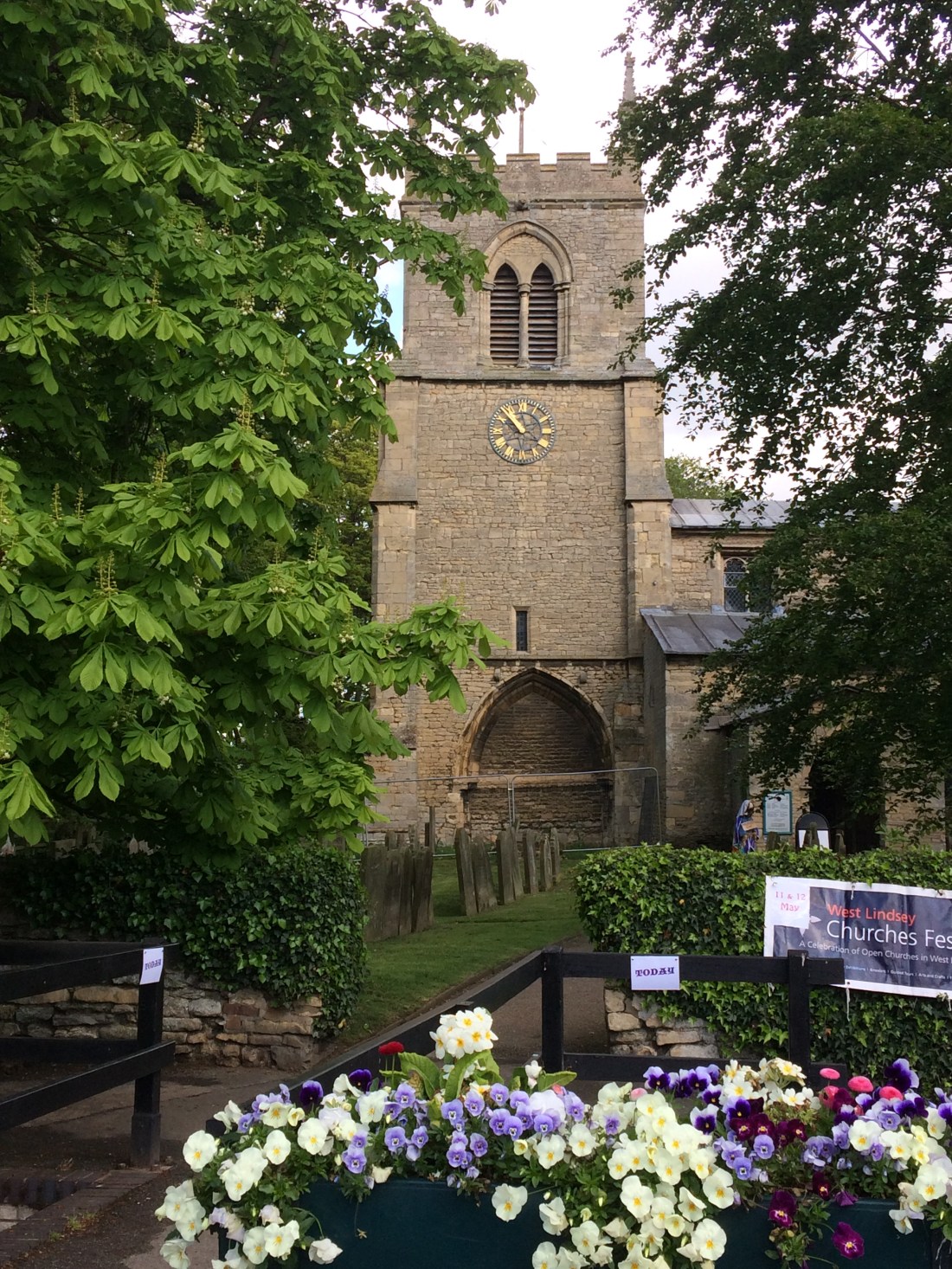
Every May in north Lincolnshire in the east of England there is the West Lindsey Churches Festival, ‘A Celebration of Open Churches in West Lindsey’.
The idea is to raise interest and money for the upkeep of these historic buildings, icons of English cultural and Christian heritage.
To be honest, I’m not sure if we’d ever heard of it. The link only came up last week from the web, so I thought it would be worth a visit. We were very glad we came.
All Saints Church, Nettleham.
Our first stop was at the pretty village of Nettleham, at the Church of All Saints just a few miles north east of the magnificent city of Lincoln.
Nettleham is a large, seemingly thriving village of around three and half thousand souls with lots of local stores and some pubs, a heartening sight if there ever was. Inside the church we were greeted very courteously by the volunteers manning their stalls of old books, games, crafts, or selling food and drink. They were all very helpful, keen to tell us about the church and the village.
The locals are friendly! We were greeted outside, even before we went in…
Sadly, in the 1960s there was a serious fire at All Saints, the result of arson. Since then the church has been restored very well, notable features being the new stained glass window at the east end and the roof.
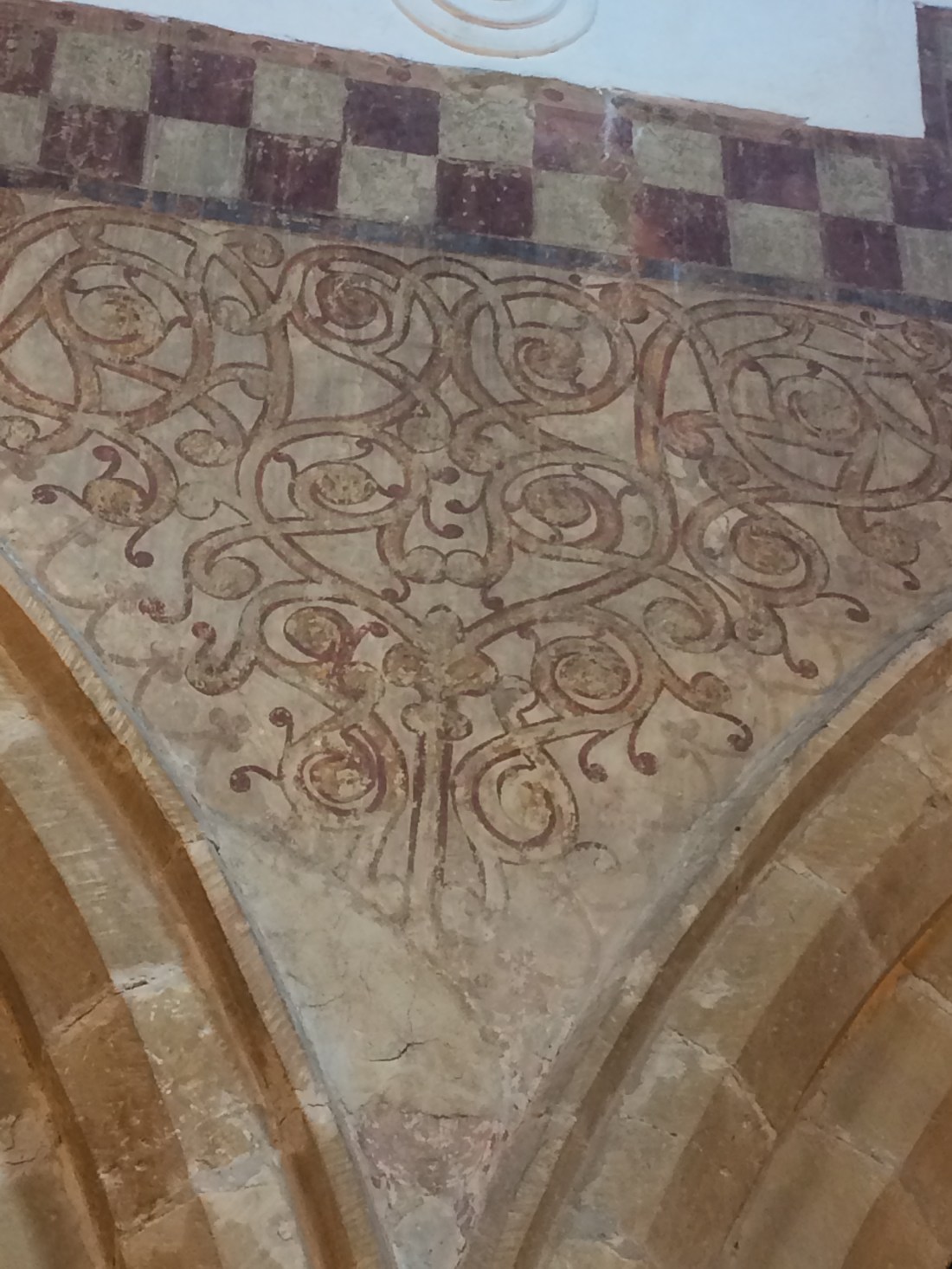
Medieval wall illustrations were revealed after the fire in the 1960s.
Modern stained glass from the late 1960s.
Of course, there are no benefits from fires, but one of the things revealed by the tragedy was a series of medieval wall pattern illustrations, of the type which used to bedeck all churches before the Reformation, after which nearly all were whitewashed over.
Carrot cake and apple cake, what is there not to like?
Naturally, one of the benefits of going to these events is sampling the local cakes. We got a piece of carrot cake and apple cake, washed down by the proverbial cup of tea. The prices too, are very reasonable. We even took away a whole lemon drizzle cake!
Yes, it’s all very English and a jolly good thing to. I can’t speak highly enough of everyone inside, they made us very welcome.
The village of Nettleham is also very pretty and worth exploring, with a running stream making lovely feature.
And a little history
Incidentally, Lindsey, in which Nettleham lies, is not merely a division or riding of historic Lincolnshire, along with Kesteven and Holland; Lindsey was once a kingdom in its own right, ruled from Lincoln around thirteen hundred years ago, before it was swallowed up by the much larger Mercia.
After that there was a manor house here, called the Bishop’s Manor House, as it eventually became a possession of the Bishops of Lincoln. Sadly this is now demolished.
But it’s not all about the past. There is very much to see and enjoy here today, not just at the Churches Festival – it’s well worth a visit at any time if you’re nearby.
Which saint, one wonders, once stood here in this empty space?
The empty church spaces now vacated, were once inhabited by colourful saints, or other such noble individuals. These days it makes me sad.
I am not a Catholic, yet, somehow our culture seemed to be somewhat lessened by their disappearance during the Reformation.
I think we lost more than just colour and ceremony in our lives at the time; these events seriously hastened in the modern materialistic world, which despite its obvious benefits, has stripped us of all our innocence now.
Just like the monasteries, creators and supporters of communities, were dissolved and stripped of all their wealth which was then reduced to its base monetary value, we too over time seem to have been stripped to the core, spiritually.
That’s how I feel. I’m not saying I wish to convert – there are reasons why I would not – but we need to reclaim something from our past, to move one step back, if you will, before we can go two forward.
Sure it was a long time ago, I’ve never known anything different from bare stone and whitewashed walls – but just think how colourful our English churches once were, how rich the lives of the faithful must have been.