Mid May comes along and it’s time once again for the annual Lincolnshire Churches Festival in eastern England.
Taking place over two weekends in Lincolnshire’s ancient northern riding of Lindsey, the festival is split between the first weekend of the 11th and 12th and the second weekend of the 18th and 19th.
Nearly 100 churches are taking part and a very warm welcome will be had in each one, with food such as cake and scones, plus drinks and some stalls to browse. The proceeds go towards the upkeep of these wonderful buildings.
Over the next two weeks, I shall be writing several pieces about this wonderful event which celebrates Lincolnshire’s fine Christian heritage and the glory of its architectural variety.
There used to be an event, commencing in the late 1950s, famously called ‘The Spalding Tulip Parade’ in south Lincolnshire, England.
Every year much time and money was spent on creating a series of floats decorated with tulips to parade around the small Lincolnshire town, sponsored by local and national businesses. Tourists flocked there every year from many parts of the country and beyond.
Sadly those days have long gone now. However a ‘vestige’ of this former glory still remains in the numerous church flower festivals which still take place in early May.
I was particularly impressed this year by Donington’s flower festival. The explorer and cartographer who essentially mapped Australia, Matthew Flinders, was born in Donington in 1774. Recently his remains were discovered and there is a move to bring them back to Donington – you could almost feel the air of anticipation at this prospect.
Strong Links
Today many strong links remain with Australia; there are numerous visits from ‘down under’ too, both sides very keen to keep up and improve the cultural associations.
Let’s hope his remains return home soon and that a tasteful setting is created for the memory and legacy of the great Matthew Flinders of Donington, Lincolnshire.
By Toussaint Antoine DE CHAZAL DE CHAMEREL (1770 – 1822) (Mauritius)Details of artist on Google Art Project – XQFjQ8PX1C_hwA at Google Cultural Institute maximum zoom level, Public Domain, https://commons.wikimedia.org/w/index.php?curid=23601763
It’s hard to believe that around this time last year we were basking in temperatures around 30 degrees centigrade in ‘dear old Blighty’.
Today it’s about 10 at best and with the lack of sun and the cool wind it feels more like 4!
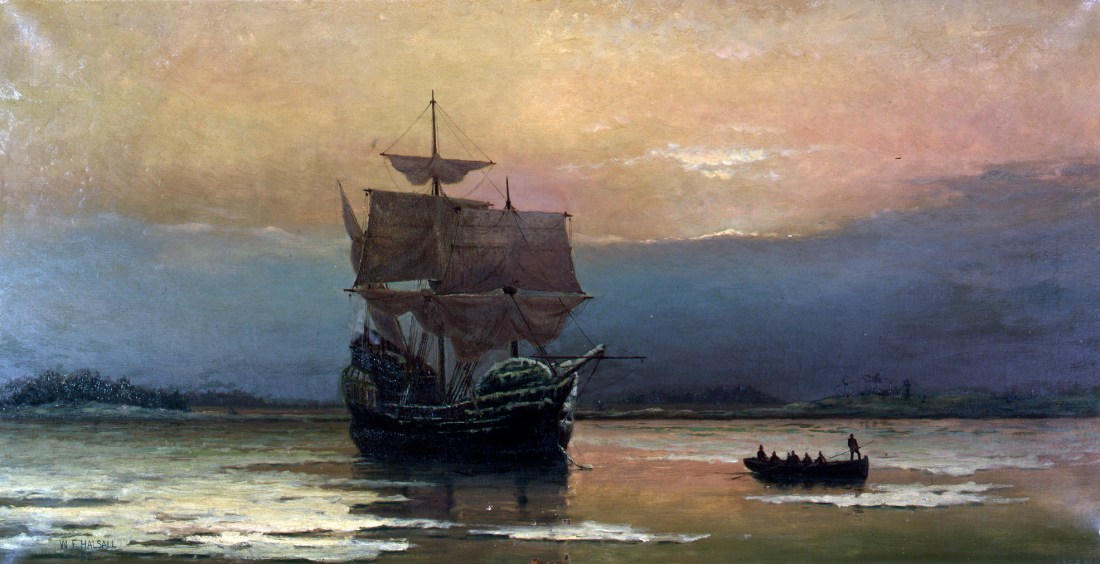
That said it got me wondering, laterally as usual, about why the famous ship the Mayflower was called as such.
According to the sources I came across it’s because the original owner of the ship was Florentine (from Florence, Italy) called Guicciardini; the Mayflower, or ‘Giglio’ in Italian, is the symbol of Florence. And the ship was due to set sail, in May.
By William Halsall – Pilgrim Hall Museum, Public Domain. Wikimedia.org
Oh to set sail for pastures new!
So the Mayflower became the symbol of new beginnings in the so-called New World and is still one America’s greatest cultural icons.
I don’t know for sure but there may be other explanations. At least according to the above its naming had little to do with the Pilgrims who sailed on it, nor indeed Plymouth in western England from where they sailed.
Nevertheless it’s fascinating to hear of people in America who can trace their lineage back to the Mayflower. I will have to look out for examples of this, I would love to speak to some of them.
By Wenceslaus Hollar – Artwork from University of Toronto Wenceslaus Hollar Digital CollectionScanned by University of TorontoHigh-resolution version extracted using custom tool by User:Dcoetzee, Public Domain, https://commons.wikimedia.org/w/index.php?curid=6241265
One of my favourite places, Lincoln Cathedral, was consecrated this month way back in 1092.
To put that into perspective, King William (Rufus) the Second of that name, son of the mighty Conqueror, had been on the throne since 1087. It was only a quarter of a century after the Normans’ hostile (in fact rather brutal) take over of the board of the richest kingdom in western Europe, but already their introduction of Romanesque architecture was changing the landscape of the country for ever.
However Lincoln Cathedral’s early history was blighted by disasters. A fire destroyed the roof in 1124, an earthquake destroyed most of it in 1185.
Nevertheless despite this the structure was rebuilt in magnificent fashion to become effectively the tallest building in the world, thanks to its huge central spire. The triple spire configuration as it was during the late medieval and early modern period must have been an incredible sight. Then, tragically, in February 1549 the central spire collapsed during a storm. The two smaller spires remained for some time until they were taken down for safety reasons.
Even so, Lincoln Cathedral still remains high on its hill, and is at least to my mind, the best cathedral in England and therefore one of the best anywhere. If you are in the region it’s well worth a visit.
There is much more I could say about the cathedral and the city but I will leave that for future posts.