Cherry Willingham Church of St. Peter and St. Paul.
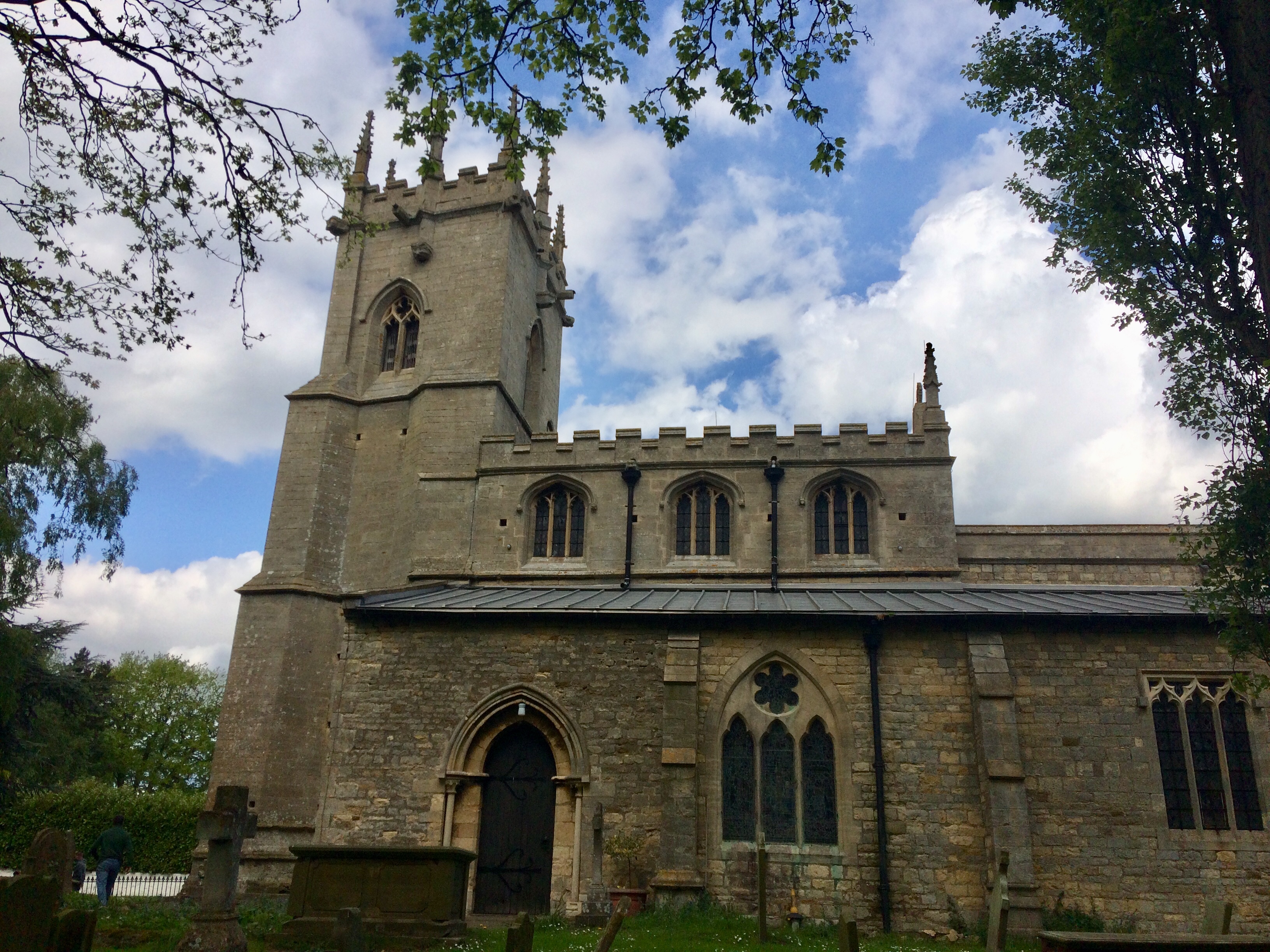
One of the most fascinating churches we visited during the West Lindsey Churches Festival this May, was at Cherry Willingham, dedicated to Saints Peter and Paul, a Grade 1 listed Georgian building.
Sitting at the highest point of the village, there are steep steps to the entrance. Suddenly you are confronted by a terrific example of Georgian architecture. From the west door entrance, you can see right through to a wonderful reredos resplendent behind the altar.
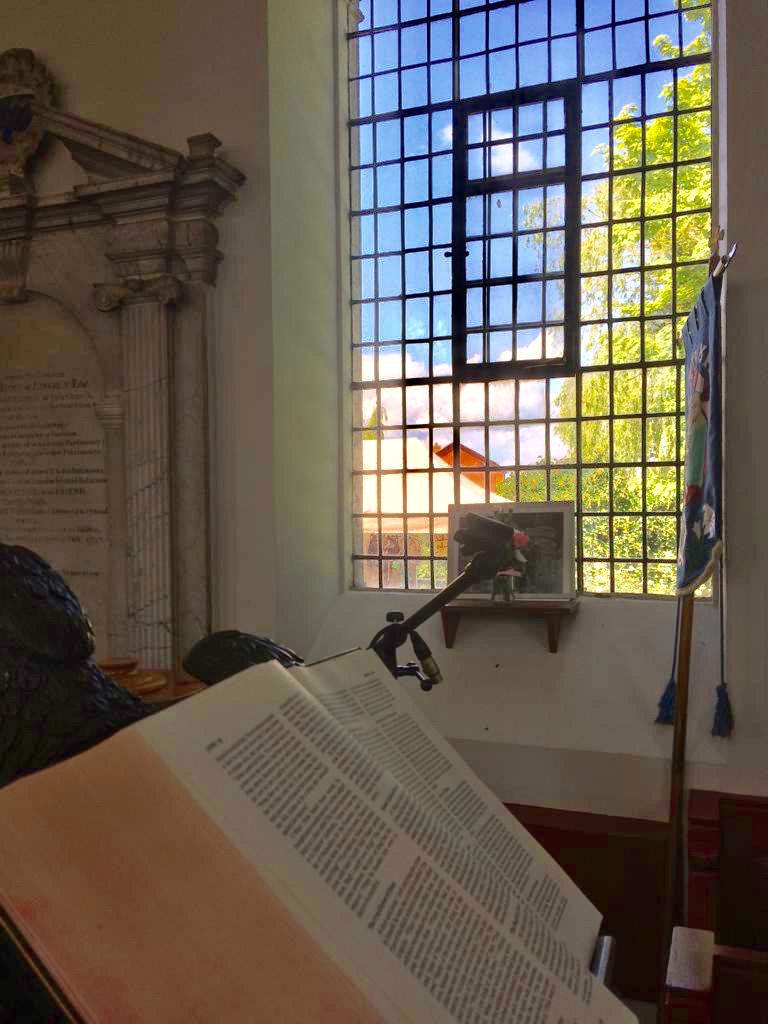
The quality of light was wonderful.
Once more we were greeted by very pleasant local people, who filled us in with all the salient historical and current facts.
Home made cakes and refreshments were on offer and there was a display of the charities the church supports.
Inside it was simply stunning.
Although quite small, what the building lacks in size it more than makes up for in style and detail.
It opened in 1753, its founder a certain Thomas Becke, who had bought an estate in the village. Inside there is a large marble monument to Mr Becke. The church is built with local Ancaster limestone, infused with fossils.
Most pleasing about the design of this small church is the quality of the light afforded by the style of windows (although our photographs possibly don’t quite do that justice), aided certainly by it being a sunny spring day, yet these large windows would surely afford good natural lighting on any cloudy day.
The reredos.
The volunteers told us that at present there is no toilet in the church – though that particular facility is arriving very soon. In the meanwhile, the very kind and courteous vicar took us to her nearby house so that we could perform that particular function!
This typifies the whole spirit we felt within the church, that of community and care. Thank you Cherry Willingham.
Fiskerton church, dedicated to St. Clement of Rome.
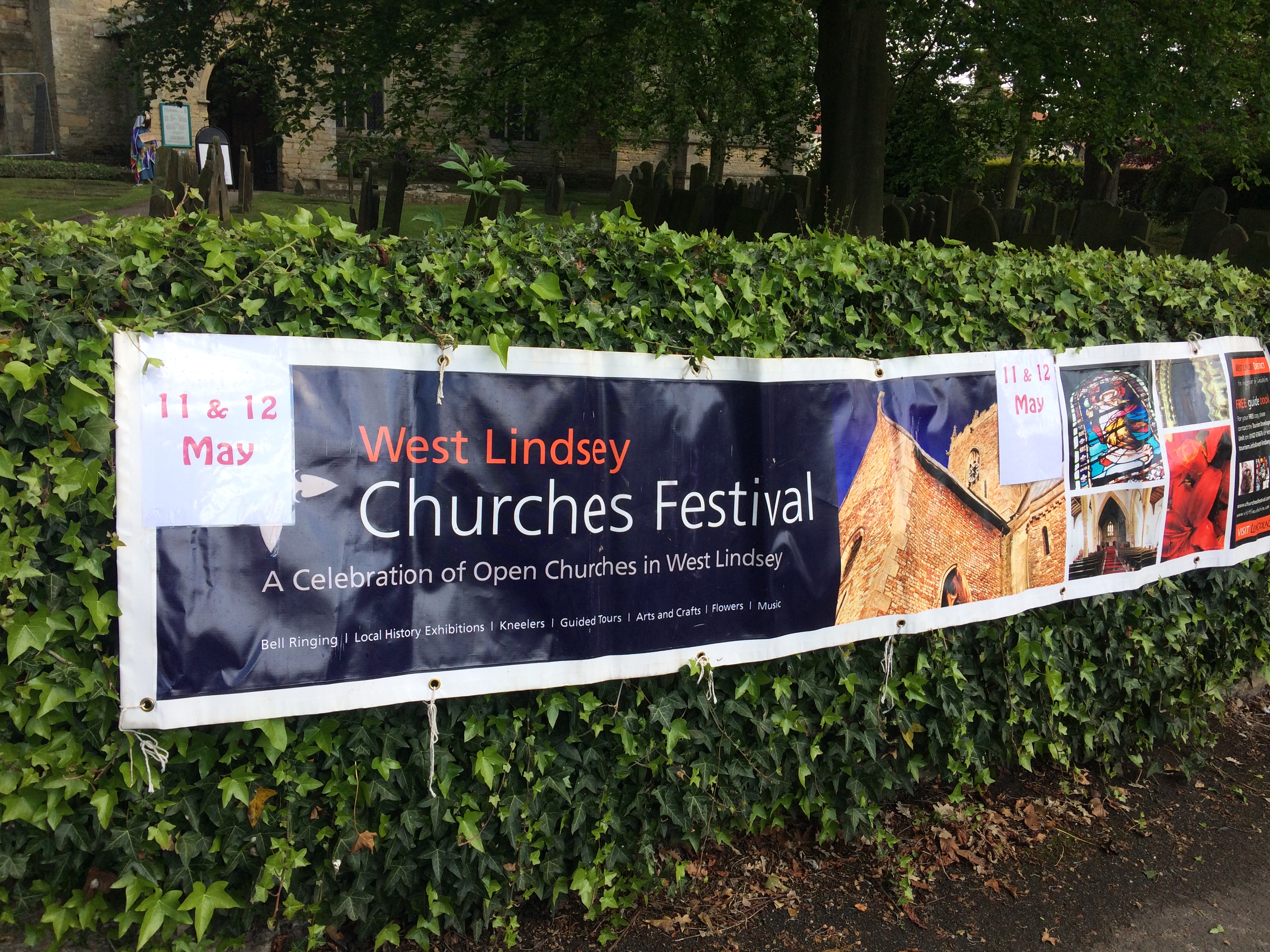
Every May in West Lindsey in northern Lincolnshire, there are nearly a hundred churches open to the public over two weekends.
Of course, you may say that churches are always open – and you would be right. What I mean is, this diverse array of architectural and cultural gems, have items such as exhibitions, old books, games and crafts on display and for sale, plus food and drink of course, the proceeds going to the upkeep of the churches. There will always be a warm welcome too.
Fiskerton’s name means enclosure or farm of fishermen, its name stemming from Anglo-Saxon times. The church is dedicated to St. Clement of Rome, a dedication I do not recall coming across too often, especially not in Lincolnshire.
Like many villages in this area of Lincolnshire, there are strong connections to the RAF, particularly in relation to World War 2.
In fact there were remembrance books and links with RAF squadrons in the Lady Chapel, a testimony to the fact that Lincolnshire during World War 2 became essentially ‘Bomber County’, due to the preponderance of bomber squadrons.
Elsewhere in the church there are some notable features, including remaining Norman architecture.
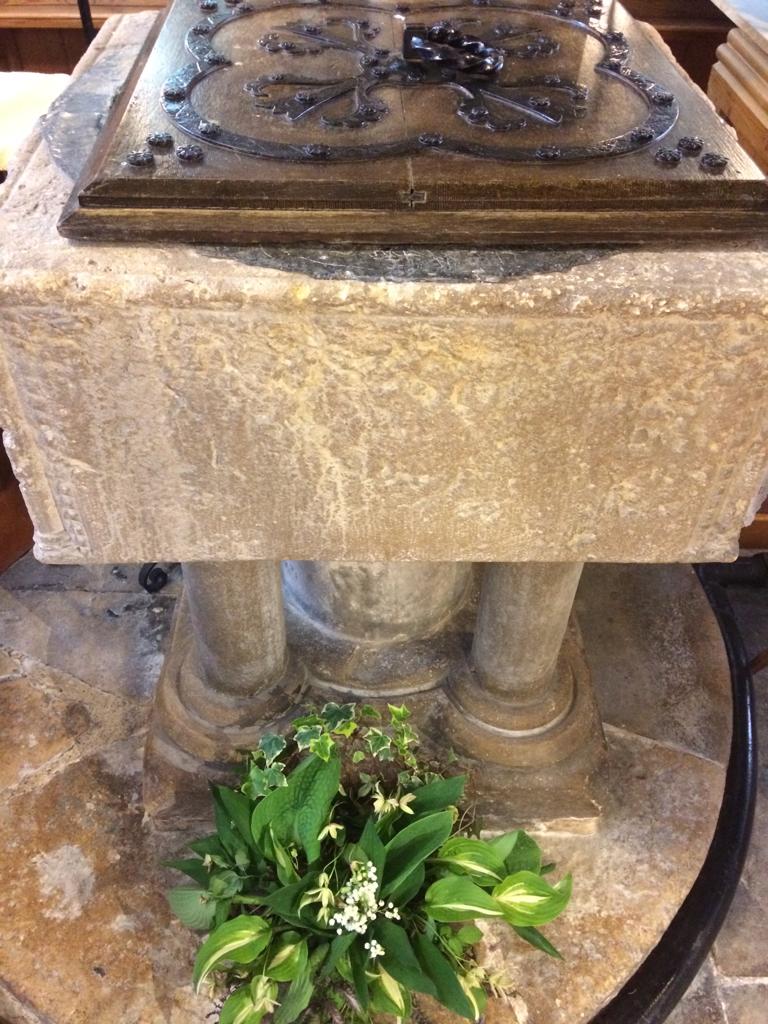
The font is especially interesting. Note the markings on the stone and the work on the ornate cover below:
The font, which looks very old, bearing interesting markings.Painting of Madonna and Child, Fiskerton church.Stained glass windows at the east end were particularly beautiful.Looking east along the nave.
Once again, the most overriding memory of our visit to this lovely church was the friendliness of everyone, volunteers who seemingly can never do too much for you.
Every May in north Lincolnshire in the east of England there is the West Lindsey Churches Festival, ‘A Celebration of Open Churches in West Lindsey’.
The idea is to raise interest and money for the upkeep of these historic buildings, icons of English cultural and Christian heritage.
To be honest, I’m not sure if we’d ever heard of it. The link only came up last week from the web, so I thought it would be worth a visit. We were very glad we came.
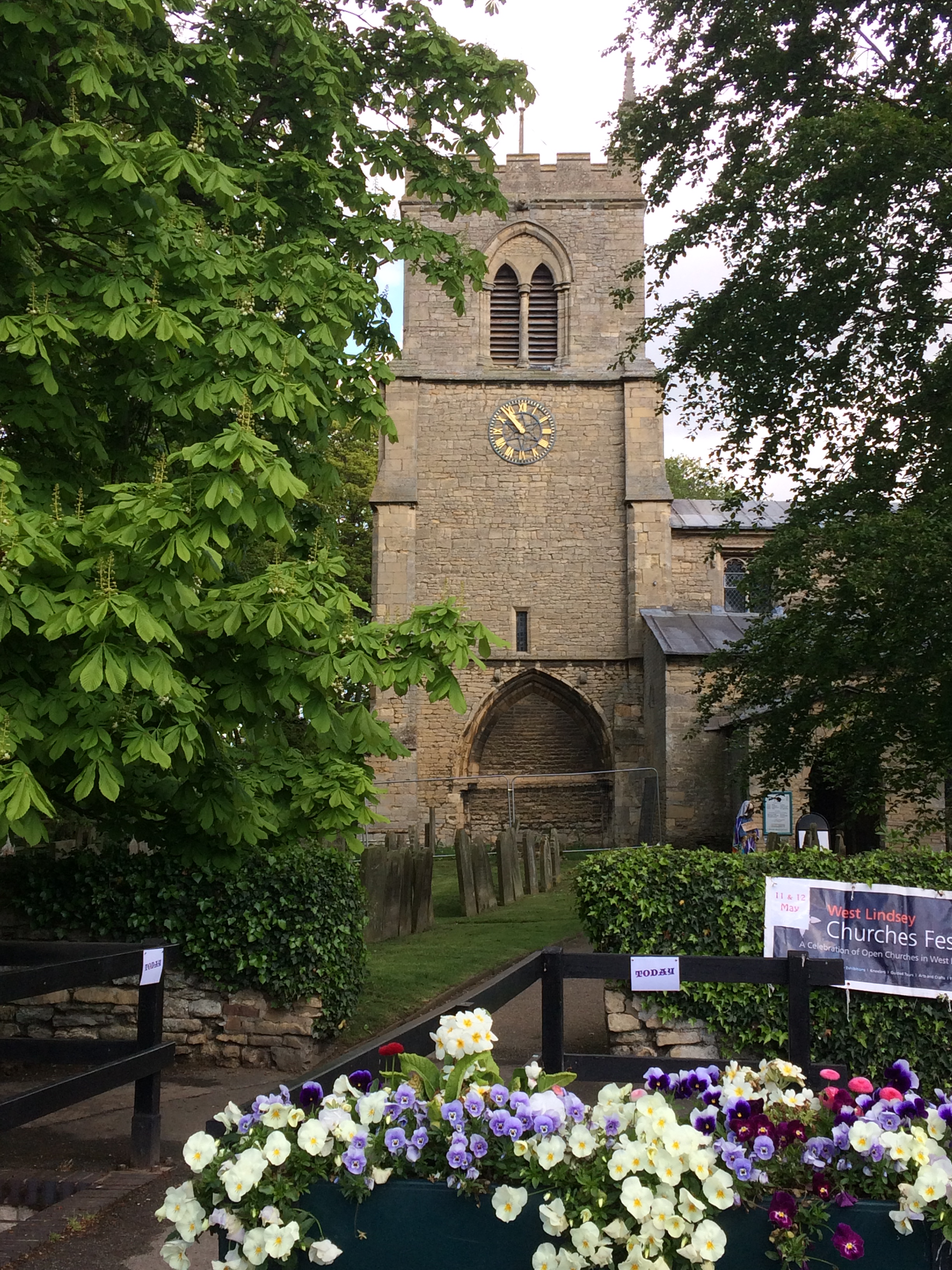
All Saints Church, Nettleham.
Our first stop was at the pretty village of Nettleham, at the Church of All Saints just a few miles north east of the magnificent city of Lincoln.
Nettleham is a large, seemingly thriving village of around three and half thousand souls with lots of local stores and some pubs, a heartening sight if there ever was. Inside the church we were greeted very courteously by the volunteers manning their stalls of old books, games, crafts, or selling food and drink. They were all very helpful, keen to tell us about the church and the village.
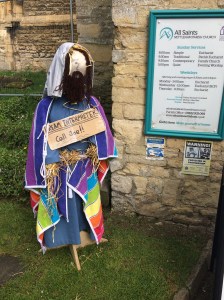
The locals are friendly! We were greeted outside, even before we went in…
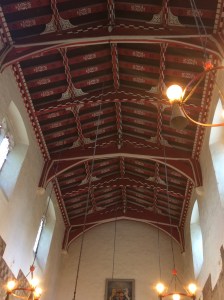
Sadly, in the 1960s there was a serious fire at All Saints, the result of arson. Since then the church has been restored very well, notable features being the new stained glass window at the east end and the roof.
Medieval wall illustrations were revealed after the fire in the 1960s.
Modern stained glass from the late 1960s.
Of course, there are no benefits from fires, but one of the things revealed by the tragedy was a series of medieval wall pattern illustrations, of the type which used to bedeck all churches before the Reformation, after which nearly all were whitewashed over.
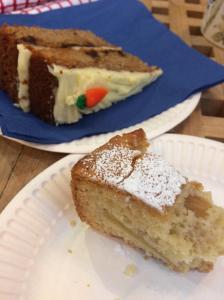
Carrot cake and apple cake, what is there not to like?
Naturally, one of the benefits of going to these events is sampling the local cakes. We got a piece of carrot cake and apple cake, washed down by the proverbial cup of tea. The prices too, are very reasonable. We even took away a whole lemon drizzle cake!
Yes, it’s all very English and a jolly good thing to. I can’t speak highly enough of everyone inside, they made us very welcome.
The village of Nettleham is also very pretty and worth exploring, with a running stream making lovely feature.
And a little history
Incidentally, Lindsey, in which Nettleham lies, is not merely a division or riding of historic Lincolnshire, along with Kesteven and Holland; Lindsey was once a kingdom in its own right, ruled from Lincoln around thirteen hundred years ago, before it was swallowed up by the much larger Mercia.
After that there was a manor house here, called the Bishop’s Manor House, as it eventually became a possession of the Bishops of Lincoln. Sadly this is now demolished.
But it’s not all about the past. There is very much to see and enjoy here today, not just at the Churches Festival – it’s well worth a visit at any time if you’re nearby.
An Evening of Brilliant Music, Humour and Poignancy in Spalding.
On the Saturday evening of May 11, ‘folk rock’ band Fairport Convention once more graced the stage at Spalding’s Civic Centre.
Although the auditorium was not quite full, there was a good, convivial atmosphere, helped by the band members’ laid back approach, great sense of humour and also by the timeless quality of the music aided by a back catalogue of over fifty years, even though the subject matter of these songs is often anything but genteel.
Take the song ‘Matty Groves’, described by founder member Simon Nicol as having two chords and nineteen verses. The song itself is a traditional, lascivious and violent tale, originally adapted for Fairport’s landmark album, ‘Liege and Lief’ in 1969, and is delivered with a rocky, cutting edge, one of the best examples of ‘folk rock’ in my opinion.
Cutting Edge Rhythm Section
Throughout the performance, that cutting edge was amply provided by the deft skills of the highly experienced rhythm section, namely Gerry Conway on percussion and Dave Pegg, the latter’s dexterous familiarity with all of the neck of his bass guitar being a wonder to behold, as was the light hearted attitude he exuded. I have seldom seen a more lyrical example of great bass playing.
Not to be outdone, however, Gerry gave a stunning, virtuoso percussive performance which combined his conventional, rather minimal electronic set with what I understand to be a traditional Peruvian drum called a Cajon (Spanish for box) on which he actually sat all night. Simply remarkable.
And the evening was not all about the band’s older back catalogue either. For example, there were lovely performances of songs written more recently by multi-instrumentalist Chris Leslie, whose easy transition from fiddle to mandolin to guitar to tin whistle… was amazing.
Conversely, yet equally impressive, was the fiddle-dedicated Ric Sanders, whose unconventional, at times jazz influenced, reverb infused playing style, perfectly complemented the rest of the band.
What is more, there were the fantastic vocal harmonies too, adding to the overall richness and quality of the sound.
Leader of the Band
However, the undoubted leader of the band is founder member Simon Nicol, whose precise, often understated guitar playing could not be overlooked, especially by amateur guitarists like myself who appreciate exactly how well he does it.
Furthermore it was Simon who provided the most poignant parts of the evening. The band’s rendition of Sandy Denny’s ‘Fotheringay’ was a particular highlight, sung with deep feeling by Simon, the story of Mary Queen of Scots final hours in 1587.
‘The Hiring’. Statue recently erected in Hall Place, Spalding
Equally moving and with some local interest too, was Ralph McTell’s beautiful song ‘The Hiring Fair’. Simon had clearly seen the statue ‘The Hiring’ recently erected in Hall Place in the town centre, giving a precis of how hiring fairs used to work throughout the country.
And so to the encore, which had to be the anthemic ‘Meet on the Ledge’, one of the band’s best known songs. It’s exactly fifty years since the tragic road accident which took the life of drummer Martin Lamble and Jeannie Franklyn, who was Richard Thompson’s girlfriend.
In the aftermath of the tragedy the band nearly split up. Thankfully for us and to continually honour those who died, they decided to carry on, though it was clear that the anniversary of the event was leaving its mark on what was a very enjoyable evening.
Finally, there is the Cropredy Convention which takes part every year in August over three days. If you missed them this year on their spring tour, why not try to catch them at Cropredy? There are many other bands and musicians to see and a good time will be had by all, that’s for sure.
There used to be an event, commencing in the late 1950s, famously called ‘The Spalding Tulip Parade’ in south Lincolnshire, England.
Every year much time and money was spent on creating a series of floats decorated with tulips to parade around the small Lincolnshire town, sponsored by local and national businesses. Tourists flocked there every year from many parts of the country and beyond.
Sadly those days have long gone now. However a ‘vestige’ of this former glory still remains in the numerous church flower festivals which still take place in early May.
I was particularly impressed this year by Donington’s flower festival. The explorer and cartographer who essentially mapped Australia, Matthew Flinders, was born in Donington in 1774. Recently his remains were discovered and there is a move to bring them back to Donington – you could almost feel the air of anticipation at this prospect.
Strong Links
Today many strong links remain with Australia; there are numerous visits from ‘down under’ too, both sides very keen to keep up and improve the cultural associations.
Let’s hope his remains return home soon and that a tasteful setting is created for the memory and legacy of the great Matthew Flinders of Donington, Lincolnshire.
By Toussaint Antoine DE CHAZAL DE CHAMEREL (1770 – 1822) (Mauritius)Details of artist on Google Art Project – XQFjQ8PX1C_hwA at Google Cultural Institute maximum zoom level, Public Domain, https://commons.wikimedia.org/w/index.php?curid=23601763












 Ciscography