Is there a point where the tide
stops,
a moment that I could see, or touch?
I’ve been looking
at tables giving times, exact
minutes of apogee, and it was
just here I’m sure,
right here,
where I pointed
and watched
and saw nothing, except
the foam stretch ahead of me
like phantom silk, all
along the buff triassic sand, as far
as I could see or walk.
“That’s where the waves
stop,” you said, “where the tide
turns back to the sea – and me.”
I stood alone
with you,
like it was the end of our world, an
eerie glowing sky reflecting my heart, with
the solstice on its way. You
turned to look at me, that smile
I knew so well, your gracious nod
I’d never seen in real life. My hand
went through you – you were not
there anymore, just an echo like the
sonorous bells over pantiles, made
uniform by the morning rime. You said
I looked ‘frit!’ in the dialect
brought across to your city,
the voice of your
distinction. ‘Your life is not
your own,’ you said, ‘even the sun
never stands still, only seems to.’
So you told me not to worry, not
even care, to let it all go
now, that it’s better to die trying
than do nothing,
a short life
with meaning and all its
tortuous crosses borne, can become
a pilot light of inspiration. You
walked towards the sea, smiling
once more and unafraid, before vanishing
out of time into the
low glinting sun, a promise
of far off warmth
and the revelation to come
I’m sorry, but I think you’re in my seat. OK, let’s
have a look at your ticket. Oh yes, that’s it, you
need to move along one. Thanks very much,
no harm done.
Ah, looks like it might be a full house tonight.
Maybe it’s the intrigue surrounding the play.
What do I mean? Well, you know – Cardenio,
and all that. One of his supposed ‘missing’ plays.
Apocrypha, I believe that’s the right term,
although that word always sounds so medicinal
to me! Anyhow, what I mean is, it all seems a
little too suspect, if you want my opinion,
something they’ve cobbled together from
various sources, though I’m sure it will be
enjoyable all the same. Better than reading Don
Quixote again, at any rate! What was that? You
think it is pretty close to the original? Right. Well,
we will see. I mean, who among us has read the
original? Oh, I see. Mn.
But then of course, there are still those who
believe he never wrote any of those plays.
And you must admit, you can see where
they’re coming from, can’t you? Well, he was,
after all, relatively uneducated, say compared
to Fletcher, even Ben Jonson. Could he really
have written Hamlet or King Lear, or described
places like Italy so well without ever setting
foot there? I have my doubts.
I say, are you feeling alright? You’re looking a
little off colour.
Actually, if you don’t mind me asking, have I
seen you here before? Maybe in town
somewhere. I thought so! I do apologise if I’m
staring but there’s something about your face,
your eyes. That hairline. And the beard. Wait!
Do you know, you’re the spitting image of that
portrait of… they found in Corpus Christi…
* some time ago we went to see the play Cardenio at Stratford, which was based on parts of a play which may have been written by Shakespeare, which itself was based on Cervantes’ Don Quixote. I imagined myself in the theatre talking to the ghost of Christopher Marlowe, who some believe to be the real Shakespeare. Complicated, it is! But then real history always is, not like the myth that we are presented with most of the time at school and elsewhere…
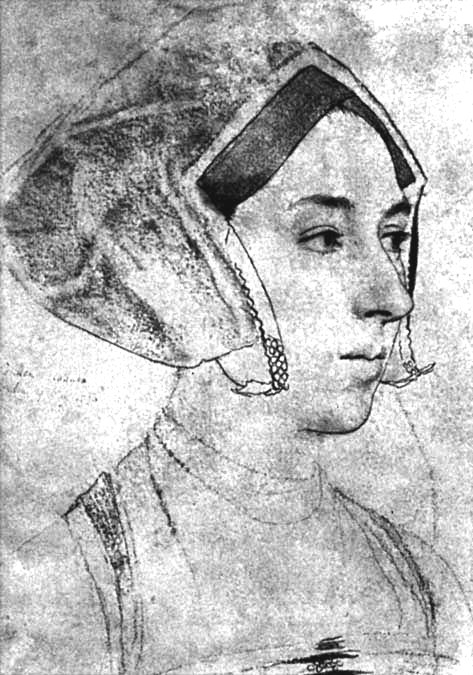
Anne Boleyn? Hans Holbein the Younger [Public domain], via Wikimedia Commons
(a response to Holbein’s sketch, purportedly of Anne Boleyn)
So, is this really you? Those full lips
well kissed, I have no doubt,
your pretty duckys hidden, fit for ravagers
we call kings. Holbein’s profile, it
simply shines your intelligence, courts
with language, love and ideas,
perhaps a little too much for kings
and enemies to take, at a time
when your sex are meant to be
little more than slaves and vessels
for petulant princes.
But no one can stop me grieving:
I imagine you blink, turn
and smile at me. Oh,
you are strong and keen, yet tender
and kind like all mothers
and lovers should be. No wonder
other men may have dreamed
on those lips, carried away
by your verve, which only victors
ever get to call treason. Now I wish
I could touch your fine chin
and whisper: “Elizabeth— remember Elizabeth!” My words
vanish into air like justice, while you
stare blankly through Traitor’s Gate;
but this little girl takes the better part
of you, better than any king before
or since, of this abject state


 Ciscography