Poem ‘Birmingham’

A38 Rubery by-Pass from Whettybridge Road brid...
(Photo credit: Wikipedia)

Birmingham

In the morning we cooked eggs,
wrapped the blanket around ourselves,
tucking in and staring like zombies
at a dead TV. There was little reason to speak,
to say that food seldom tasted so good.
Birmingham, that first time,
seemed like the bleakest place;
November had fallen cold and hard
and Rubery, the name you couldn’t say,
was depressed and downbeat,
so many shops boarded up
it was like a battle zone.
But there was enough to be grateful for
in that nest of warmth,
watching Saturday’s light rise
and bleach your bedsit walls

poem © copyright df barker 2012

Poem ‘Weapon Take’

Weapon Take

No rusty blade
ever turns up here,
no shadow of a ship
or bejewelled belt;

no iconic helm
to add credence
to our wounded identity.
Not even signs

of a mystery hillock
rising in hugging mists
to excite or intrigue
those metal detector men.

Merely one vast industrial
scar, scoured of feature,
almost of life, tamed,
or destroyed,

depending on your view,
turned inside out
by Angevin priors
and inscrutable Dutchmen.

I come from a long
line of diggers
and dark-eyed women,
grown out of this morass,

hardened to sweat
and pitiless Ural winds.
People who made-do,
though never in

any doubt they
were the subjected
men of their Hundred,
the brave new Wapentake,

where the councillors
still speak in a
double-Dutch behind
tall, timbered walls.

poem and image © copyright dfbarker 2012
*poem first published in collection ‘Anonymous Lines’, available at amazon.

** Wapentake was the Danish word for the English Hundred (a small, political unit, originally meaning a hundred homes). This word is still used in the ‘Danelaw’ counties of eastern England.

Poem ‘Think of Me’

Think of me

please pay your respects
to the dust trodden into carpets,
ingrained in chairs
and in curtains,
all along these tired window ledges

Then will you write my name
on the dusty shelves
where my books used to lie?
For in truth
they were more surely me

image and poem © copyright dfbarker 2012

Poem ‘Pomegranates’

Pomegranates

They smile when I shut the heavy, creaking door,
from behind their neat wooden kiosks
stuffed with pamphlets and insipid books.
Smiles of recognition, a nodding
acceptance as if to say –
‘Oh, it’s you!’ Volunteer women serving Christ
better than those above them in Church.

I walk along the emphatic southern aisle under
über-Norman arches, at the far end of which
hangs a limp flag of Saint Andrew,
in honour of Mary Queen of France, Scotland
and some say of England, too.
Glancing to my left a young man kneels,
wringing hands beneath a life-size figure

of a crucified Jesus, hanging high in space.
He stares upwards, rocking gently back and forth,
as if imploring Him to be real,
to writhe, sweat, bleed, perhaps to save Himself
and then, somehow, to save him as well.
I’m here to light a candle outside
Saint Oswald’s shrine and to sit for a time

in silence inside the tidy chapel,
to pray for a poor boy in pain,
perhaps to ponder on those relics,
those bits of bodies and other things,
worshipped once and then dispersed,
despised in fractured minds,
to us now mostly objects of indifference.

Oswald’s arm must lie hereabouts,
known to someone who still believes
in its restorative power, like the monks
who consumed this place, where Domesday
came and went without event,
where the Chronicle of a people faded to grey
in an undrying ink. Still it awaits the next line.

In this fossil the dead are lucky.
They are dead but in faith, whereas I roam
restlessly among echoes and whispers,
a heartless void. I cut across through the choir
to find I’m not alone, where the true
Queen of Hearts lies. Letters of gold spell
her name to all, but for me she smiles

brighter than anyone alive,
a smile from scorched Iberian lands,
her fate to end up on this drab island
where fashioned pomegranates mark her spot,
from which she expects to rise
at some glorious hour, where, until then,
the anonymous faithful lay fresh fruit

and flowers to mark her special days.
I watch a tourist, a German tricolour sewn
onto his rucksack, as he reads
the commemorative words. A sudden,
unexpected pride washes over me
while he pauses on her ground to think –
where I was once intrigued.

Almost believing.

image and poem © copyright dfbarker 2012
*poem first published in poetry collection ‘Anonymous Lines’, available at amazon.com
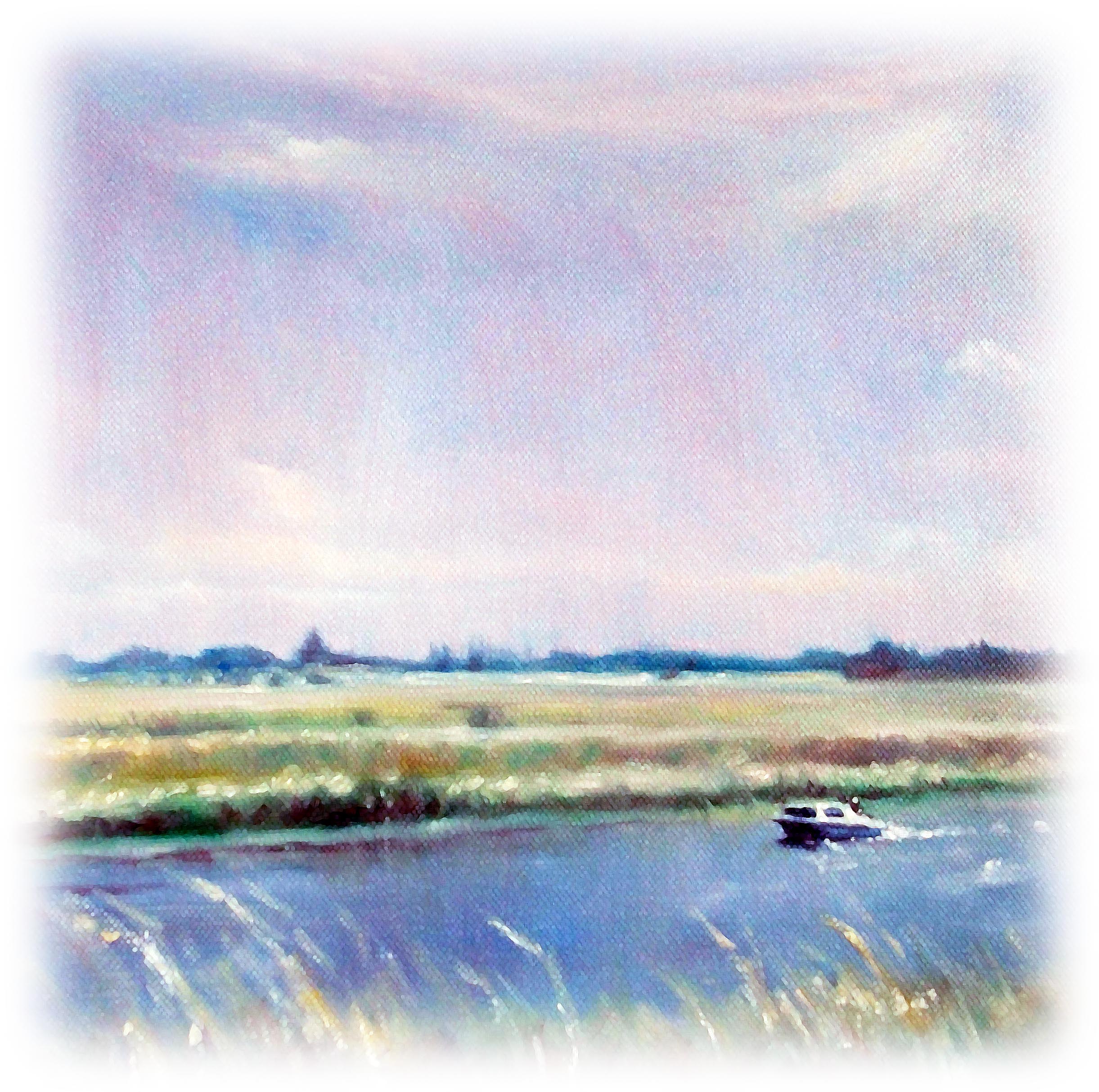
**image from part of an historical reconstruction I did in watercolour of Spalding Priory, as it might have appeared in the fifteenth century.

Poem ‘Mare Incognito’ (for J)

Mare Incognito (for J)

Somewhere between
Southwold and Saltfleet,
that’s all I’m prepared to say.

Where eastern seaboards
lose out each year,
glacial moraines fall away

with no answer to tides
that even kings couldn’t resist.
England crumbling in eye and mind.

Cliffs.
Now that could be a clue
but they’re not too high,

though high enough to sit on
and savour the grey seas,
the view, such as it is.

Does it matter?
Fine days won’t do, not to this mind.
Sea mists, fogs, or battleship skies

which leave enough to be imagined,
whose easterlies cut me into me
whatever I wear—they’re best—

when the only way to keep warm
is to keep moving, jogging
below the sleek aerobatics of herring-

and black-backed gulls,
super-marine harbingers of storm
doing their best to bring life to

Mitchell’s drawings of seaplanes—
and the spitfire.
Such an elegance in death.

But I’m here to forget about war,
about politics which can only
divide and kill.

Grey days mean I’m alone
in a moody make-believe.
I turn my back on all that was,

think about what might be,
where nightmares a few miles away,
that lost world within my right hand,

might just be gone when I return
or answer the bleep which says
I’m connected, branded for life.

Leave me now.
For a little while longer
let me say I’m free

image and poem © copyright df barker 2012