Its strange what you forget and then remember, years afterwards.
Place names, particularly English place names can be pretty strange sometimes, testimony to all the tribes who have invaded this fair isle over the millennia.
Take Lincoln, capital city of Lincolnshire in eastern England, for example. The name that has come down us is composed of two elements, one Celtic or Ancient British, the other Roman.
Lyn or Lindum means a settlement near a pool, in this case what we now call the Brayford Pool, where the university is situated. King’s Lynn in Norfolk probably refers to a pool also.
Then the last element, coln… what is that? It’s a condensed version of the Roman word Colonia, which were settlements dotted throughout the empire where retired soldiers would go to live – Lincoln being one them. So the full Roman or latin name would have been Lindum Colonia. In later times the name got shortened to its present form.
There are other examples too, of course, the most famous one being Koln in Germany, usually referred to as Cologne in English and French.
Very often a place name can tell you quite a lot about the origin of the settlement and can make travelling and map reading so fascinating.
I sometimes think we do suffer from being ‘in-betweenies’, that is neither northern or southern. Well, the simple answer to that is that we are East Midlanders, of course.
I certainly don’t mind being called a ‘yellowbelly’ and, in all honesty, my part of the county in the south is admittedly extremely flat.
That said, I am very fond of the north of Lincolnshire; the Wolds are gorgeous, reaching as high as 500 feet around Normanby le Wold, and the coast has some of the finest beaches you will ever see.
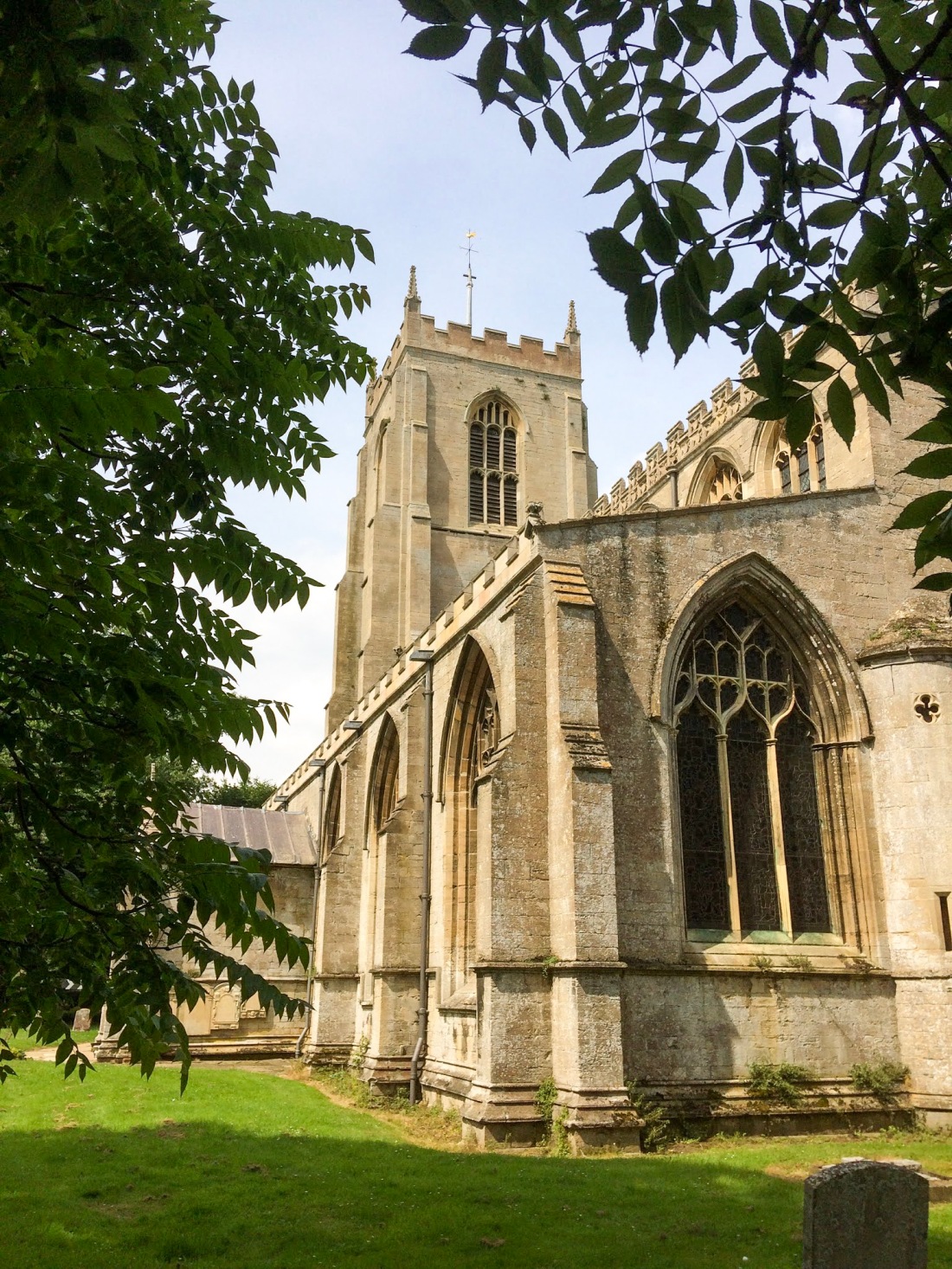
But perhaps one of the greatest glories of Lincolnshire as a whole, is the quality and diversity of our ecclesiastical heritage. The range of churches is stunning and the county town of Lincoln has, in my opinion, the best cathedral in the whole of England.
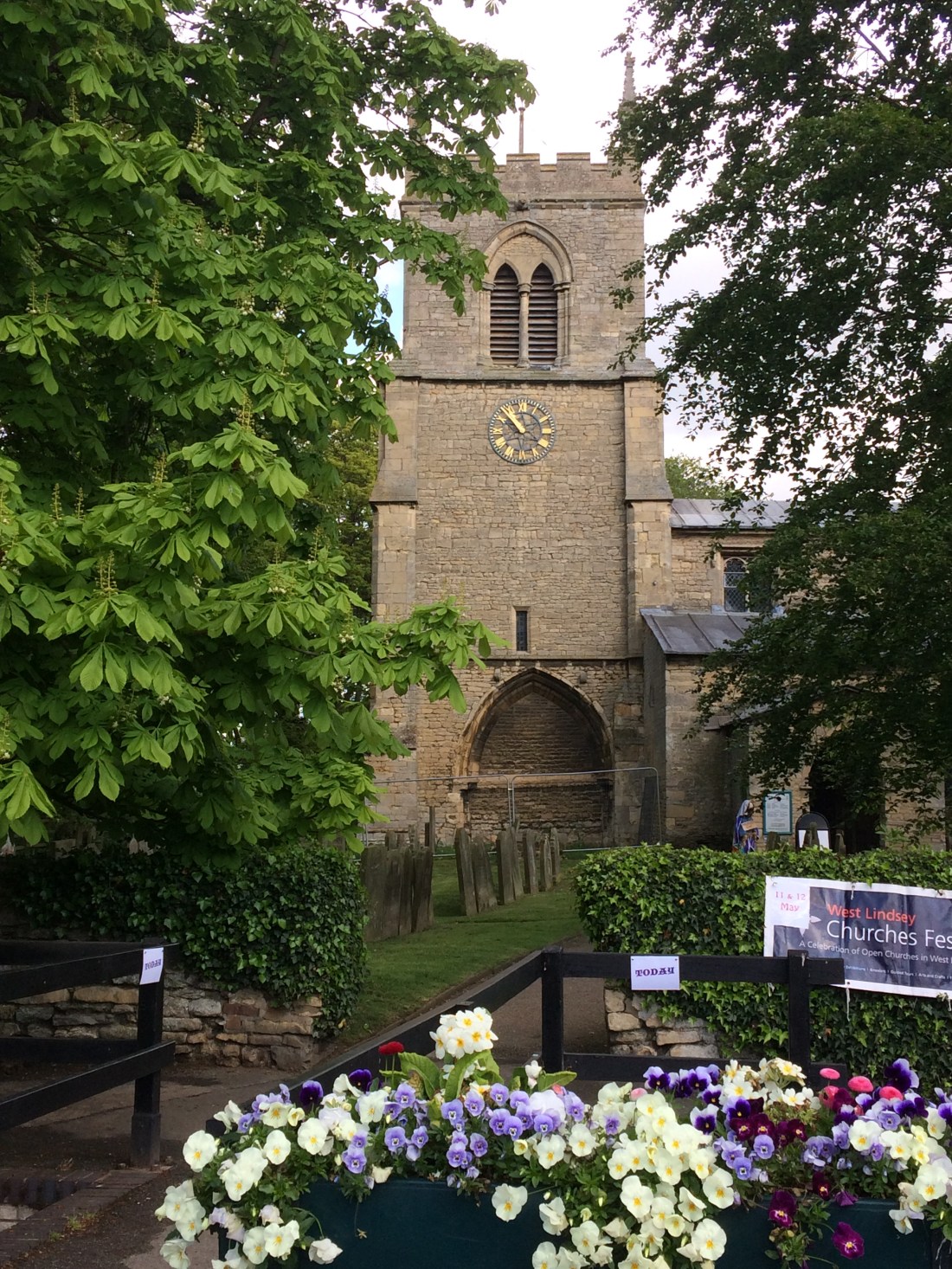
Every May in north Lincolnshire in the east of England there is the West Lindsey Churches Festival, ‘A Celebration of Open Churches in West Lindsey’.
The idea is to raise interest and money for the upkeep of these historic buildings, icons of English cultural and Christian heritage.
To be honest, I’m not sure if we’d ever heard of it. The link only came up last week from the web, so I thought it would be worth a visit. We were very glad we came.
All Saints Church, Nettleham.
Our first stop was at the pretty village of Nettleham, at the Church of All Saints just a few miles north east of the magnificent city of Lincoln.
Nettleham is a large, seemingly thriving village of around three and half thousand souls with lots of local stores and some pubs, a heartening sight if there ever was. Inside the church we were greeted very courteously by the volunteers manning their stalls of old books, games, crafts, or selling food and drink. They were all very helpful, keen to tell us about the church and the village.
The locals are friendly! We were greeted outside, even before we went in…
Sadly, in the 1960s there was a serious fire at All Saints, the result of arson. Since then the church has been restored very well, notable features being the new stained glass window at the east end and the roof.
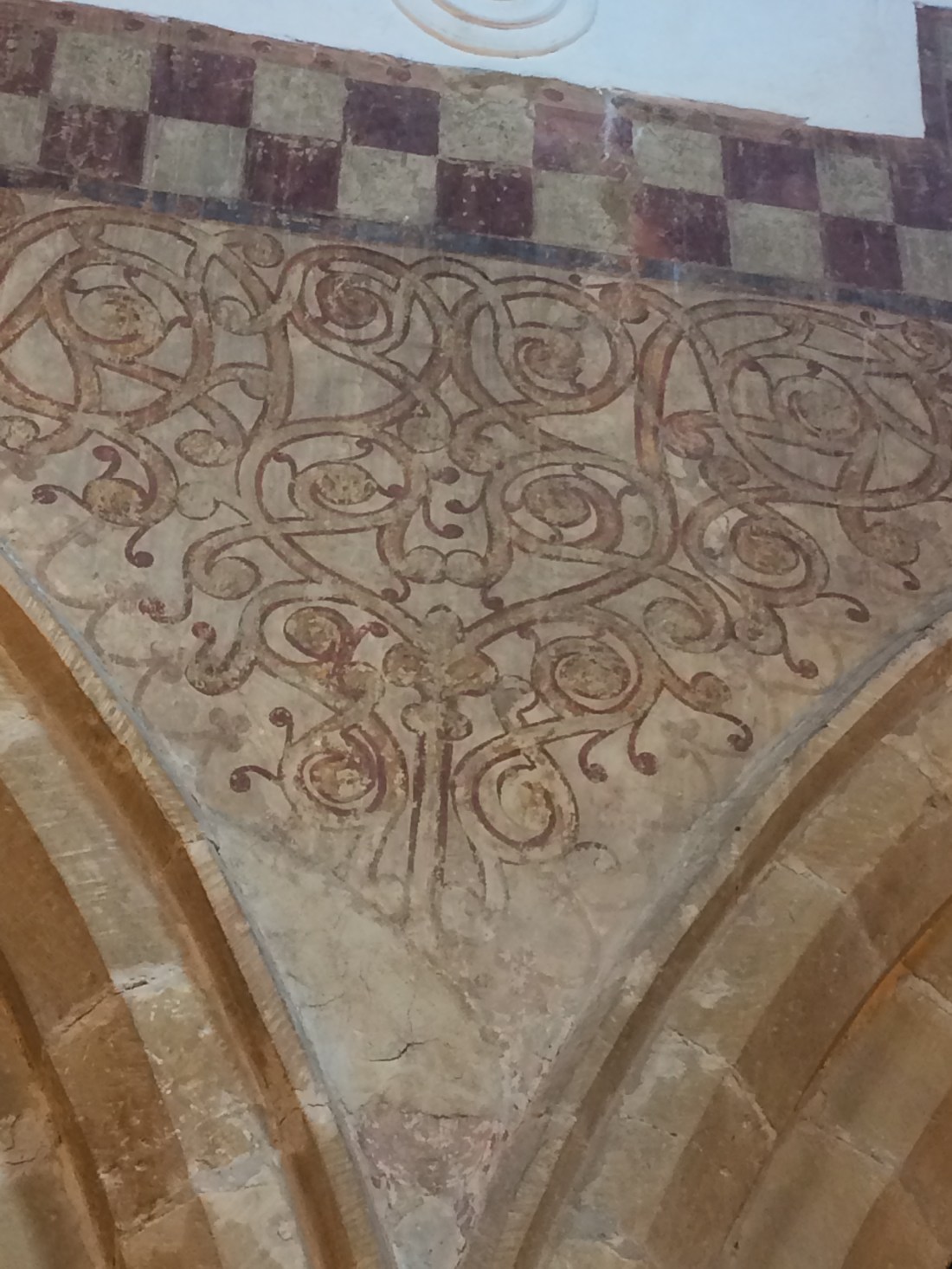
Medieval wall illustrations were revealed after the fire in the 1960s.
Modern stained glass from the late 1960s.
Of course, there are no benefits from fires, but one of the things revealed by the tragedy was a series of medieval wall pattern illustrations, of the type which used to bedeck all churches before the Reformation, after which nearly all were whitewashed over.
Carrot cake and apple cake, what is there not to like?
Naturally, one of the benefits of going to these events is sampling the local cakes. We got a piece of carrot cake and apple cake, washed down by the proverbial cup of tea. The prices too, are very reasonable. We even took away a whole lemon drizzle cake!
Yes, it’s all very English and a jolly good thing to. I can’t speak highly enough of everyone inside, they made us very welcome.
The village of Nettleham is also very pretty and worth exploring, with a running stream making lovely feature.
And a little history
Incidentally, Lindsey, in which Nettleham lies, is not merely a division or riding of historic Lincolnshire, along with Kesteven and Holland; Lindsey was once a kingdom in its own right, ruled from Lincoln around thirteen hundred years ago, before it was swallowed up by the much larger Mercia.
After that there was a manor house here, called the Bishop’s Manor House, as it eventually became a possession of the Bishops of Lincoln. Sadly this is now demolished.
But it’s not all about the past. There is very much to see and enjoy here today, not just at the Churches Festival – it’s well worth a visit at any time if you’re nearby.





 Ciscography