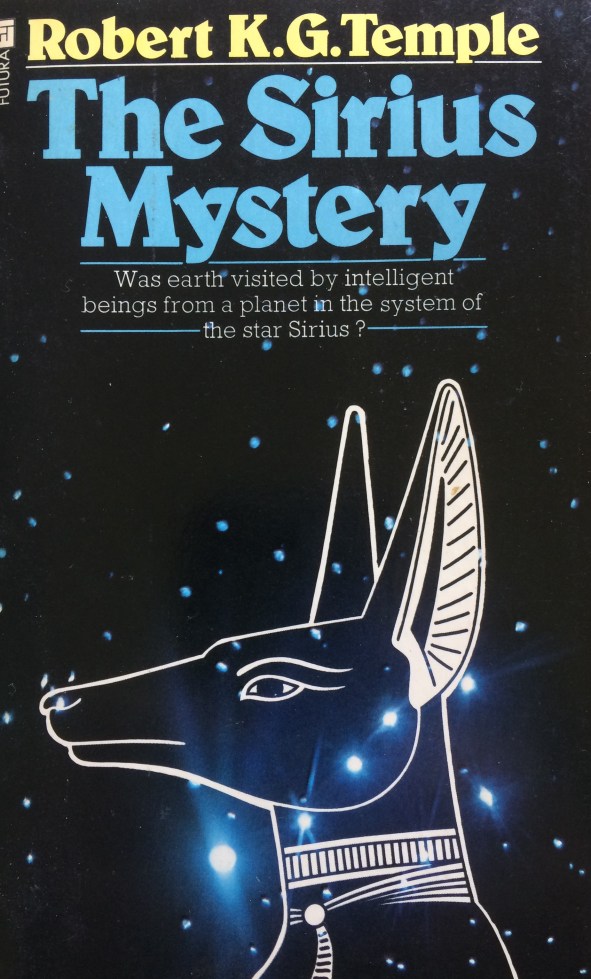
Book Review: ‘The Sirius Mystery’ by Robert K. G. Temple

IMG_1319

Was this planet really visited by space travellers from the star Sirius in the ancient past?

This is the question posed by author Robert K. G. Temple. His book, ‘The Sirius Mystery’ (Futura 1977) is another of my favourite books from yesteryear. I remember the day I bought it, in a train station, the arresting cover drawing me to it. I still thoroughly recommend it to anyone interested in the possibility of ‘ancient aliens’ and human culture in general.

It’s a complicated book that you have to persist with, though it’s well worth it, and this paperback has very small type, which these days would not add to the reading enjoyment. Nevertheless, although several decades old now, it’s still in very good condition. I’m kind of good with books that way.

Sophisticated

The starting point of the book is that it seems the Dogon tribe of Mali (former French Sudan) in west Africa, have sophisticated astronomical knowledge of the star Sirius, which is in fact a binary star, that is, two stars spinning around each other; it takes Sirius B (the dense smaller, actually invisible companion to Sirius A) around fifty years to orbit its larger, very bright sibling. Sirius itself is important to mythology in general, particularly in ancient Egypt, where its rising was used in the timing of the flooding of the Nile; it is often called ‘The Dog Star’.

The work of French early twentieth century anthropologists Griaule and Dieterlen forms the basis of the main evidence for the book. They spent much time with the Dogon, unravelling their art, culture and mythology which embody this knowledge. It’s from this that the startling information about the Dogon’s knowledge came.

Simples

But to boil it down here for simplicity’s sake, how is it possible for the Dogon, in fact any people on earth, to have what appears to be complex, accurate knowledge of far off star systems, without telescopes, or without going there themselves? After all, it was only in the twentieth century that knowledge of Sirius’ invisible companion star came about, using modern, sophisticated telescopic technology.

Ruling out co-incidence, or that the Dogon could somehow remotely see Sirius B orbiting Sirius A light years away, what possible conclusions can we come to, apart from someone else giving them that information?

Ancient spacecraft?

It transpires from the work of the anthropologists that the Dogon do describe what we might today call aerial craft, possibly spacecraft, their various states of ascent and descent as seen from the ground. There are even suggestions that the being(s) on board these possible aerial ships, was called ‘Nommo’ and that he might be semi-aquatic, due to tribal drawings.

Interestingly, this description and knowledge does appear to link up with ancient Mesopotamian/Middle Eastern mythology, which describes similar ‘craft’ and ‘beings’, who imparted their knowledge to ‘primitive’ mankind.

So, as the saying goes, there’s a lot of smoke here, but where’s the fire? The evidence, such as it is, is highly persuasive. But do we need to re-examine it? Are we in danger of being guilty of imposing our own (modern Western) notions and sensibilities on to different cultures?

Keeping an open mind

The truth is, I don’t know. Twenty years ago, I was pretty much a full on believer in extraterrestrials and this was one of the best ‘go to’ books for ‘proof’ of them and their hand in humanity’s development.

Now, having re-read the book again in recent years, it’s still one of the best in this category you can find. Even so, as fascinating and well written as it is, I keep an open mind about it all.

I suppose it’s asking a little too much to demand aliens to disclose themselves, but if they’ve always been here, with us, then there’s nothing to disclose, is there?

Leofwine Tanner 2019

It’s like Marmite? ‘The Ashes’ Yeast Extract Battle for Breakfast

IMG_1284
The two contenders going head to head – but how different are they?

Well, I love Marmite… but I prefer Vegemite just that teeny bit more! Sorry.

For years my only love was Marmite, in the yeast extract stakes, at any rate.

And then one day, not too long ago, I decided to get some – horror of horrors – Vegemite! Naturally I’d heard the name before, even heard it in some 1980s Australian rock song, but being a bit of a traditionalist and a stick-in-the-mud, I’d never taken the plunge into that particular version of yeast extract.

What’s more, to be fittingly topical, it’s The Ashes (England versus Australia at cricket) again this summer, that battle between leather and willow, weather permitting; a tense battle of minds, of whether to sledge, or not to sledge. So what about comparing dear old Blighty’s version with the Antipodean?

Well, to settle an argument with myself, I decided to compare the two makes side by side, in one sitting, if you will. And my findings were surprising.

I’m not an expert on taste, I just know what I like. Sticking to tradition to start with, I plumped for Marmite first. Fine, lovely, just how I like it. Then came the Vegemite and… wait a minute! You know, it wasn’t the same. Did I detect, I mean was there just a little trace of a taste of… chocolate? Dark chocolate at that. OK, it was somehow different, a bit.

Either way, I sat down with a cup of tea to wash it all down and collect my thoughts. And whether I could taste chocolate or not, I came away with the startling, unpatriotic conclusion that I preferred the Australian! Yes, Vegemite won by a nose, the tip of a tongue.

I just hope that England can do better this summer.

Fabulous Fairport Convention – Folk Rock at its Best

An Evening of Brilliant Music, Humour and Poignancy in Spalding.

On the Saturday evening of May 11, ‘folk rock’ band Fairport Convention once more graced the stage at Spalding’s Civic Centre.

Although the auditorium was not quite full, there was a good, convivial atmosphere, helped by the band members’ laid back approach, great sense of humour and also by the timeless quality of the music aided by a back catalogue of over fifty years, even though the subject matter of these songs is often anything but genteel.

Take the song ‘Matty Groves’, described by founder member Simon Nicol as having two chords and nineteen verses. The song itself is a traditional, lascivious and violent tale, originally adapted for Fairport’s landmark album, ‘Liege and Lief’ in 1969, and is delivered with a rocky, cutting edge, one of the best examples of ‘folk rock’ in my opinion.

Cutting Edge Rhythm Section

Throughout the performance, that cutting edge was amply provided by the deft skills of the highly experienced rhythm section, namely Gerry Conway on percussion and Dave Pegg, the latter’s dexterous familiarity with all of the neck of his bass guitar being a wonder to behold, as was the light hearted attitude he exuded. I have seldom seen a more lyrical example of great bass playing.

Not to be outdone, however, Gerry gave a stunning, virtuoso percussive performance which combined his conventional, rather minimal electronic set with what I understand to be a traditional Peruvian drum called a Cajon (Spanish for box) on which he actually sat all night. Simply remarkable.

And the evening was not all about the band’s older back catalogue either. For example, there were lovely performances of songs written more recently by multi-instrumentalist Chris Leslie, whose easy transition from fiddle to mandolin to guitar to tin whistle… was amazing.

Conversely, yet equally impressive, was the fiddle-dedicated Ric Sanders, whose unconventional, at times jazz influenced, reverb infused playing style, perfectly complemented the rest of the band.

What is more, there were the fantastic vocal harmonies too, adding to the overall richness and quality of the sound.

Leader of the Band

However, the undoubted leader of the band is founder member Simon Nicol, whose precise, often understated guitar playing could not be overlooked, especially by amateur guitarists like myself who appreciate exactly how well he does it.

Furthermore it was Simon who provided the most poignant parts of the evening. The band’s rendition of Sandy Denny’s ‘Fotheringay’ was a particular highlight, sung with deep feeling by Simon, the story of Mary Queen of Scots final hours in 1587.

IMG_1280
‘The Hiring’. Statue recently erected in Hall Place, Spalding

Equally moving and with some local interest too, was Ralph McTell’s beautiful song ‘The Hiring Fair’. Simon had clearly seen the statue ‘The Hiring’ recently erected in Hall Place in the town centre, giving a precis of how hiring fairs used to work throughout the country.

And so to the encore, which had to be the anthemic ‘Meet on the Ledge’, one of the band’s best known songs. It’s exactly fifty years since the tragic road accident which took the life of drummer Martin Lamble and Jeannie Franklyn, who was Richard Thompson’s girlfriend.

In the aftermath of the tragedy the band nearly split up. Thankfully for us and to continually honour those who died, they decided to carry on, though it was clear that the anniversary of the event was leaving its mark on what was a very enjoyable evening.

Finally, there is the Cropredy Convention which takes part every year in August over three days. If you missed them this year on their spring tour, why not try to catch them at Cropredy? There are many other bands and musicians to see and a good time will be had by all, that’s for sure.

Leo’s Book Review: ‘From the Holy Mountain’

IMG_1248

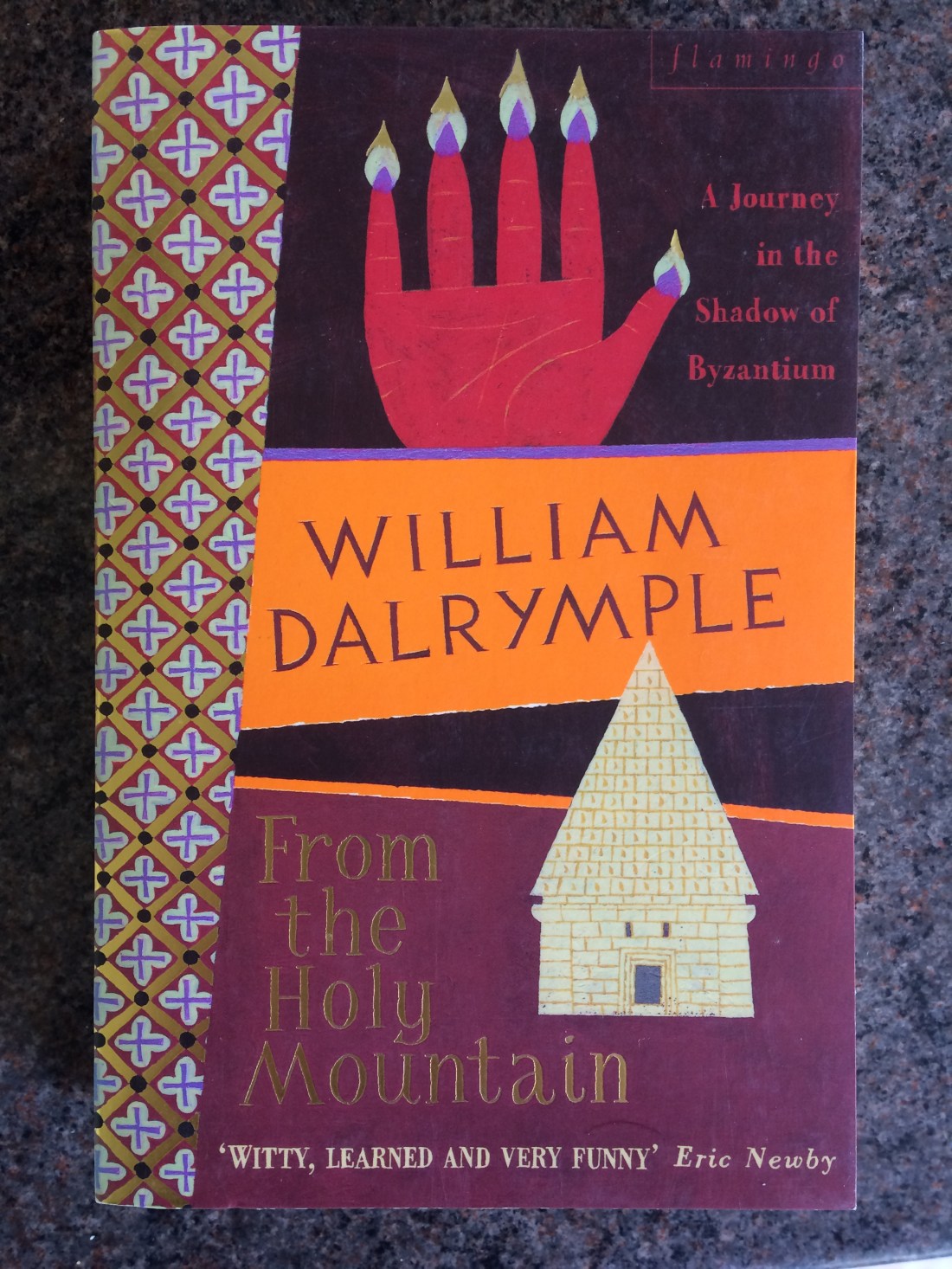
‘A Journey in the Shadow of Byzantium’. By William Dalrymple.

I can’t tell how inspirational I found this book when I first read it.

At the time, around 1997, I was virtually reading nothing new beyond a few books on astrology or Buddhism, two subjects I was heavily into at the time.

Then one chance visit to a bookshop and this title seemed to shout out from the shelves, saying ‘Read Me!’ The cover and illustrations are simply stunning, produced by Dalrymple’s wife, Olivia Fraser. They fit hand in glove with the content in a way which leads you in with all the colourful and sensual allure of a Bazaar… but that would perhaps be an ironic observation, in that this book is a travelogue revealing the long slow demise of Orthodox Christianity in the Middle East.

Essentially the book is based on the journey of a Byzantine monk and historian, John Moschos, in 578 AD along the Silk Route which the author retraces, only to find that much of that culturally rich and colourful Christian soaked world has now gone and in further more rapid decline.

Humour and Grief

There are strong elements of humour, similar to Dalrymple’s earlier work ‘In Xandadu’ (which still leaves me in stitches when I re-read it), but ‘Holy Mountain’ is a much more serious, haunting book, leaving you practically grieving for the lost world of Byzantium, the continuation of the Roman Empire in the East.

From the first sentence, where the author describes in plain yet evocative prose the cell in which he is staying at the start of his journey from Mount Athos in Greece, you are led into another world, not only the rather fraught one of today within the author’s mind, but also this lost, remoter world, which somehow seems much more wholesome and meaningful than our own despite all the technology which allows me to write this.

Similarly his all-round historical knowledge of Byzantine and Islamic culture, plus his understanding of architectural detail are stunning, yet written succinctly in such a way as to not put you off with complication. It is a great gift.

Vestiges

In places he finds these vestiges of Orthodox Christianity, monasteries and churches barely holding on, plus apocalyptically minded priests, and his description of the characters he meets fills you with both hope and resignation too, a feeling that his generation might be the last to witness such places and people.

By the end, the author seems like a forlorn character, reminding me of Paul Morel in DH Lawrence’s ‘Sons and Lovers’, as he walks away after his mother had died. The sense of loss and hopelessness are overbearing at times.

In doing this review I have realised I must re-read this wonderful book once again. It was first published in the mid 1990s; I wonder how much of the world he describes is still there 22 years on?

So I can’t recommend this book enough, it brought back my love of reading.

Keeping My Faith

IMG_1232.JPG
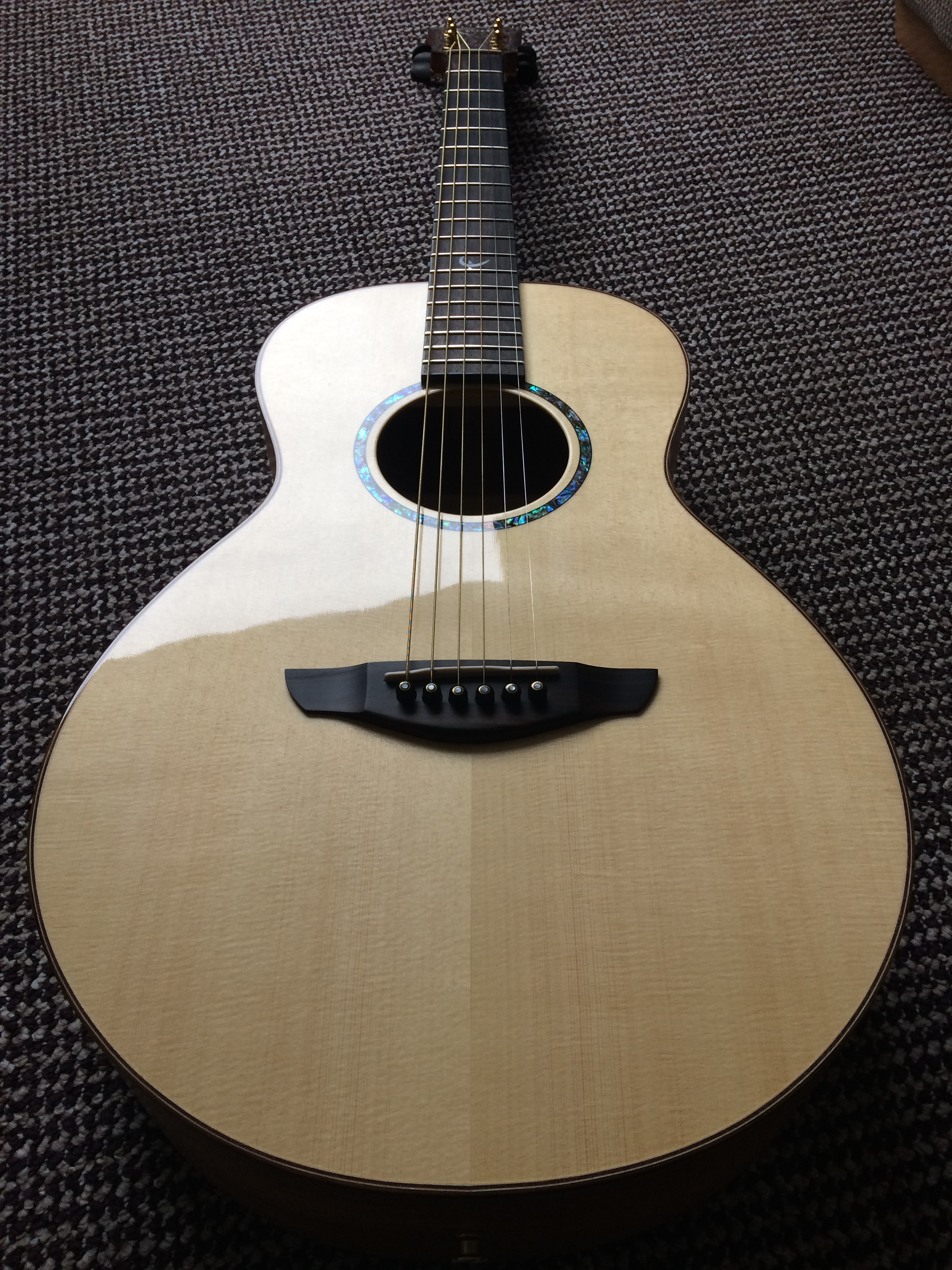
My Faith Mercury – in all its parlour beauty. Note the lovely rosewood binding.

I’ve had my Faith Mercury parlour guitar for nearly four years now. I remember that it wasn’t a very easy purchase.

So OK, let me explain. I love electric guitars too; I’d had my American Stratocaster for number of years but it simply wasn’t getting played. It wasn’t that I didn’t like it, far from it. I don’t gig so it’s far easier sitting around with an acoustic. I just wanted something smaller, lighter, easier in my lap – a ‘sofa guitar’ you might say.

Look, I’d got other acoustics (I’ll come back to them another time) but not a genuine 12 fret join-at-the-neck acoustic. They are usually called parlour guitars due to the fact that they were originally made in more genteel times for ladies to strum in their parlours. How quaint, I thought. I’ve seen plenty of women who can handle much bigger guitars than this, but again that’s another story.

You actually traded in the Strat?

So, once I’d come to terms with the knowledge that parlour guitars weren’t necessarily the exclusive property of women, I had to make a decision. Yes, I was going to trade in the Strat! What? It was hard to let it go: Heck, even the smell of it was great.

Yet, when I first took hold of that light Faith Mercury parlour it was the perfect fit for noodling, fingerstyle playing which is basically where I’m at these days. You might call it the quintessential songwriters’ guitar and I’ve been known to write a few.

IMG_1235
Nice touch.

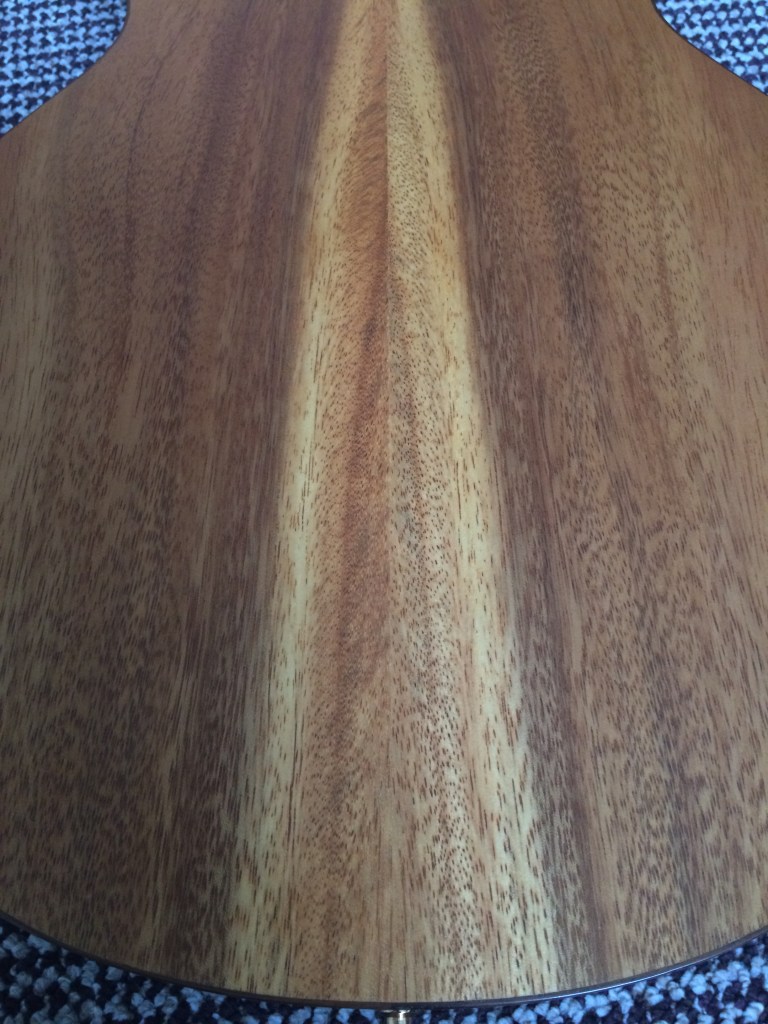
The Faith Mercury is a perfect wee beastie: The simple Faith logo on the headstock, solid woods all round with a spruce top, trembesi back and sides and some beautiful rosewood binding to boot, which I really love. Mine has the glossy top, with matt finish back and sides. The solid trembesi, I am told, sits tonally somewhere between rosewood and mahogany. Sounds great.

Not boxy out of the box

However, perhaps the most surprising thing, considering it’s a parlour guitar, is that it’s not that boxy sounding; in fact there’s a fair amount of bass and thus a fuller, richer sound than I was expecting. It was in tune ‘right out of the box’ as the saying goes, and it’s so easy to play, the action just right for me. And by the way, it wasn’t actually a box but rather a very nice case emblazoned with the Faith logo.

My only ‘quibble’ is the fact that it doesn’t smell like a Martin (Martin owners will know what I mean) – but you can’t have everything, I suppose. Faith make some fantastic, great value guitars and I wouldn’t hesitate buying another. The only problem is making a choice. I’ve always fancied another Faith Mercury with the scoop and pick up. Equally I’d like a Venus, but which one?

IMG_1237
The grain of the solid trembesi wood is particularly impressive.

Bog oak – is that a thing?

Then there’s the one made with that ancient bog oak, was it? Actually I think they’ve made several by now. One day I will make my mind up. I just hope I don’t have to trade in another to get one.

But get this. About a month ago my wife said, “can you teach me to play guitar?” After getting up off the floor and saying “yes, of course, Darling,” I wondered which of my several acoustics she would prefer to learn on. Absolute no brainer, the Faith Mercury won hands down. “It’s just the right shape for me,” she said, having struggled just a little with the others. Now she’s already trying to pick out the ‘Game of Thrones’ theme tune and I can’t get a look in!

IMG_1238
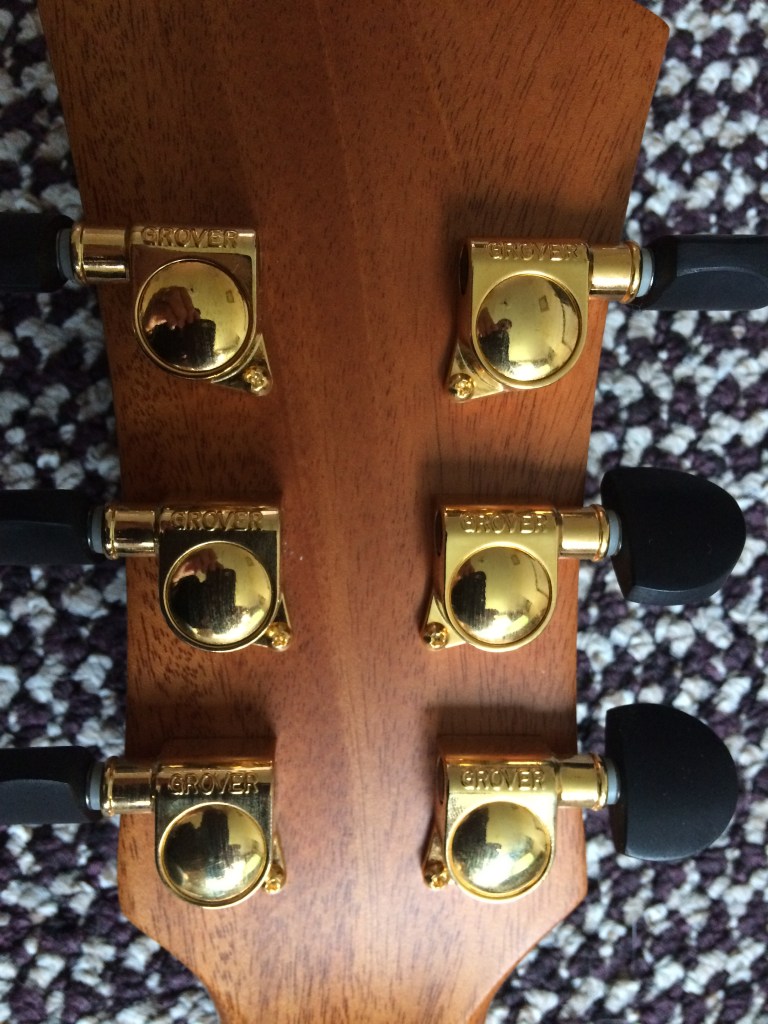
Oh, did I say Grovers too?

It looks like parlour guitars are indeed very suitable for women and most especially the Faith Mercury. I’ll just have to remind her that it’s actually my guitar!

Leo Tanner 2019

http://www.faithguitars.com