Mary Cassatt seated in a chair with an umbrella. Verso reads “The only photograph for which she ever posed. Courtesy of Durand-Ruel.” By Durand-Ruel – The Frick Collection/Frick Art Reference Library Archives., Public Domain, Wikimedia Commons.
Although born near Pittsburgh, USA in 1844, Mary Cassatt spent most of her life in France.
For someone who came to epitomise the ‘new woman’ of the time, who never married, and developed a career of their own, it is perhaps no surprise that we find Aquarius rising in her chart.
Aquarius is independent, freedom loving and likes to break new ground, yet can remain quite conservative at heart. This is shown in many aspects of her life. One of her primary subjects was women and their relationship to children, a traditional, genre.
The new feminine
Interestingly as well, we find Neptune in Aquarius in the first house. Neptune I equate with femininity and in Aquarius this is coloured by looking at it in new, independent spirit.
She clearly identified with this. Neptune’s quite tight trine aspect with Mars in Gemini in 5th house, adds much creative flair to her artistic expression. It was fellow impressionist, Degas, who introduced her to pastel and engraving, both genres she went onto master, testifying to her latent abilities.
Mother and Child Before a Pool By Mary Cassatt – Online Collection of Brooklyn Museum; Photo: Brooklyn Museum, 46.106_transpc002.jpg, Public Domain, Wikimedia Commons.
Professional opposition
We also find Saturn quite close to her ascendant in opposition to the Moon in Leo in the 7th house. Saturn here indicates caution and her strong moral fibre, but the opposition to the Moon reveals troubles and frustrations in her life, particularly within herself, in relationships and professional life. The Moon in Leo in itself is naturally creative and artistic.
Both the Moon and Saturn are in good aspect to Uranus in Aries in the 2nd house, further supporting her kind of organic, sensible way of breaking new ground by truly living the part of the ‘new woman’.
Creative releases
Also, Saturn’s trine to Mercury in the 5th house, shows an easy creative release for her through something which is manually dexterous, like painting. Mercury also in good aspect the Moon in Leo supports this release function through some kind of creativity.
Finally, I come to Venus, essentially unaspected in Cancer in the 6th house of work. I found this a little surprising at first, though a prominent Venus isn’t a necessarily a prerequisite for artistic ability.
Enjoying work
Venus in Cancer is tender, likes the home and family and is another symbolic representation of what she painted a lot of, women and children. In the 6th house, this is a classic indication of working artistically, or simply loving work.
Also, an unaspected planet can often ‘shout’ to be heard, so to speak. It may well have spoken to her creatively, but is this Venus also symbolic of the fact that she never married, that she was tied to her work?
So in all, Mary Cassatt may have been something of an enigma. She lived the life of a ‘new woman’, widened the boundaries of art through her involvement in the impressionist movement, yet inwardly, she retained strong moral values and a liking for tradition.
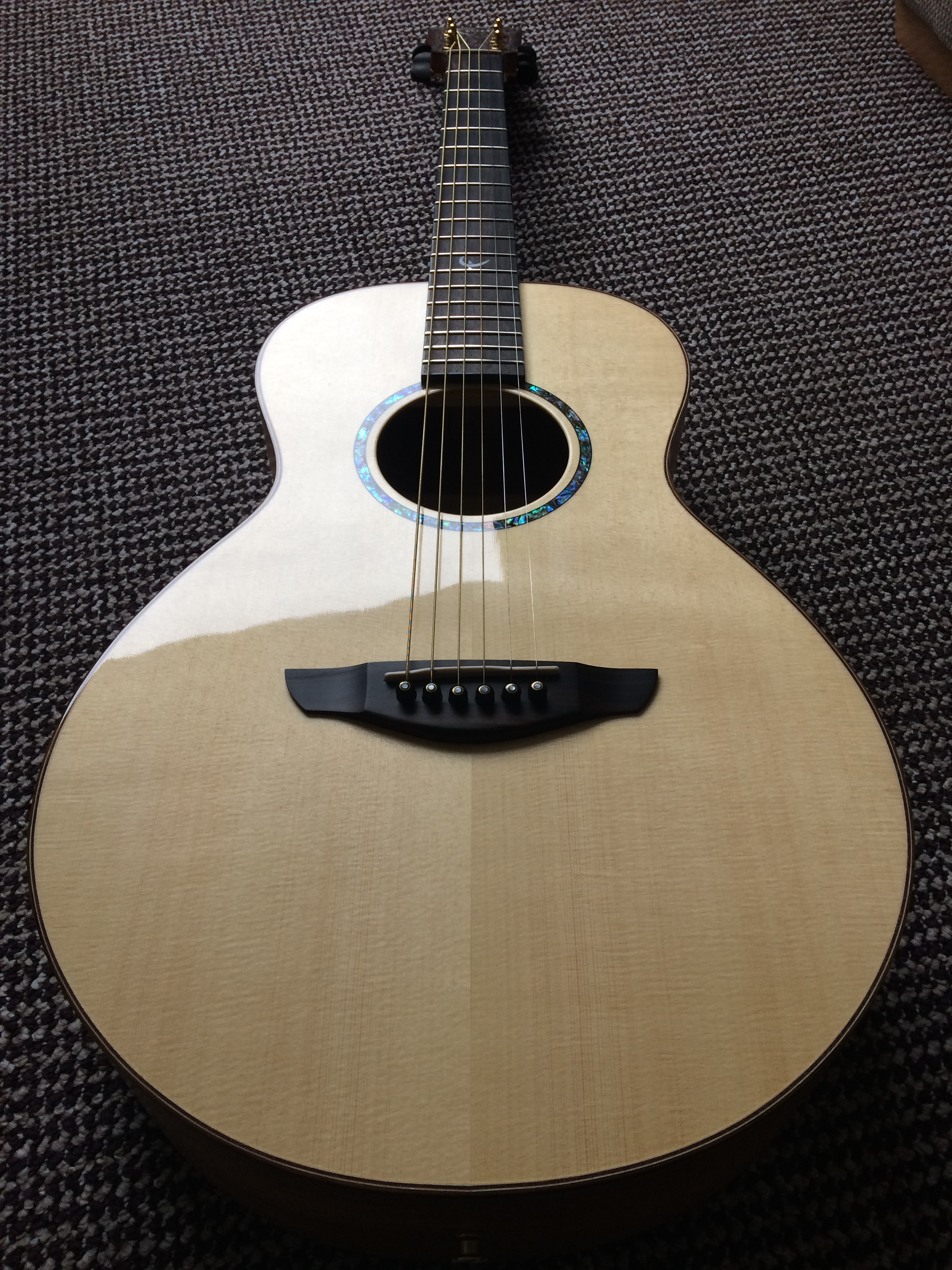
My Faith Mercury – in all its parlour beauty. Note the lovely rosewood binding.
I’ve had my Faith Mercury parlour guitar for nearly four years now. I remember that it wasn’t a very easy purchase.
So OK, let me explain. I love electric guitars too; I’d had my American Stratocaster for number of years but it simply wasn’t getting played. It wasn’t that I didn’t like it, far from it. I don’t gig so it’s far easier sitting around with an acoustic. I just wanted something smaller, lighter, easier in my lap – a ‘sofa guitar’ you might say.
Look, I’d got other acoustics (I’ll come back to them another time) but not a genuine 12 fret join-at-the-neck acoustic. They are usually called parlour guitars due to the fact that they were originally made in more genteel times for ladies to strum in their parlours. How quaint, I thought. I’ve seen plenty of women who can handle much bigger guitars than this, but again that’s another story.
You actually traded in the Strat?
So, once I’d come to terms with the knowledge that parlour guitars weren’t necessarily the exclusive property of women, I had to make a decision. Yes, I was going to trade in the Strat! What? It was hard to let it go: Heck, even the smell of it was great.
Yet, when I first took hold of that light Faith Mercury parlour it was the perfect fit for noodling, fingerstyle playing which is basically where I’m at these days. You might call it the quintessential songwriters’ guitar and I’ve been known to write a few.
Nice touch.
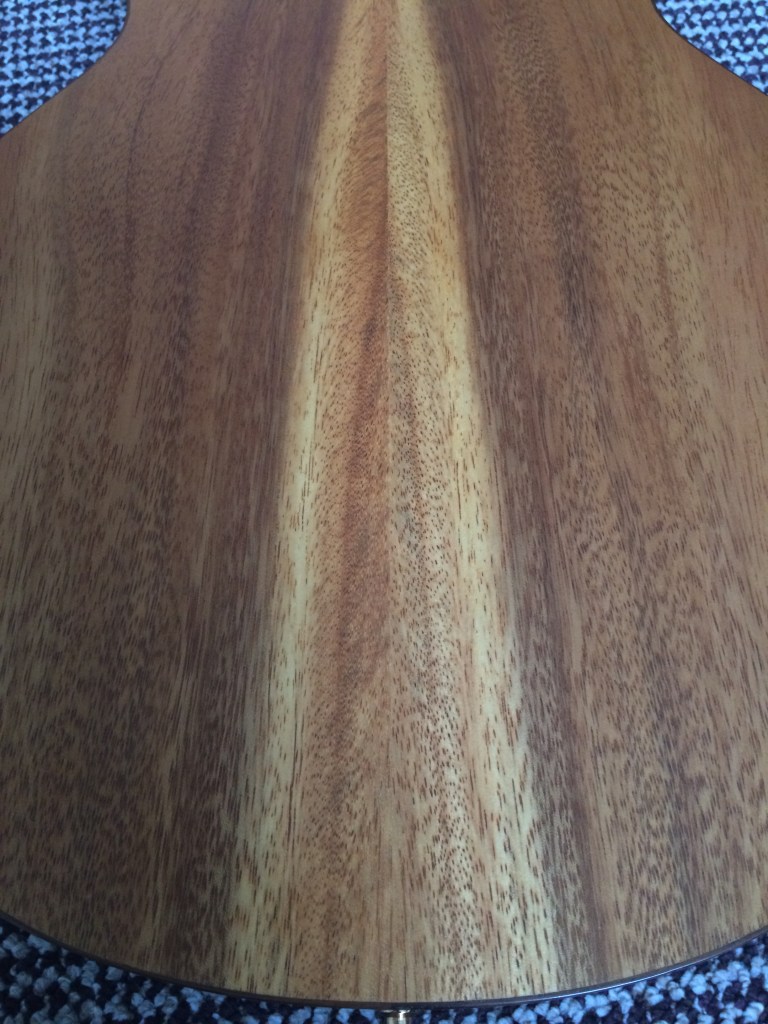
The Faith Mercury is a perfect wee beastie: The simple Faith logo on the headstock, solid woods all round with a spruce top, trembesi back and sides and some beautiful rosewood binding to boot, which I really love. Mine has the glossy top, with matt finish back and sides. The solid trembesi, I am told, sits tonally somewhere between rosewood and mahogany. Sounds great.
Not boxy out of the box
However, perhaps the most surprising thing, considering it’s a parlour guitar, is that it’s not that boxy sounding; in fact there’s a fair amount of bass and thus a fuller, richer sound than I was expecting. It was in tune ‘right out of the box’ as the saying goes, and it’s so easy to play, the action just right for me. And by the way, it wasn’t actually a box but rather a very nice case emblazoned with the Faith logo.
My only ‘quibble’ is the fact that it doesn’t smell like a Martin (Martin owners will know what I mean) – but you can’t have everything, I suppose. Faith make some fantastic, great value guitars and I wouldn’t hesitate buying another. The only problem is making a choice. I’ve always fancied another Faith Mercury with the scoop and pick up. Equally I’d like a Venus, but which one?
The grain of the solid trembesi wood is particularly impressive.
Bog oak – is that a thing?
Then there’s the one made with that ancient bog oak, was it? Actually I think they’ve made several by now. One day I will make my mind up. I just hope I don’t have to trade in another to get one.
But get this. About a month ago my wife said, “can you teach me to play guitar?” After getting up off the floor and saying “yes, of course, Darling,” I wondered which of my several acoustics she would prefer to learn on. Absolute no brainer, the Faith Mercury won hands down. “It’s just the right shape for me,” she said, having struggled just a little with the others. Now she’s already trying to pick out the ‘Game of Thrones’ theme tune and I can’t get a look in!
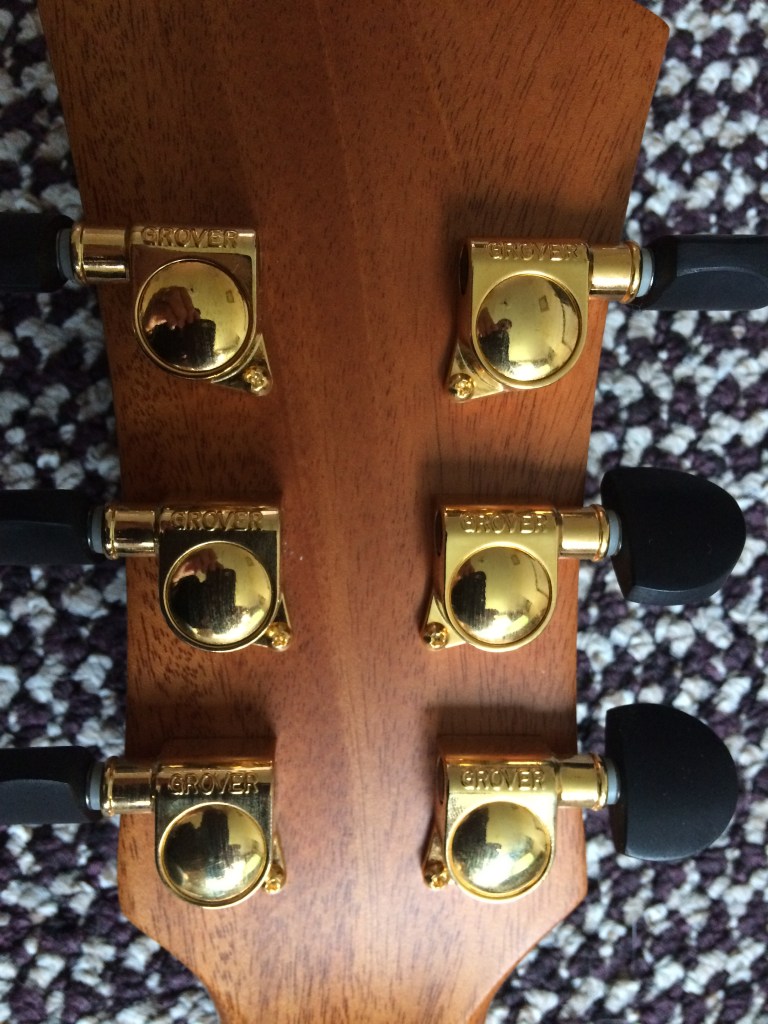
Oh, did I say Grovers too?
It looks like parlour guitars are indeed very suitable for women and most especially the Faith Mercury. I’ll just have to remind her that it’s actually my guitar!
‘Manifesto’ is due out on amazon and kindle imminently!
Synopsis
Taking a break from crime fiction, Milly Reynolds’ new ebook is an imaginative and quirky take on the state of current affairs as well as the meandering course of history.
Eleanor Cross, a disaffected Tory MP, takes us with her as she rides on the waves of destiny towards the formation of a new political party which will challenge old ideas.
Written as a very loose prose poem, this book sets down the policies that some might put in place if given the chance to take over the country.
Review
Aiming where novella meets prose poem, Milly Reynolds has really pulled out the stops with this unusual new ebook. Both mysterious and funny, contemporary yet timeless, Milly’s head strong heroine, a disaffected MP, is challenged to ride the transformative waves of destiny towards a new future for herself and her country. An imaginative and quirky take on the state of current affairs and the long course of history.
English: A map of the British Empire in 1921 when it was at its height with British Raj indicated when it too was at its height as well. (Photo credit: Wikipedia)
Heat
When stepping off the ship, heat
hit him,
something heavy and palpable, his duty drawn
out into an exile
stuffing the bank accounts
of far-off millionaires, stuffing
him and the natives from Melbourne
to Manitoba.
Such a relief to be on the train,
officers hankering in rigid
silence for the cool heights of Shimla,
Home Counties in miniature once bleeding
the big world dry, where spinsters
of Little England began to
watch their gingham fade
He favoured his mother’s
side, whose pale skin and eyes were
more fondly remembered
than appreciated, now more than
a world away,
spattered freckles on his face
where the sweat ran
free in that searing carriage;
sights of displaced women
wrapping up in their shawls, children
standing and sitting, staring
and sleeping, heading on to homes they’d
never seen (or ever see), leaving him
to watch the scorched earth slide
by like some weary sentence,
his mind hanging on
to the boney cattle half
hidden in mud, in the channels
of sometime rivers
gaping for monsoon
*The characters portrayed in this story are not based upon anyone living or dead, they are wholly imaginary.
**WARNING! SOME READERS MAY FIND SOME OF THE GRAPHIC IMAGERY CONTAINED HERE UNSETTLING.
The twentieth century was only a few months old but Captain Robert Charlesworth had already seen enough of it. Like most of those aboard ship, he was glad to see green Blighty once more.
The hill of Spion Kop had deprived him of several friends, a cousin and the forefinger and second finger of his right hand. His days firing the much vaunted Lee Enfield Rifle were truly over. Perhaps he could learn to shoot left-handed. He had also suffered a much more substantial, though less obvious wound in the same incident, leaving a rather nasty hole where his right nipple used to be. He had known, barring infection in the extreme heat, that he would come through it. Nevertheless, every time he looked at the short stub of his forefinger and the wholly vacant second, he cursed the way his hand had got in the way of that piece of shrapnel, even though more than one doctor had stated that those two fingers may have saved his life.
Only minutes before, his friend Lieutenant Hawtrey, had bought it right next to him, pieces of his friend’s head spattering him and his comrades as they fell to the ground on the pitted slope. Try as he might, he could not get rid of that image in his mind, lying on the scorched, bone-dry earth, Hawtrey, his head with a grievous wound, a head that he had heard shouting behind him only seconds earlier. He had heard of such things, assuming such tales had gathered goriness in the repeated telling. But nothing in his training or experience had prepared him for such utter confusion, such heat, such unimaginable horror.
And like most of the men, he’d had nightmares ever since.
“Paddy! Watch out!!” A foot to the left or to the right and he and Lieutenant Hawtrey might still be sharing a joke together. A foot to the left or to the right – and the shrapnel might well have taken him out instead of Hawtrey. As it stood, it was fortunate that more of them hadn’t been ripped to shreds along with Hawtrey in that same instant. Shrapnel had a way of doing that.
Whatever might have been, the resulting nightmare was the same every time, his friend staggering about without a head, arms out for balance, belligerent Boer bullets tearing into his chest, but failing to bring him down. Each time he awoke, disturbed and sweating, it was as if Hawtrey was unable to rest, just like all those who had been there. His diary entry for January 24 1900, written several days later with an awkward scrawl of his left hand, repeated the same sentence, over and over: “Lieutenant Patrick James Hawtrey, Lancashire Fusiliers, age 22. MAY YOU REST IN PEACE. May I find peace, too.”
There was to be no peace for Captain Robert Charlesworth, at least not that spring. A telegram awaited him ashore: “Wife gravely ill. Fever. Come urgently…”
*
The whistles had gone. Doors slammed shut. He felt the carriage shudder gently forward, almost mournfully slow. Liverpool Street Station passed before him; the madness that was London. They called in ‘The Smoke’, and with good reason. He felt strangely removed from those men in the engine way ahead, fitfully working in the noise, the steam and the sweat.
He pulled out his wife’s last letter from his pocket as the carriage emerged into the sunlight. She had always known that he would return home safely, despite the injuries he had described to her. He had apologised to her for not writing in his own hand. Captain Inglis had kindly acted as secretary. She had said previously that at least the ring finger of his left hand was still intact, the finger onto which she had pushed his wedding band two years ago. The Boers could not destroy that. She believed in destiny, she knew they would be married on the first day they met. The vicarage tea party, the beautiful garden, that wonderful summer’s day in the Queen’s Diamond Jubilee year.
In those days the English, or their ruling elite, were at their apogee. The Queen would seemingly reign forever, the empire would expand to cover the entire globe, removing the need for any other colour than pink in school atlases. A Pax Anglicana – that could never be. How much longer could the queen live? Now, the whole world seemed to have changed. Germany and America, growing in industrial and military strength for several decades, were beginning to snap at the bulldog’s heels.
The England he had left behind at the end of the last century was no more; the government had fallen, the battle for the hill of Spion Kop in the searing South African summer, during the first month of the new century had seen to that, a hill that would have been insignificant, irrelevant among the Pennine hills from where sprung his wife’s family, the Reveleys. Mary was made of strong stuff. The Reveley’s were Yorkshire grit! Their line reached back to beyond the Conquest, hardened by the northern climate. She might live in East Anglia now but you couldn’t wipe out the strength of generations. She would pull through.
But maybe this was wishful thinking. In reality, Mary had not inherited the strong Reveley strain at all. She had always been weak, hyper-sensitive, hopelessly romantic. It seemed the same physical susceptibilities which led her to catching every illness going, also cajoled her to join every good liberal cause.
Her mother had introduced her into the temperance movement. Mary was often out and about with her ladies helping the local working class, particularly trying to help them to stop drinking. Most especially, she was keen to stop young men from starting to rely on the demon drink. She believed in prevention rather than cure.
Mary was also an active member of the Liberal Party, much to the annoyance of Robert’s father who was a fervent Tory.
“The girl’s weak in the mind as well as the body,” he once told Robert while he was writing a sermon in his study. “I simply find it disturbing that she and her mother spend so much time helping the undeserving. What is more, she also advocates the policies of the Liberal Party, which are, in my opinion, threatening the very fabric of this country, those strong, steadfast values which have forged the empire.”
Robert knew better than to argue with his father. He said nothing, staring coldly out of the window of the study which overlooked the garden. The words did not injure him inside anymore. He often wondered what benefit a lifetime of faith had given his father’s cold heart.
Outside of the carriage it was starting to rain. Occasional wafts of smoke flew by and beyond, the rolling landscape was showing signs of turning green.
Robert realised from the beginning that he had been attracted to Mary purely because she was so different to anyone else he had known. He was spellbound by her flaxen-haired fragility, those deep blue eyes and full lips, so unlike the thin-lipped primness of his own mother. Mary, he assumed, had been drawn to his sheer physical presence, the dark moustache, his fierce, yet kindly hazel eyes and that emphatic red lieutenant’s tunic which he wore on that first meeting, in the bright sunlight not so long ago. Everyone said they looked good together – everyone, that is, except his mother and father.
“Robert, my dear, she is too weak to bear children, of that I am quite sure,” his mother told him quietly the day their engagement was announced.
“Forgive me, mother,” he said, trying to channel his anger, “but if there is any reason why you disapprove of our engagement, I do so wish that you would be more forthcoming.”
There was no argument. The Charlesworths never argued. His mother never mentioned the subject again. The criticism all came from his cloth-wearing father.
They had been married nearly two years ago and Mary had still not conceived. Robert had been away for most of that time. He calculated that they had spent roughly nine of those twenty three months together. Mary had busied herself in her temperance and political activities. Robert wondered how his parents had tolerated her presence under the same roof when he was away. They were patient and Mary was saintly. Despite their barely concealed distaste for her activities, which included playing the cello, they acknowledged her aristocratic pedigree, a pedigree which far outstripped anything in the Charlesworth family. Perhaps, he wondered, this was the source of his father’s venom. How could someone of such a lineage possess a bleeding heart? Surely it should be stone-cold, like his? Her family represented the very background of England, like the Pennines, where they had lived for centuries.
At first Robert had been alone in the carriage, for which he was glad. Then what looked like a young family entered at one stop; father, mother and a young son about four years old, he assumed, all well-turned out, clearly upper middle class which was his own station in life. Within a minute or two he detected the young boy’s incessant stare from the corner of his eye. He ignored it to begin with, assuming the boy hadn’t seen too many soldiers in uniform. Robert could have worn civilian clothes but he insisted on his uniform. He wanted to wear it with pride.
Then it occurred to him that the true nature of the boy’s inquisitiveness was nothing to do with the uniform. He looked down and saw that all the time his right hand had been exposed in all its ugliness. He glared back at the boy who sniffed, laying his head on his mother’s arm as she read The Times.
“Arthur, no!” she snapped, forcing him upright. “Your mother wouldn’t want you slouching.” The boy coughed in acceptance, looking up at the luggage rack opposite. Charlesworth had only been away nine months but already he couldn’t recognise a nanny when he saw one. Appearances were truly deceiving.
Outside the station, the gaunt Ridgeley was formally waiting for him. The middle-aged man removed his hat and greeted him dutifully, saying nothing more. The door of the carriage swung open. Robert climbed in, feeling a twinge in his right side as he sat down. A small price to pay, he thought. At least he wasn’t dead, like Hawtrey. The railway station was about a three minute carriage ride from the vicarage.
His father, uncharacteristically, was waiting by the open front door wringing his hands. Robert removed his cap, extending his left hand. His father took it, firmly.
“Robert,” said his father, with a firm nod of his head, “I am afraid that Mary’s been taken already.”
He looked into his father’s eyes. “I see.”
An hour later, Robert was sitting in their bedroom where, he was told, she had lain for a time. He heard the front door shut. He peered down from above. It was Ridgeley, suitcase in hand. He had been summarily dismissed for failing to get the final telegram to Southampton on time. Robert thought this was harsh. He had a feeling she had gone, that there was nothing more he could do. Providence, if it could be called that, had seen to it.
The room had been left as it was, except for the linen which had been washed. There were no letters, no messages. She had been too ill. Lying on the bed was the old parian doll which she had been so fond of, a keepsake from her childhood. The doll was another item which aroused his father’s disdain on account of it being made in Germany.
“Mark my words,” he’d said, seeing it for the first time, “very soon we will all be violently anti-German. They are simply too full of themselves. And they make too many things.”
Robert, on the other hand, was rather fond of it. He picked it up and stroked the face. It was unglazed, a pleasing, if unusual texture for porcelain. Some people called it bisque. The face, though child-like, was not unlike Mary. The blond curls, white skin, with a ready blush and the blue, blue eyes. The dress was a rusty brown, in a style not seen worn by ladies since the 1880s. He would keep it, hidden from his father’s gaze.
“The funeral,” his father said later, fork dangling a fatty piece of ham, “will be at St. Paul’s, next Thursday. Eleven o’clock.”
He recognised his father’s attempt at a question, which always sounded like a plain statement. Robert looked at his mother who had barely eaten anything. “Yes. Of course,” Robert said finally. “That would be fine. Thank you, Father.” He was struggling to cut the meat with only one good hand. He refused any help. “And I meant to say, Father…”
“Yes? What is it?”
“Mr and Mrs Reveley. Are they…”
“A letter came this morning. They are grateful to us and ‘thank God that her final hours were so peaceful’. They are arriving on Wednesday morning.”
Robert wiped his mouth with a serviette. “Yes, thank you, Father.”
All was in order, fully organised. The slow ticking of the grandfather clock punctuated the grey silence.
His mother gave a gentle cough. “Robert, you really ought to make and effort – to see her.” His father nodded but remained silent, too interested in clearing his plate.
“I appreciate your concern, Mother.”
He would not see her, not like that. He had seen enough death this year to last him a lifetime. It was bad enough to have that image of Hawtrey ingrained in his mind. Try as he might he struggled to recall those few short years of friendship, the drinking, the jokes, the scrapes. They were like images from a different lifetime. No, Mary would remain unblemished in his mind forever. The doll would remind him of her.
Image via Wikipedia
THE SECOND AND FINAL PART WILL POSTED WITHIN A COUPLE OF DAYS.





 Ciscography