Lincolnshire Church Festivals

PHOTO-2019-05-11-16-35-16
Inside the church at Cherry Willingham.

Nearly 100 churches to visit!

Mid May comes along and it’s time once again for the annual Lincolnshire Churches Festival in eastern England.

Taking place over two weekends in Lincolnshire’s ancient northern riding of Lindsey, the festival is split between the first weekend of the 11th and 12th and the second weekend of the 18th and 19th.

Nearly 100 churches are taking part and a very warm welcome will be had in each one, with food such as cake and scones, plus drinks and some stalls to browse. The proceeds go towards the upkeep of these wonderful buildings.

Over the next two weeks, I shall be writing several pieces about this wonderful event which celebrates Lincolnshire’s fine Christian heritage and the glory of its architectural variety.

http://www.churchesfestival.info

The Hiring Fair Statue, Spalding, Lincolnshire

IMG_1280

A statue celebrating the history of hiring fairs has recently been erected in the Lincolnshire agricultural town of Spalding.

Also called statue, or mop fairs, they were first introduced by King Edward the Third of England after the Black Death as a means of regulating labour due to the extreme shortage in the workforce.

They soon became widespread all over Great Britain and Ireland, the practice continuing up until the Second World War.

Spalding, centre of the south eastern riding of Lincolnshire called Holland, was, and still is, the hub of a rich and diverse agricultural community.

Amerigo Vespucci – What’s in a Name?

Portrait_of_Amerigo_Vespucci
By Officially unknown (poss. Cristofano dell’Altissimo) – Uffizi, Public Domain, https://commons.wikimedia.org/w/index.php?curid=18157134

We owe Italy quite a lot really, don’t we?

Pizza, pasta, risotto, fine wine, passion, flair, fashion style, not to mention the Romans (and yes, what did they ever do for us?) to name but a few. These are things our lives would be far less rich without.

Well, some say it was around this day in history, May 10 or 11, when someone else Italian set sail on a voyage to what we now term ‘the New World’, namely Amerigo Vespucci.

Born in Florence in 1454, Vespucci is famous for debunking Columbus’ notion that the West Indies and Brazil were in fact the other side of the world, actually the easternmost parts of Asia.

In other words, he envisioned the new discoveries as a completely new, separate landmass from Asia. Originally termed the New World, what the new continent lacked was a proper name. Step up Amerigo Vespucci once again, whose latinised Christian name reads as ‘Americus’.

It was only a small step from there to someone suggesting that this huge piece of earth should be called after him, but with a feminine ending – America – and why not? Are we still grateful to him and Italy?

PS. Of course, we know now that the Vikings founded what they termed ‘Vinland’ in what is now the north eastern seaboard of North America centuries before Columbus, but that’s another story…

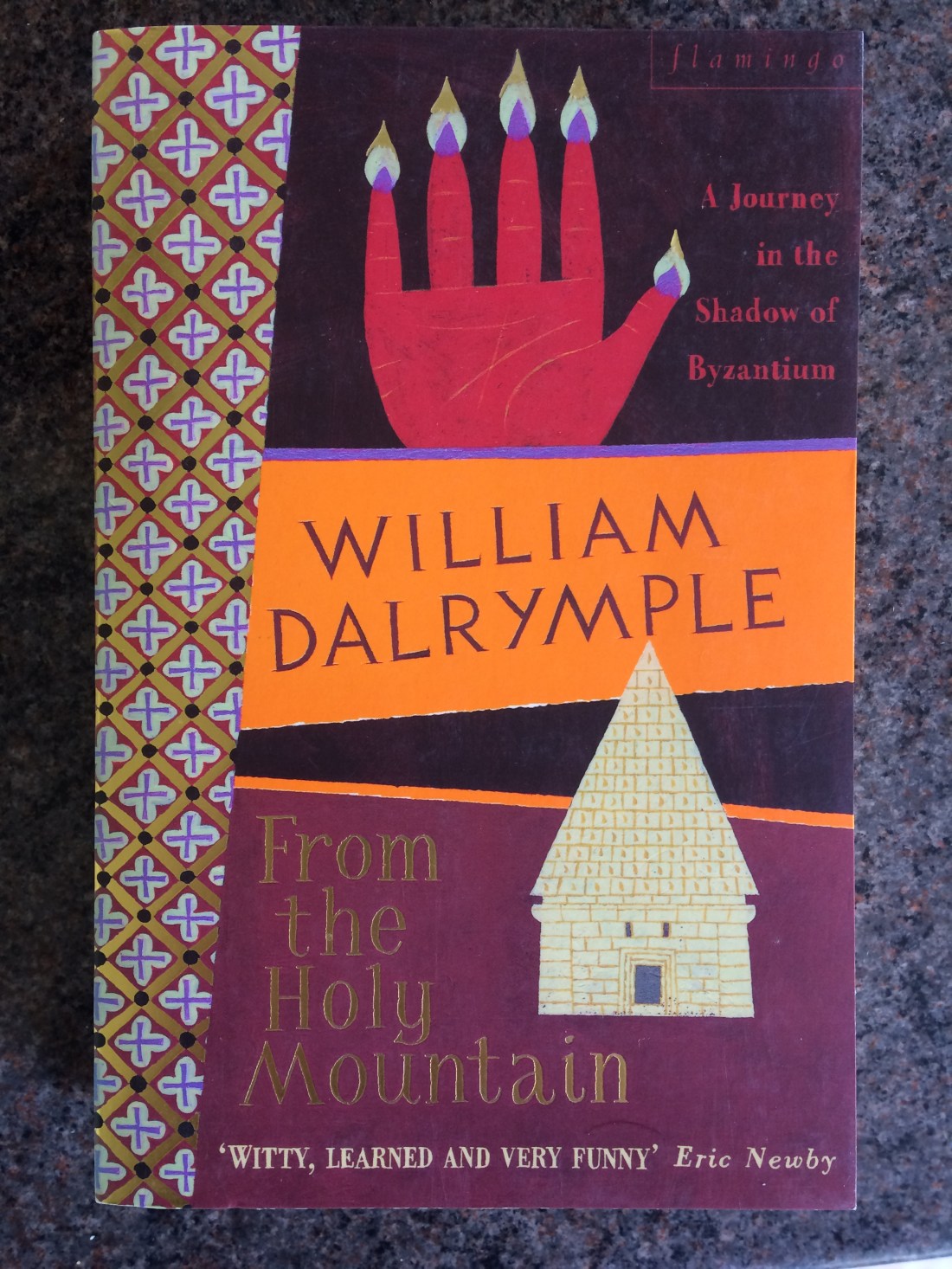
Leo’s Book Review: ‘From the Holy Mountain’

IMG_1248

‘A Journey in the Shadow of Byzantium’. By William Dalrymple.

I can’t tell how inspirational I found this book when I first read it.

At the time, around 1997, I was virtually reading nothing new beyond a few books on astrology or Buddhism, two subjects I was heavily into at the time.

Then one chance visit to a bookshop and this title seemed to shout out from the shelves, saying ‘Read Me!’ The cover and illustrations are simply stunning, produced by Dalrymple’s wife, Olivia Fraser. They fit hand in glove with the content in a way which leads you in with all the colourful and sensual allure of a Bazaar… but that would perhaps be an ironic observation, in that this book is a travelogue revealing the long slow demise of Orthodox Christianity in the Middle East.

Essentially the book is based on the journey of a Byzantine monk and historian, John Moschos, in 578 AD along the Silk Route which the author retraces, only to find that much of that culturally rich and colourful Christian soaked world has now gone and in further more rapid decline.

Humour and Grief

There are strong elements of humour, similar to Dalrymple’s earlier work ‘In Xandadu’ (which still leaves me in stitches when I re-read it), but ‘Holy Mountain’ is a much more serious, haunting book, leaving you practically grieving for the lost world of Byzantium, the continuation of the Roman Empire in the East.

From the first sentence, where the author describes in plain yet evocative prose the cell in which he is staying at the start of his journey from Mount Athos in Greece, you are led into another world, not only the rather fraught one of today within the author’s mind, but also this lost, remoter world, which somehow seems much more wholesome and meaningful than our own despite all the technology which allows me to write this.

Similarly his all-round historical knowledge of Byzantine and Islamic culture, plus his understanding of architectural detail are stunning, yet written succinctly in such a way as to not put you off with complication. It is a great gift.

Vestiges

In places he finds these vestiges of Orthodox Christianity, monasteries and churches barely holding on, plus apocalyptically minded priests, and his description of the characters he meets fills you with both hope and resignation too, a feeling that his generation might be the last to witness such places and people.

By the end, the author seems like a forlorn character, reminding me of Paul Morel in DH Lawrence’s ‘Sons and Lovers’, as he walks away after his mother had died. The sense of loss and hopelessness are overbearing at times.

In doing this review I have realised I must re-read this wonderful book once again. It was first published in the mid 1990s; I wonder how much of the world he describes is still there 22 years on?

So I can’t recommend this book enough, it brought back my love of reading.

Inspirational! The North Norfolk Coast

Wells Morning Light
The North Norfolk Coast near Wells Next the Sea.

When I used to paint (I’m hardly picking up a brush these days), I found the North Norfolk coast in eastern England to be most inspirational.

There is something about the quality of the light, perhaps because it is north facing. There is a strong ‘elemental’ feeling to the whole area which is difficult to put into words.

I am not alone in this of course. It is a popular tourist destination, is home to much wildlife and many want to relocate there. The house prices in certain parts have skyrocketed in recent years.

But that can’t stop us visiting. I think I shall have to return soon and who knows – maybe I will be inspired.