Winners can claim truth
when history is written?
Then what is the truth?
copyright Leofwine Tanner 2019

copyright Leofwine Tanner 2019

However, time was, when once a green teenager, that books like Andrew Tomas’ ‘Beyond The Time Barrier’ published in 1974 by Sphere Books Ltd., fired my imagination, which is no bad thing.
What first drew me to the book was the cover, naturally. The connection between flying saucers and the sphinx, or Egyptian civilisation as a whole is intriguing, and there have been many books written since which hint, if not exactly prove, that human civilisation owes its origin to alien interference.
However, once you get into the core of this short book (160 pages), Tomas’ thesis, as far as I understand it, is that time may not be what it seems, that the so-called rules of time might be broken, or that the past and future can be seen by sensitive individuals using various mediums.
Most intriguing for me, however, is his interpretation of the Tarot cards, which he thinks may have originated in Egypt. He seems to say that they do not merely predict what happens in an individual’s future through divination, but perhaps could also encapsulate the essential meaning of each century from the first century BC to our own twenty first century.
How is this? He takes the traditional images of the cards, ‘The Emperor’, ‘The Hermit’, ‘The Devil’ etc., and sees a summation of each century’s character. For instance, take the card called ‘The Pope’. If we are counting from the first card, ‘Il Bagattel’ standing for the first century BC, then ‘The Pope’ coincides with the fourth century AD – the most significant event (most might agree) of that century being the Emperor Constantine making Christianity the state religion of the Roman Empire.
It’s all very interesting, especially when one looks at the card standing for the twentieth century, ‘Il Matto’ (The Fool), who seems to be blindly walking towards a precipice, despite a dog’s futile attempts to prevent him falling over. I think you can see that such a symbol might very well fit when describing the tragedy of two world wars and all the other conflicts of that time.
However, it could also be argued that it’s easy to find events which match the pictures on the cards. This may be true.
Similarly, he takes a look at the prophecies of Saint Malachy, the twelfth century Irish Bishop of Armagh, who allegedly predicted future popes from his time using allegory and symbols, each pontiff given an epithet, like Pope John the Twenty Third who died in 1963.
One rather imaginative interpretation of Malachy’s description of Pope John, ‘Pastor et Nauta’, or Shepherd and Pilot, is that it’s meant to be ‘Astor et Nauta’, or Astronautics, which certainly did begin during his reign.
One worrying aspect of these prophecies is that we are now, as of 2019, apparently living in the time of the last Pope that Saint Malachy gave an epithet to, namely Pope Francis, ‘Petrus Romanus’. Some have interpreted this as to mean that we are living at the end of the age, but people have been saying this for hundreds of years… so who really knows?
There are also references to Nostradamus, Edgar Cayce, Jeane Dixon and Nicholas Roerich, the latter whom he believes made prophecies through the medium of painting rather haunting landscapes. He is certainly one of my favourite painters.
However, like I said above, I do not subscribe to all this conjecture, except to say that it was books like this which set me on the path of ‘free thinking’, not necessarily believing anything I was told, nor ruling anything out. I believe we should be open to anything. Uncertainty is the usual state of affairs and is actually quite good in the long run – the truth will probably never be known.
Leofwine Tanner 2019
Look, I don’t think I’m weird about this. I really don’t. I think lots of you sniff your books. And probably other people’s too. The way books smell matters. The cheap hard white academic institutional paper of tenure books and reheated dissertations has a smell that tells you from the beginning that you will learn a […]
via Book sniffing note: Slanguage, by Bernard Share — Sesquiotica
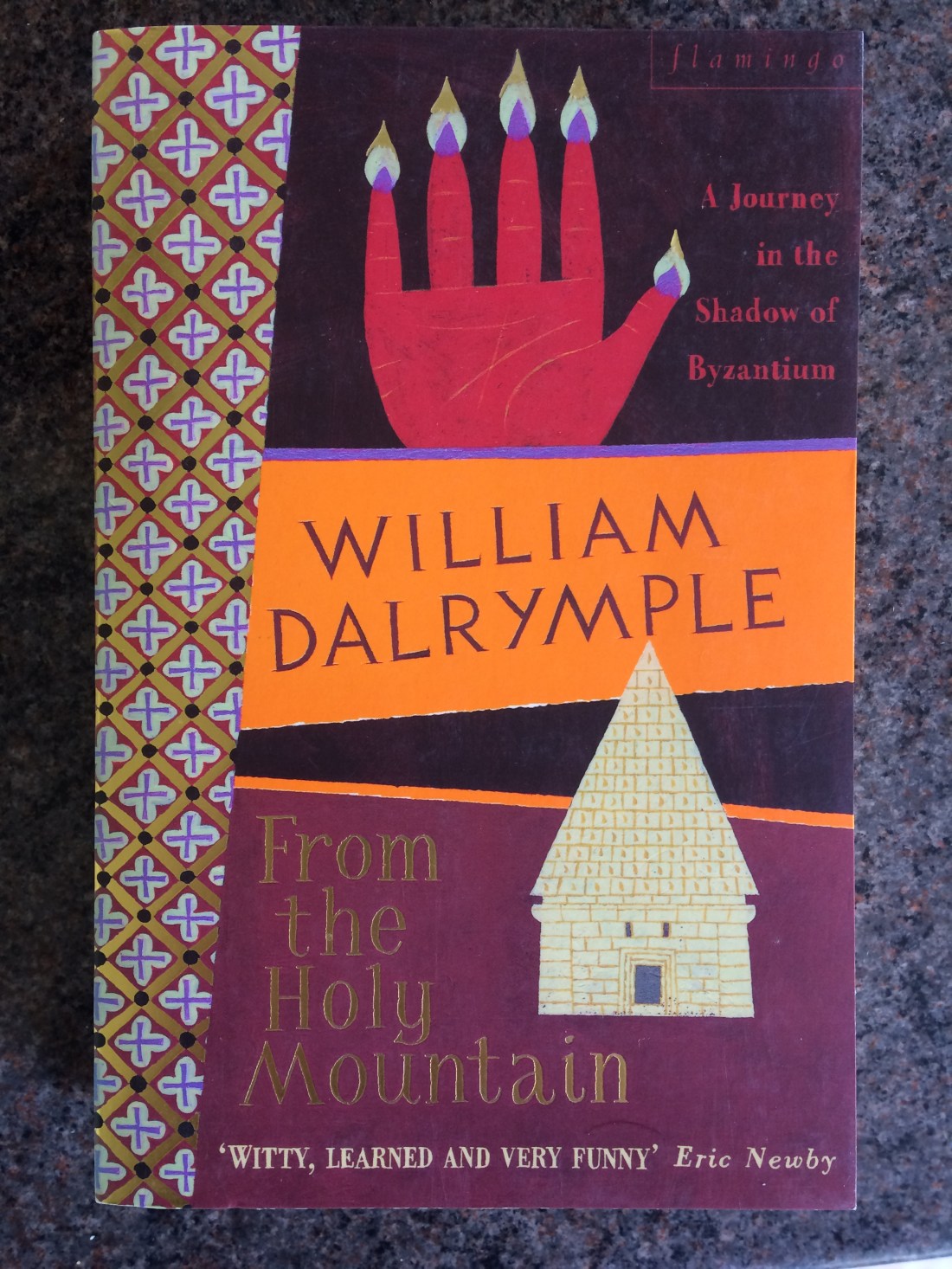
I can’t tell how inspirational I found this book when I first read it.
At the time, around 1997, I was virtually reading nothing new beyond a few books on astrology or Buddhism, two subjects I was heavily into at the time.
Then one chance visit to a bookshop and this title seemed to shout out from the shelves, saying ‘Read Me!’ The cover and illustrations are simply stunning, produced by Dalrymple’s wife, Olivia Fraser. They fit hand in glove with the content in a way which leads you in with all the colourful and sensual allure of a Bazaar… but that would perhaps be an ironic observation, in that this book is a travelogue revealing the long slow demise of Orthodox Christianity in the Middle East.
Essentially the book is based on the journey of a Byzantine monk and historian, John Moschos, in 578 AD along the Silk Route which the author retraces, only to find that much of that culturally rich and colourful Christian soaked world has now gone and in further more rapid decline.
There are strong elements of humour, similar to Dalrymple’s earlier work ‘In Xandadu’ (which still leaves me in stitches when I re-read it), but ‘Holy Mountain’ is a much more serious, haunting book, leaving you practically grieving for the lost world of Byzantium, the continuation of the Roman Empire in the East.
From the first sentence, where the author describes in plain yet evocative prose the cell in which he is staying at the start of his journey from Mount Athos in Greece, you are led into another world, not only the rather fraught one of today within the author’s mind, but also this lost, remoter world, which somehow seems much more wholesome and meaningful than our own despite all the technology which allows me to write this.
Similarly his all-round historical knowledge of Byzantine and Islamic culture, plus his understanding of architectural detail are stunning, yet written succinctly in such a way as to not put you off with complication. It is a great gift.
In places he finds these vestiges of Orthodox Christianity, monasteries and churches barely holding on, plus apocalyptically minded priests, and his description of the characters he meets fills you with both hope and resignation too, a feeling that his generation might be the last to witness such places and people.
By the end, the author seems like a forlorn character, reminding me of Paul Morel in DH Lawrence’s ‘Sons and Lovers’, as he walks away after his mother had died. The sense of loss and hopelessness are overbearing at times.
In doing this review I have realised I must re-read this wonderful book once again. It was first published in the mid 1990s; I wonder how much of the world he describes is still there 22 years on?
So I can’t recommend this book enough, it brought back my love of reading.
 Ciscography