
Our kin losing touch
while predators lurk in mind.
Outside, walls crumble
copyright Leofwine Tanner 2019
copyright Leofwine Tanner 2019
copyright Leofwine Tanner 2019

However, time was, when once a green teenager, that books like Andrew Tomas’ ‘Beyond The Time Barrier’ published in 1974 by Sphere Books Ltd., fired my imagination, which is no bad thing.
What first drew me to the book was the cover, naturally. The connection between flying saucers and the sphinx, or Egyptian civilisation as a whole is intriguing, and there have been many books written since which hint, if not exactly prove, that human civilisation owes its origin to alien interference.
However, once you get into the core of this short book (160 pages), Tomas’ thesis, as far as I understand it, is that time may not be what it seems, that the so-called rules of time might be broken, or that the past and future can be seen by sensitive individuals using various mediums.
Most intriguing for me, however, is his interpretation of the Tarot cards, which he thinks may have originated in Egypt. He seems to say that they do not merely predict what happens in an individual’s future through divination, but perhaps could also encapsulate the essential meaning of each century from the first century BC to our own twenty first century.
How is this? He takes the traditional images of the cards, ‘The Emperor’, ‘The Hermit’, ‘The Devil’ etc., and sees a summation of each century’s character. For instance, take the card called ‘The Pope’. If we are counting from the first card, ‘Il Bagattel’ standing for the first century BC, then ‘The Pope’ coincides with the fourth century AD – the most significant event (most might agree) of that century being the Emperor Constantine making Christianity the state religion of the Roman Empire.
It’s all very interesting, especially when one looks at the card standing for the twentieth century, ‘Il Matto’ (The Fool), who seems to be blindly walking towards a precipice, despite a dog’s futile attempts to prevent him falling over. I think you can see that such a symbol might very well fit when describing the tragedy of two world wars and all the other conflicts of that time.
However, it could also be argued that it’s easy to find events which match the pictures on the cards. This may be true.
Similarly, he takes a look at the prophecies of Saint Malachy, the twelfth century Irish Bishop of Armagh, who allegedly predicted future popes from his time using allegory and symbols, each pontiff given an epithet, like Pope John the Twenty Third who died in 1963.
One rather imaginative interpretation of Malachy’s description of Pope John, ‘Pastor et Nauta’, or Shepherd and Pilot, is that it’s meant to be ‘Astor et Nauta’, or Astronautics, which certainly did begin during his reign.
One worrying aspect of these prophecies is that we are now, as of 2019, apparently living in the time of the last Pope that Saint Malachy gave an epithet to, namely Pope Francis, ‘Petrus Romanus’. Some have interpreted this as to mean that we are living at the end of the age, but people have been saying this for hundreds of years… so who really knows?
There are also references to Nostradamus, Edgar Cayce, Jeane Dixon and Nicholas Roerich, the latter whom he believes made prophecies through the medium of painting rather haunting landscapes. He is certainly one of my favourite painters.
However, like I said above, I do not subscribe to all this conjecture, except to say that it was books like this which set me on the path of ‘free thinking’, not necessarily believing anything I was told, nor ruling anything out. I believe we should be open to anything. Uncertainty is the usual state of affairs and is actually quite good in the long run – the truth will probably never be known.
Leofwine Tanner 2019

copyright Leofwine Tanner 2019

The idea is to raise interest and money for the upkeep of these historic buildings, icons of English cultural and Christian heritage.
To be honest, I’m not sure if we’d ever heard of it. The link only came up last week from the web, so I thought it would be worth a visit. We were very glad we came.
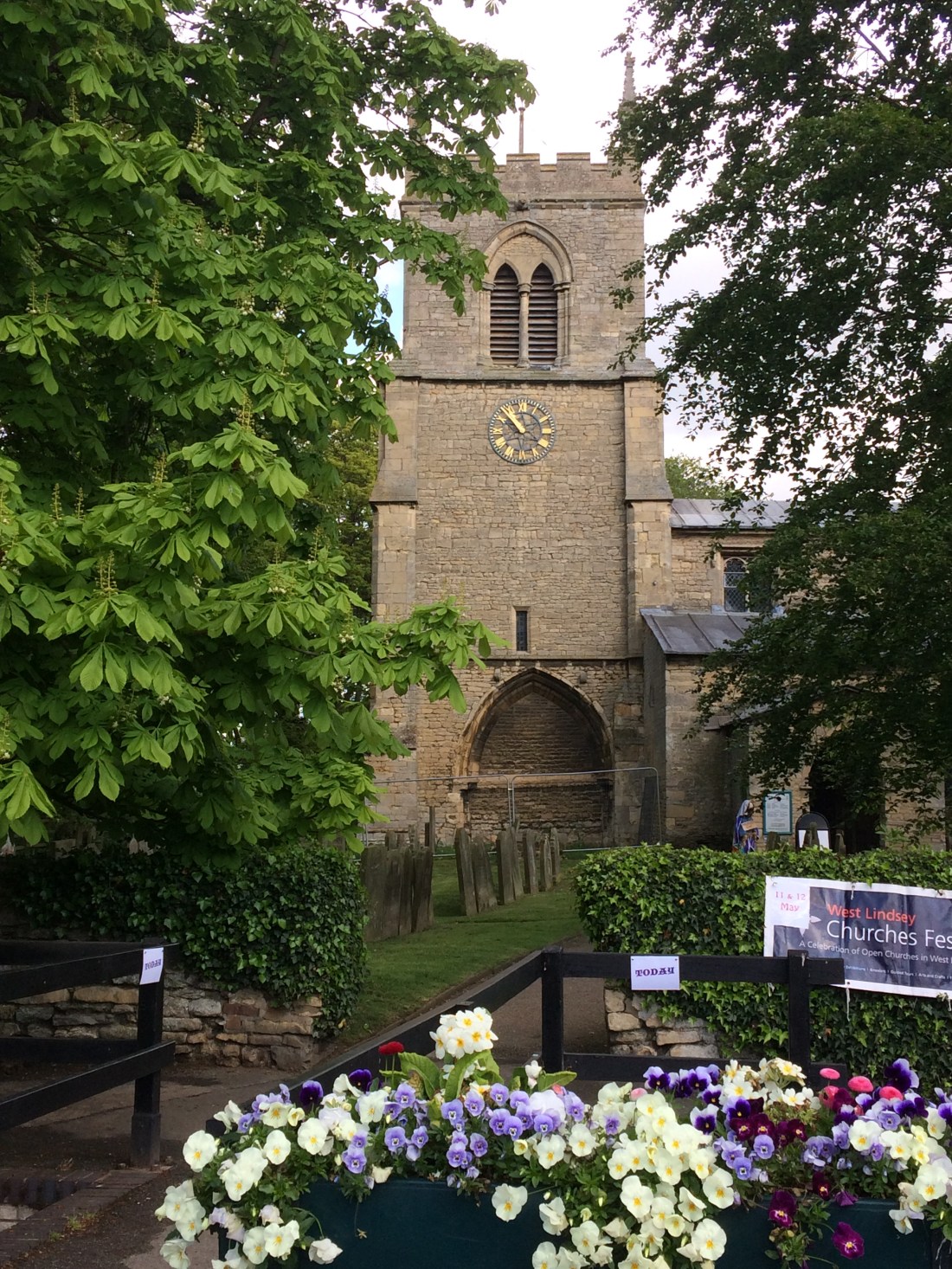
Our first stop was at the pretty village of Nettleham, at the Church of All Saints just a few miles north east of the magnificent city of Lincoln.
Nettleham is a large, seemingly thriving village of around three and half thousand souls with lots of local stores and some pubs, a heartening sight if there ever was. Inside the church we were greeted very courteously by the volunteers manning their stalls of old books, games, crafts, or selling food and drink. They were all very helpful, keen to tell us about the church and the village.

Sadly, in the 1960s there was a serious fire at All Saints, the result of arson. Since then the church has been restored very well, notable features being the new stained glass window at the east end and the roof.
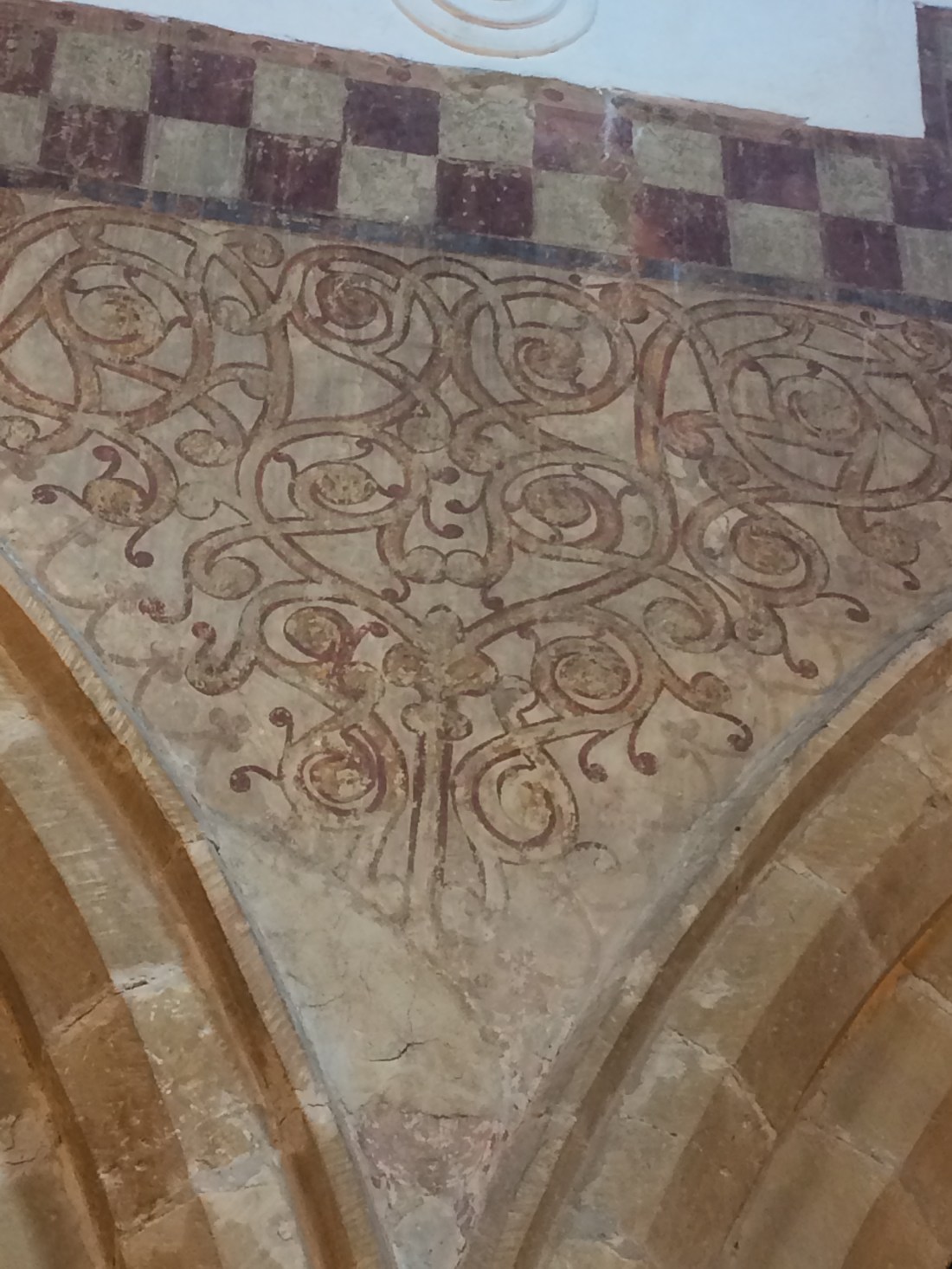


Of course, there are no benefits from fires, but one of the things revealed by the tragedy was a series of medieval wall pattern illustrations, of the type which used to bedeck all churches before the Reformation, after which nearly all were whitewashed over.

Naturally, one of the benefits of going to these events is sampling the local cakes. We got a piece of carrot cake and apple cake, washed down by the proverbial cup of tea. The prices too, are very reasonable. We even took away a whole lemon drizzle cake!
Yes, it’s all very English and a jolly good thing to. I can’t speak highly enough of everyone inside, they made us very welcome.

The village of Nettleham is also very pretty and worth exploring, with a running stream making lovely feature.
Incidentally, Lindsey, in which Nettleham lies, is not merely a division or riding of historic Lincolnshire, along with Kesteven and Holland; Lindsey was once a kingdom in its own right, ruled from Lincoln around thirteen hundred years ago, before it was swallowed up by the much larger Mercia.
After that there was a manor house here, called the Bishop’s Manor House, as it eventually became a possession of the Bishops of Lincoln. Sadly this is now demolished.
But it’s not all about the past. There is very much to see and enjoy here today, not just at the Churches Festival – it’s well worth a visit at any time if you’re nearby.
copyright Leofwine Tanner 2019
 Ciscography