
Lights still shine for you
For others memories fade
Life beyond the grave
copyright Francis Barker 2020
copyright Francis Barker 2020

Catherine married the heir to the English throne, Arthur Prince of Wales, in 1501. However, Arthur died soon afterwards. When Arthur’s brother, Henry ascended the throne on the death of his father in 1509, he quickly married his brother’s widow, forging an important alliance between England and Spain.
However, over the course of the next twenty years, Catherine failed to deliver Henry a living male heir, her only major ‘crime’. Following a long protracted dispute between Henry and Papal legates, during which the Pope refused to annul the marriage, Henry declared himself Head of the Church of England, allowing him to divorce Catherine and marry his mistress, Anne Boleyn in 1533.
Catherine died in January 1536 at Kimbolton Castle, and is buried in Peterborough Cathedral.
copyright Francis Barker 2019
What is not generally acknowledged is the hard work and mental torture that this man must have gone through to get to that crucial point, basically becoming exasperated with such practices as the selling of indulgences, which supposedly reduced a person’s time in purgatory.
According to the birth data given, Luther was born with Leo rising, making the Sun his ruler, which is found in Scorpio in house 4. Essentially, here is a lover of life, a deeply passionate and intense person who is interested not only in his family and background but also the fundamentals of life – what he saw as the truth, stripped back to brass tacks.
His Sun is in good aspect to Chiron in house 8, indicating that he suffered much through his deeply penetrating attitude, his wish to get to the fundamentals, but which also put him in to a positive position to help others later.
This can be seen through his encouragement to look to scripture, rather than the other teachings of the then Catholic church. This would necessitate the translation of the Bible into the native tongues of Europe, something which Luther also encouraged.
His character is also moulded strongly by the elements; he has no planetary activity in earth and lots in fire and water.
He clearly saw things in black and white, he was emotional, intense, and with the Moon in Aries in house 9, he could be a bit of a firebrand, reacting quickly, strongly, angrily at times, especially in mental pursuits, perhaps most particularly in higher mind/philosophical areas. This was only exacerbated by the Moon’s opposition of Pluto in house 3. He clearly often felt blocked by the intransigence of the Catholic authorities, who were not supportive of his wish to reform and sweep away.
His character is also strongly defined by two important conjunctions. Mercury is almost exactly conjunct Neptune in Sagittarius in house 5.
He had a free thinking, creative mind, able to quickly grasp ideas and philosophy, but behind all this was a strong sense of spirituality, a connection to the numinous (Neptune); it’s almost like having a direct line to God, or believing that you have. I think this was a most important trait.
The other highly symbolic conjunction was between Venus and Saturn in Scorpio in house 4. Though deeply and powerfully emotional, he was also mightily controlled, willing to endure suffering, loss, privation even torture for what he believed.
He certainly did not ‘get his kicks’ from any run of the mill enjoyment and would probably view most earthly pleasures as pointless and tedious. The strength of these two conjunctions alone, are a prime indication of his motivation to become a priest/friar in the first place.
Add to this the cutting zeal of Mars in Scorpio (aided by loose conjunction with Jupiter) in house 4, being the ruler of house 9 of philosophy and religion, plus the above said conditioning of Venus, being the ruler of house 3 of the everyday mentality, and a picture of him fully emerges as someone of complete determination and belief that his deeply felt spiritual cause is correct.
Most interestingly, the north node in house 9 is exactly opposite Jupiter in house 3. The north node shows where are meant to go in life and in his case it is towards a more outer, philosophical direction, a direction which he certainly led.
It would have been much easier for him to have continued as a Doctor of Theology, which, although clearly religious, is very much more house 3 activity than 9, especially in the way the Catholic church was structured then, where he stood to glean much, even materially, from his position in Wittenberg University. Such was the strength of his belief and conviction, he decided to take the harder route and thus became the historical figure he is now.
Few other people, especially common people, have had such an impact on history, a fact which I believe is fully shown in the quality of the chart of his nativity.
copyright Leofwine Tanner 2019
*If you are interested in getting your own astrological report, or would like one created for a loved one or a friend, please contact me at leoftanner@gmail.com.

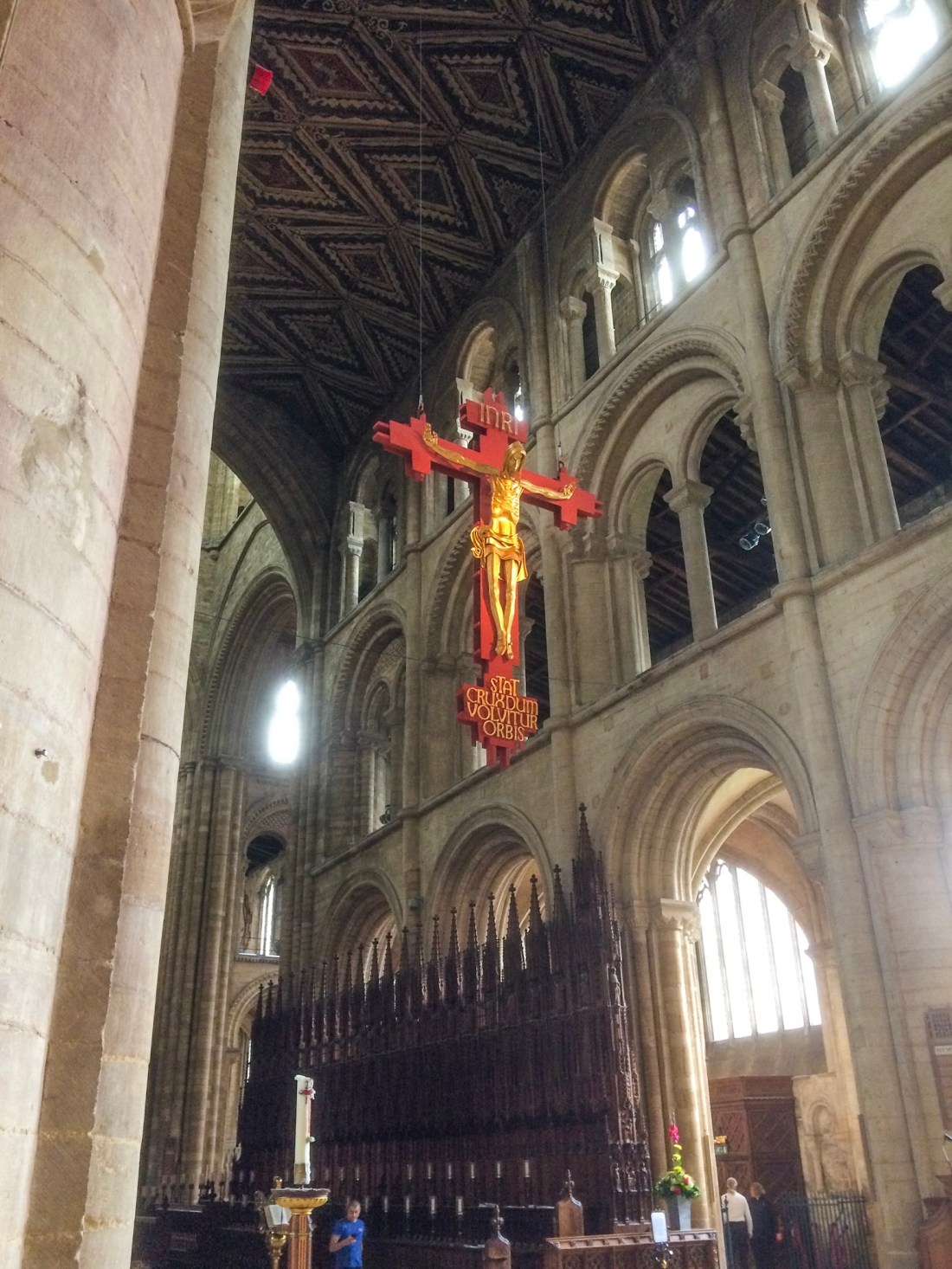
The long nave is quite stunning, with a beautiful roof and with a modern golden image of Christ suspended high as a focal point.
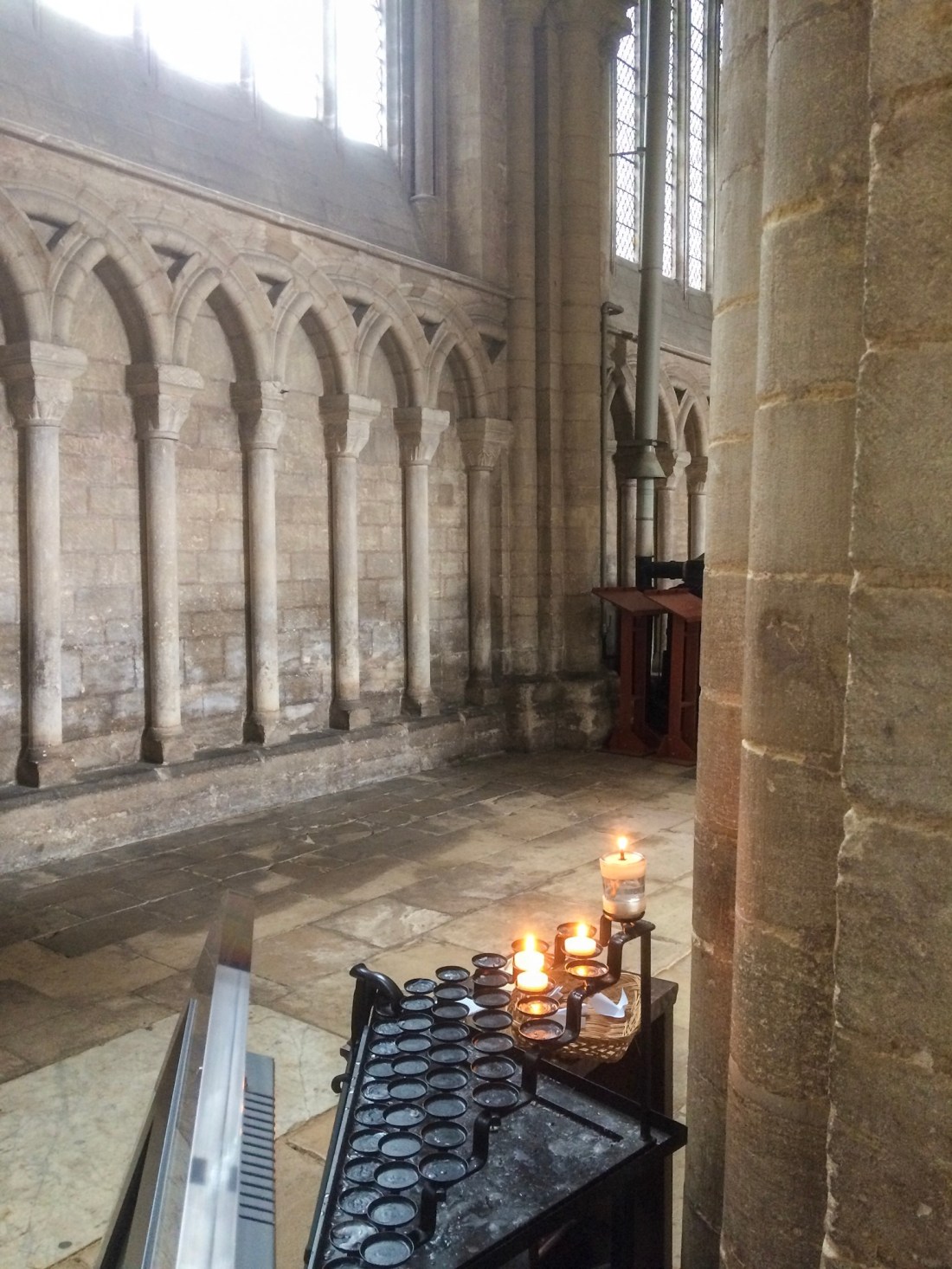
The cathedral is dominated by Norman and early English architecture, with numerous examples of Norman arches, such as these interlacing examples above.

The cathedral is also notable for its association with two famous queens.
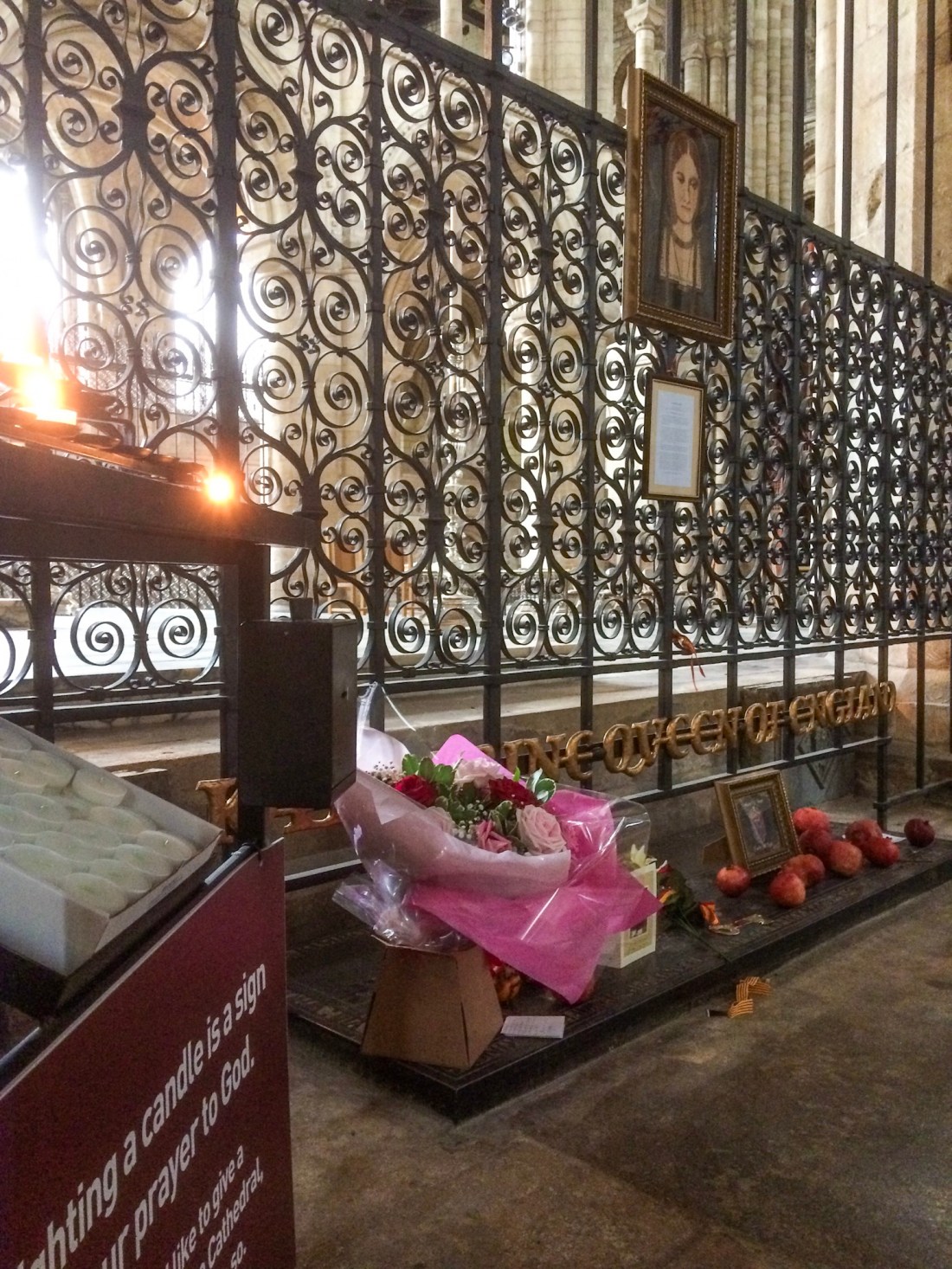
The first was Catherine of Aragon, Queen of England when she was married to Henry VIII. Catherine was buried here in 1536 and her tomb is still something of a shrine to her memory, with pomegranates very prominent as her symbol because the fruit appears on her badge. Pomegranates are an ancient symbol for fecundity and regeneration.
Catherine certainly suffered much during her husband’s long and protracted break with Rome, in which she was the innocent victim, her only crime it would seem was not being able to produce a living male heir for Henry to perpetuate the Tudor dynasty. This was how she was treated after being completely dutiful to the king, but Henry had to have his way. Her motto, which translates as ‘humble and loyal’, is a phrase she very much lived up to.

The second queen associated with Peterborough Cathedral is Mary Queen of Scots.
Mary inherited the Scottish throne after only a few days of being born, thrusting her into a world of political intrigue and shenanigans which she was never able to control.
She essentially became a pawn of more powerful rulers and some despicable characters. However, in 1559 she duly became Queen Consort to Francis II of France, solidifying Scotland’s long alliance with France.

Sadly within 18 months the young kind died prematurely. Had he lived, Mary’s life would have turned out entirely differently. As it was, she became a teenage widow and a long series of political and personal disasters ensued when she returned to Scotland. Eventually she fled to England and came under Elizabeth’s control.
After many years’ imprisonment in England, during which the still substantial Catholic faction within England with aid from Spain continually conspired to depose Elizabeth and put Mary on the English throne, she was finally executed at nearby Fotheringhay Castle in 1587.
She was initially buried in Peterborough Cathedral, but her son, James I of England, had her remains transferred to Westminster Abbey in London.
words and photographs copyright Francis Barker 2019


Nearly all reports of his personality describe him as dutiful, serious, methodical. He was certainly extremely organised and was a passionate defender of Catholicism, promoting and financing what we now call the Counter Reformation, with some degree of success.
Spain was engaged in a long running conflict fighting the Dutch Rebellion, and sent more than one armada of ships, also using Spanish troops based in the Netherlands, in an attempt to invade England and re-establish Catholicism in that country.
Ultimately, however, both of these failed, the Northern Provinces of the Netherlands effectively becoming independent in 1581, and England successfully fending off the most famous Spanish Armada in 1588.
Looking at his chart, Philip would appear to have been a much more rounded individual than the one generally left to us by posterity, or at least in English books on history.
He had Libra rising, with Venus, his ruling planet, in Gemini conjunct Jupiter in house 9, in good aspect to a Moon in Aquarius and Saturn in Aries. Jupiter was also technically conjunct Mercury which had just moved into Cancer. His Gemini sun is also in house 9.
Put all this together and I would venture that here is a quite charming, diplomatic, sociable, affable, responsible and very generous individual, with a strong interest in philosophical and religious issues. The Moon’s south node is also very close to the Venus Jupiter conjunction, indicating that he was at his most natural in the realms of diplomacy, culture and philosophy and was probably highly knowledgeable about them.
Philip II was described by at least one ambassador as being highly attractive, charming and courteous, a fact often overlooked in the English speaking world, it would seem.
We should also remember that he was married four times, one of his wives being none other than Queen Mary I of England, who was absolutely besotted with him. I think from all this, we can see that the ‘stars’ did not lie, he was indeed a very charming and gracious individual.
One surprising apparent fact was that he was not a great linguist. All the above indications suggest that he would have made a great scholar of foreign languages, but appears to ‘only’ have spoken Spanish (Castilian) and Latin.
I think we can put this down to the fact that he devoted himself to the pursuit of religion and diplomacy (and foreign wars), at a time when Spain was the most powerful country in Europe with a vast and still growing overseas empire, negating the need for him to speak such languages as French and German at a time when the accepted lingua franca was still Latin.
At that time, England, for example, was still rather insignificant with an even more insignificant language. Rulers like Henry VIII and his daughter Elizabeth, who had undoubted linguistic gifts as revealed in their birth charts, would have certainly benefited from being able to converse in several foreign languages.
Philip and other Spanish rulers of that time, did not need to do this and so he became the champion of the Catholic cultural dominance of Europe and the then known world.
If we probe a little deeper into this man’s mentality, we see his Mercury in Cancer in house 10 loosely conjunct Jupiter. Both of these planets are rulers of house 3 and 9 respectively, which between them signify the everyday and higher mentality.
Mercury in Cancer might tend to let emotions impinge upon logical thought at times, though I suspect he could always be relied upon to put up a good defensive and emotive argument when it came to such issues as religious belief and faith, especially as Jupiter, ruler of house 3 conjunct Venus in Gemini indicates a flexible and persuasive aspect to the mind as well, able to grasp and use detail.
When Philip died in 1598, although he had failed to secure the Northern Netherlands and defeating England, he had secured the throne of Portugal and seen Spain’s oversees possessions reach nearly their greatest extent.
The fact that his ambitions in Europe were always confronted by virulent opposition is shown by his house 7 (opponents and relationships) ruler, Mars in passionate and resolute Scorpio in close square aspect to the Moon, his house 10 ruler of ambition and career. The Dutch Protestants and Queen Elizabeth of England were certainly strong and determined opponents.
Looking at this in another way, his house 2 Mars in Scorpio is in a quincunx (or inconjunct) aspect of 150 degrees to the Venus Jupiter conjunction.
Traditionally, this points to two virtually irredeemable areas of his life, like a kind of compartmentalisation, something which would actually be quite useful, one would think, with such a powerful statesman as this.
In other words, the man of charm and sophistication symbolised by Venus/Jupiter, might have been able to easily divorce itself, when needed, from the deep driving energy and ruthlessness of the Scorpio Mars, particularly in regard to financial matters and security (house 2) and also in certain areas of diplomacy (Mars ruler of house 7).
Finally, as house 7 also rules marriage, and as we find limiting Saturn housed there in his chart, I note that ‘poor’ Philip was married four times and widowed four times, something which would affect anyone deeply, even the most powerful man in the world, whose obvious grace and charm has sadly eluded most of us in the telling of history.
*If you are interested in getting your own astrological report, or would like one created for a loved one or a friend, please contact me at leoftanner@gmail.com.
copyright Leofwine Tanner 2019
 Ciscography