The voice and song remind me
of why I don’t come.
The words and the platitudes wash over me,
echo and reverberate around this sacred space,
crying for heaven
though never finding any home.
The bats are nearer but unaware
of their advantage,
leaving me staring high into this perpendicular sky.
Is this all that is left?
Listening to Betjeman and Vaughan Williams
to stir us up,
to remind us of what once was.
This is me and you coming here,
cultural appreciators
though never spiritual partakers
in a creed we can’t believe.
Give me the fire and brimstone,
a faith which disturbs me
into knowing I’m not already saved.
It is better than this – looking up in awe
into a world that is lost.
words and photographs copyright Francis Barker 2019
They smile when I shut the heavy, creaking door,
from behind their neat wooden kiosks
stuffed with pamphlets and insipid books.
Smiles of recognition, a nodding
acceptance as if to say –
‘Oh, it’s you!’ Volunteer women serving Christ
better than those above them in Church.
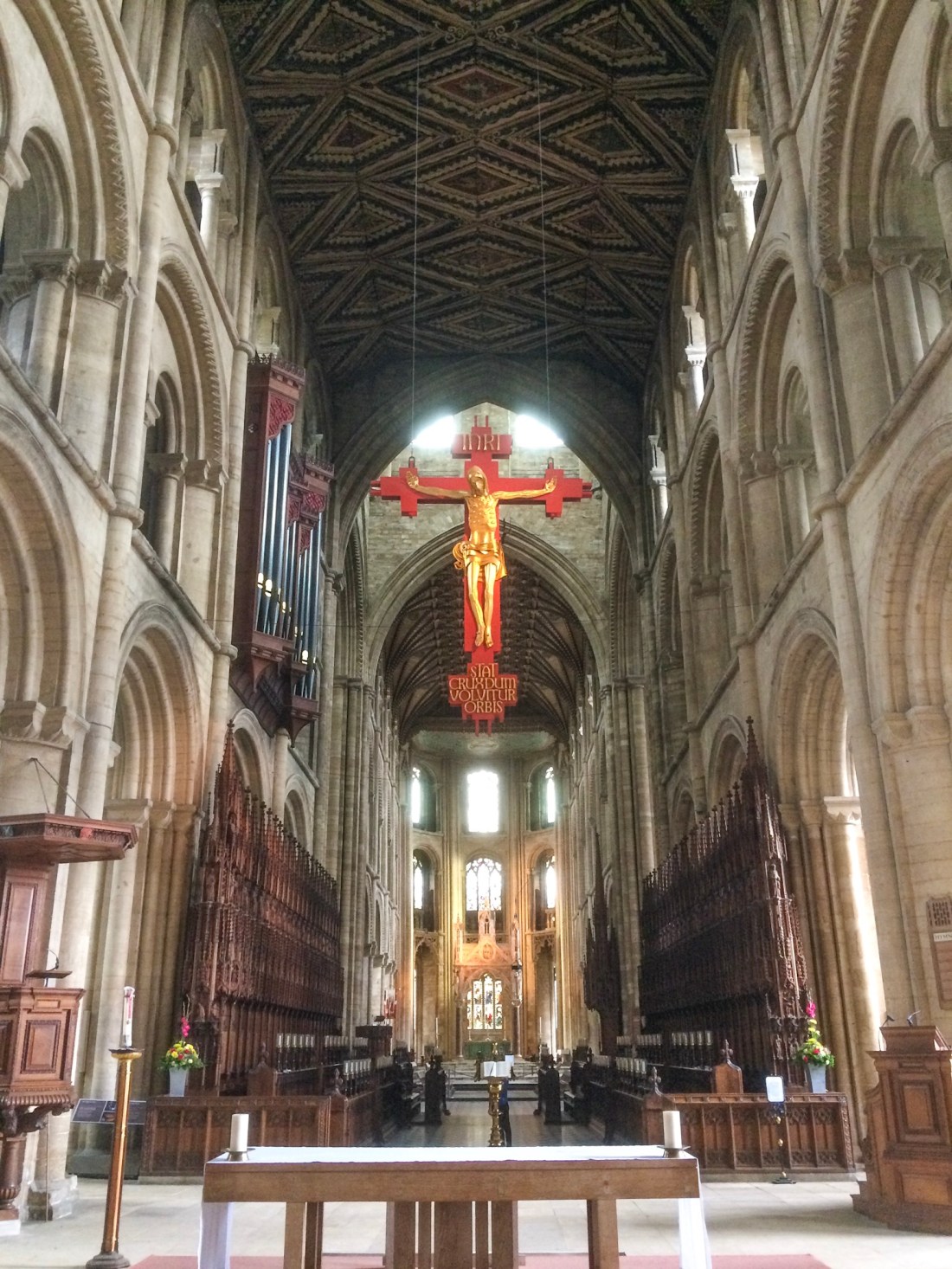
I walk along the emphatic southern aisle under
uber-Norman arches, at the far end of which
hangs a limp flag of Saint Andrew,
in honour of Mary Queen of France, Scotland
and some say of England, too.
Glancing to my left a young man kneels,
wringing hands beneath a life-size figure
of a crucified Jesus, hanging high in space.
He stares upwards, rocking gently back and forth,
as if imploring Him to be real,
to writhe, sweat, bleed, perhaps to save Himself
and then, somehow, to save him as well.
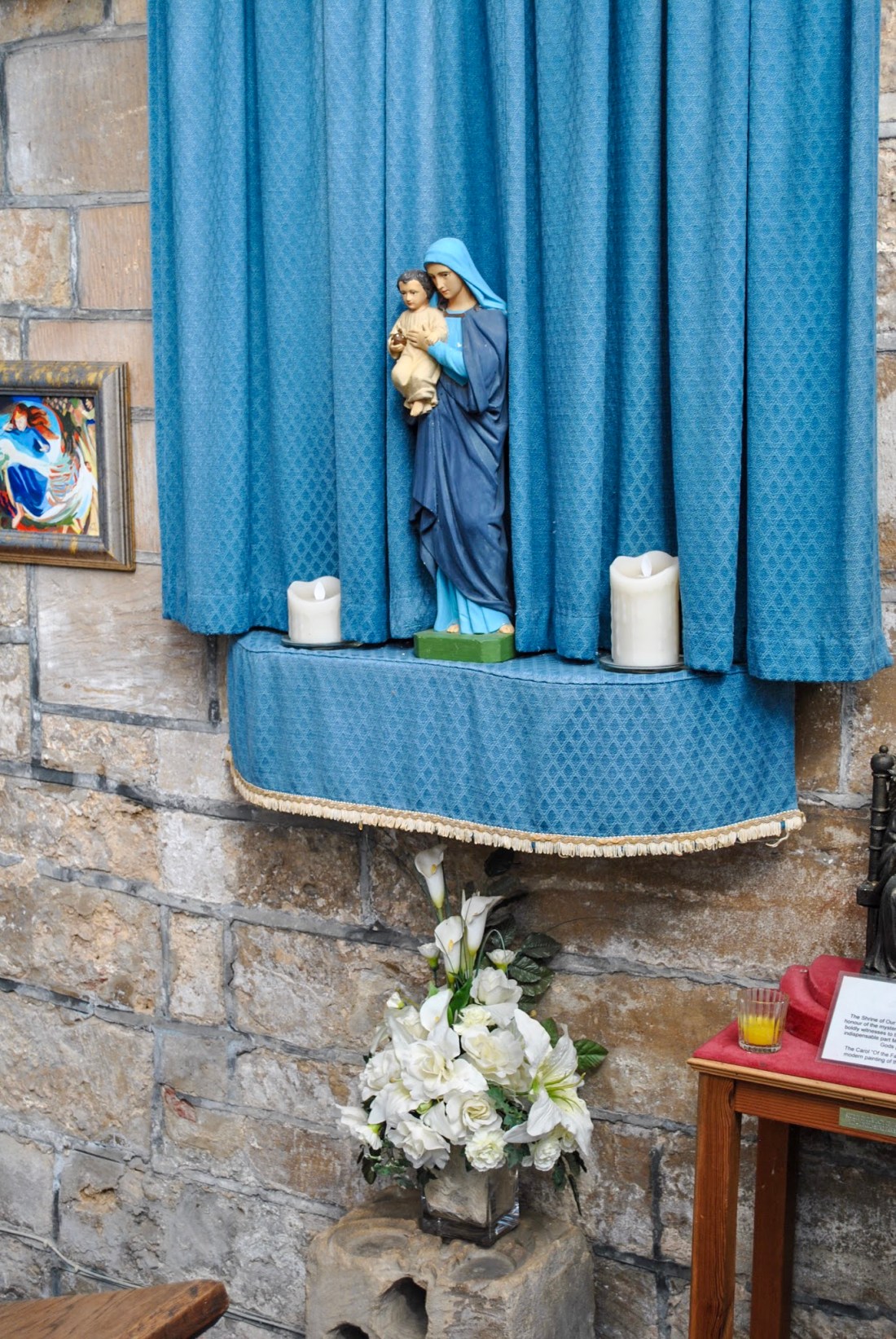
I’m here to light a candle outside
Saint Oswald’s shrine and to sit for a time
in silence inside the tidy chapel,
to pray for a poor boy in pain,
perhaps to ponder on those relics,
those bits of bodies and other things,
worshipped once and then dispersed,
despised in fractured minds,
to us now mostly objects of indifference.
Oswald’s arm must lie hereabouts,
known to someone who still believes
in its restorative power, like the monks
who consumed this place, where Domesday
came and went without event,
where the Chronicle of a people faded to grey
in an undrying ink. Still it awaits the next line.
In this fossil the dead are lucky.
They are dead but in faith, whereas I roam
restlessly among echoes of whispers,
a heartless void. I cut across through the choir
to find I’m not alone, where the true
Queen of Hearts lies. Letters of gold spell
her name to all, but for me she smiles
brighter than anyone alive,
a smile from scorched Iberian lands,
her fate to end up on this drab island
where fashioned pomegranates mark her spot,
from which she expects to rise
at some glorious hour, where, until then,
the anonymous faithful lay fresh fruit
and flowers to mark her special days.
I watch a tourist, a German tricolour sewn
onto his rucksack, as he reads
the commemorative words. A sudden,
unexpected pride washes over me
while he pauses on her ground to think –
where I was once intrigued.
Almost believing.
Resting place of Catherine of Aragon, Queen of England. Peterborough Cathedral. Featured image at top of page are of pomegranates on her tomb.
King Philip II of Spain effectively became the most powerful man in the world when he inherited the crown from his even more powerful father, The Holy Roman Emperor Charles V, who abdicated in 1556.
Nearly all reports of his personality describe him as dutiful, serious, methodical. He was certainly extremely organised and was a passionate defender of Catholicism, promoting and financing what we now call the Counter Reformation, with some degree of success.
Rebellion and Conflict
Spain was engaged in a long running conflict fighting the Dutch Rebellion, and sent more than one armada of ships, also using Spanish troops based in the Netherlands, in an attempt to invade England and re-establish Catholicism in that country.
Ultimately, however, both of these failed, the Northern Provinces of the Netherlands effectively becoming independent in 1581, and England successfully fending off the most famous Spanish Armada in 1588.
Looking at his chart, Philip would appear to have been a much more rounded individual than the one generally left to us by posterity, or at least in English books on history.
A Man of Refinement and Grace
He had Libra rising, with Venus, his ruling planet, in Gemini conjunct Jupiter in house 9, in good aspect to a Moon in Aquarius and Saturn in Aries. Jupiter was also technically conjunct Mercury which had just moved into Cancer. His Gemini sun is also in house 9.
Put all this together and I would venture that here is a quite charming, diplomatic, sociable, affable, responsible and very generous individual, with a strong interest in philosophical and religious issues. The Moon’s south node is also very close to the Venus Jupiter conjunction, indicating that he was at his most natural in the realms of diplomacy, culture and philosophy and was probably highly knowledgeable about them.
Married and Widowed Four Times
Philip II was described by at least one ambassador as being highly attractive, charming and courteous, a fact often overlooked in the English speaking world, it would seem.
We should also remember that he was married four times, one of his wives being none other than Queen Mary I of England, who was absolutely besotted with him. I think from all this, we can see that the ‘stars’ did not lie, he was indeed a very charming and gracious individual.
One surprising apparent fact was that he was not a great linguist. All the above indications suggest that he would have made a great scholar of foreign languages, but appears to ‘only’ have spoken Spanish (Castilian) and Latin.
Not a Linguist but a Defender of Faith
I think we can put this down to the fact that he devoted himself to the pursuit of religion and diplomacy (and foreign wars), at a time when Spain was the most powerful country in Europe with a vast and still growing overseas empire, negating the need for him to speak such languages as French and German at a time when the accepted lingua franca was still Latin.
At that time, England, for example, was still rather insignificant with an even more insignificant language. Rulers like Henry VIII and his daughter Elizabeth, who had undoubted linguistic gifts as revealed in their birth charts, would have certainly benefited from being able to converse in several foreign languages.
Philip and other Spanish rulers of that time, did not need to do this and so he became the champion of the Catholic cultural dominance of Europe and the then known world.
A Well Developed Mind
If we probe a little deeper into this man’s mentality, we see his Mercury in Cancer in house 10 loosely conjunct Jupiter. Both of these planets are rulers of house 3 and 9 respectively, which between them signify the everyday and higher mentality.
Mercury in Cancer might tend to let emotions impinge upon logical thought at times, though I suspect he could always be relied upon to put up a good defensive and emotive argument when it came to such issues as religious belief and faith, especially as Jupiter, ruler of house 3 conjunct Venus in Gemini indicates a flexible and persuasive aspect to the mind as well, able to grasp and use detail.
When Philip died in 1598, although he had failed to secure the Northern Netherlands and defeating England, he had secured the throne of Portugal and seen Spain’s oversees possessions reach nearly their greatest extent.
Virulent Enemies
The fact that his ambitions in Europe were always confronted by virulent opposition is shown by his house 7 (opponents and relationships) ruler, Mars in passionate and resolute Scorpio in close square aspect to the Moon, his house 10 ruler of ambition and career. The Dutch Protestants and Queen Elizabeth of England were certainly strong and determined opponents.
Looking at this in another way, his house 2 Mars in Scorpio is in a quincunx (or inconjunct) aspect of 150 degrees to the Venus Jupiter conjunction.
A Ruthless Streak
Traditionally, this points to two virtually irredeemable areas of his life, like a kind of compartmentalisation, something which would actually be quite useful, one would think, with such a powerful statesman as this.
In other words, the man of charm and sophistication symbolised by Venus/Jupiter, might have been able to easily divorce itself, when needed, from the deep driving energy and ruthlessness of the Scorpio Mars, particularly in regard to financial matters and security (house 2) and also in certain areas of diplomacy (Mars ruler of house 7).
Finally, as house 7 also rules marriage, and as we find limiting Saturn housed there in his chart, I note that ‘poor’ Philip was married four times and widowed four times, something which would affect anyone deeply, even the most powerful man in the world, whose obvious grace and charm has sadly eluded most of us in the telling of history.
*If you are interested in getting your own astrological report, or would like one created for a loved one or a friend, please contact me at leoftanner@gmail.com.
It’s Sunday and the west door is locked.
I’ve tried it, checked my watch, the date.
Yes it’s true, I can’t go inside.
So I walk around, a facade, that’s all it is,
tall and beautiful it may be,
with some of the finest medieval stone work anywhere,
in a county already noted for its
ecclesiastical glories – but
it’s a fossil now of former faith,
where lip services are still carried out,
fed through the waterless canals of devotion,
enacted by the tired words of priests
standing before a withered congregation,
the last one leaving making sure the door
is locked behind them
to preserve the emptiness of our time






 Ciscography