Mozart – Sheer Genius – Astrology Musings

printed musical note page
Photo by Pixabay on Pexels.com

Wolfgang Amadeus Mozart was no mere child prodigy. In his short life he produced 41 symphonies, 17 piano sonatas, 20 operas… in fact around 600 works in total. He is, perhaps, the greatest known musical genius of all time.

He was born with Virgo rising, very useful for artists of all kinds, especially where attention to detail is paramount.

Astonishing talent, inherited genius

Astonishingly, the north node of the Moon – which along with the opposing south node, is often regarded as a karmic point in a birth chart – is virtually exactly conjunct his rising degree in Virgo and almost exactly opposite Uranus on the descendant in Pisces.

IMG_2001

Uranus is often equated with genius, amongst other things, and being exactly conjunct the south node, it symbolises a born genius, someone who has inherited some astonishing, unusual gift. However, it is one thing to have the potential, quite another to realise it. Thankfully for all of us, his talent was spotted early.

In astrological terms, one is supposed to head more towards the north nodal position in the ‘present’ life, in Mozart’s case, right on the ascending degree, meaning that he had to push himself forward, realise his unique ability in music and composition.

The Virgo Pisces axis is particularly symbolic here, with Uranus and descendant (DC) in vast, inspirational Pisces and the ascendant (AC) in exacting, attention to detail Virgo, the perfect axis for bringing spiritual dreams into earthly reality, in his case in the form of music.

A wellspring of inspiration from the subconscious

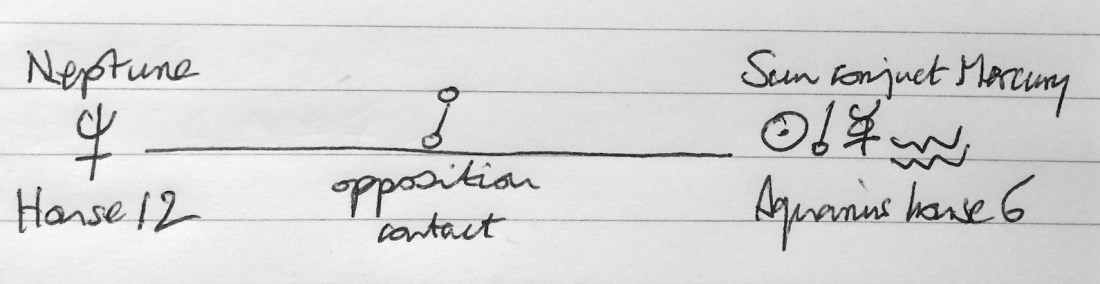
His ruling planet, Mercury, which is also house 10 and MC ruler (career/life direction), was found in Aquarius conjunct his Sun in house 6 – opposite Neptune in house 12.
img_2001-1.jpg

In many ways this substantiates the nodal position above on a different level. Here is the unconventional person (Aquarius), a natural workaholic too (Sun conjunct Mercury with Saturn nearby in house 6), but in contact with the spiritual numinous (Neptune) from the subconscious (house 12) in the form of music.

I find this remarkable and may attest, in astrological terms at least, to his genius and what the nature of it might be. His Venus trine Mars will also give him much creative energy and potential.

Another interesting feature of his chart, is the exact conjunction between the Moon and Pluto in Sagittarius in house 4, in good aspect to Jupiter in Libra in house 2. I think this basically represents an open, friendly manner, but probably with caustic edge at times. He would appear to have had a good sense of humour and keen on the odd bawdy joke. This aspect might also represent an interesting family and home life, plus ancestry.

copyright Francis Barker 2019

Stockhausen: Neptune, Uranus and the Nature of Genius. Astrology Musings

red lights in line on black surface
Photo by Pixabay on Pexels.com

Karlheinz Stockhausen, one of the most important composers of the 20th century, was also one its most controversial. The outer planets, Uranus, Neptune and Pluto are generational in influence, but if one or more of them touch sensitive parts of our birth chart, they can put us in touch with powerful trans-personal energy.

According to his known birth data, he was born with Leo rising, with a Leo Sun exactly conjunct Neptune.

A fount of inspiration

Here is a powerful, creative individual, with a personal connection to the numinous through Neptune, with all the inspirational, spiritual qualities associated with that planet. He was certainly a major visionary in musical terms and has had a huge influence on jazz and popular music as well as classical.

As we have seen previously, Neptune is invariably prominent in some way in the birth charts of creative artists, but he was clearly no idle dreamer.

Practical application

With Mercury and Venus in Virgo in house 2, the latter trine Jupiter in Taurus in house 10, he was very keen to apply his undoubted inspiration practically, effectively, in detail, and to disseminate it, not only in way to earn a living, but in building a successful career out of it. Indeed, he was also a fine writer and communicator too, teaching his ideas successfully. Without this grounding effect, his genius may well have been lost to the world.

What is more, revolutionary Uranus was very close to the MC (midheaven) in Aries in house 9.

The shock of the new

This midheaven point is traditionally associated with the career or life direction and with Uranus in Aries activating this very personal angle of his chart, we can see the unusual, avant-garde, revolutionary and pioneering qualities he brought to bear in his career. Revolutionary literally means turning upside down: he essentially did this, being a pioneer in the sphere of electronic music.

More than once, his music has been described as ‘disruptive’ (Uranus) and unfathomable (Neptune). He also has Mars in good aspect to Uranus, bringing much supportive, instigating energy and (in Gemini) variability to his repertoire.

copyright Leofwine Tanner 2019

Poem: Perennial Busker

man playing red and white electric guitar
Photo by Sofia Báthory on Pexels.com

Give me your roll up
your beaten up guitar
and I’ll even feed your dog

I’ll sing you a few songs
of tragedy, of lost love
and revolution never won

I know a few chords
and I can bash out some tunes
I scream with the best of them

Just don’t think to monopolise
this tale of hard time
it comes naturally to me

copyright Leofwine Tanner 2019

Gustav Holst and ‘The Planets’ – Musings

astronomy-constellation-cosmos-1025469
Photo by faaiq ackmerd from Pexels

English classical composer Gustav Holst’s most famous work, The Planets, is a testimony to his lifelong fascination for and interest in astrology.

From an early age, his step mother’s involvement with theosophy, inspired him to look beyond perceived reality and examine philosophy. Apart from being a composer, he was primarily a teacher and a trombonist.

Aquarius and astrology

When Gustav was born he had the Moon and Saturn rising in Aquarius. I think this says so much about him. Aquarius tends to be the individualist of the zodiac and anyone with a strong showing of this sign can be somewhat unusual. Holst’s fascination for astrology is quite typical in this regard.

Interestingly, in The Planets Suite, which was completed towards the end of the First World War, it is Saturn which I think is the most successful.

Saturn’s pain and peace

When I was younger I was an avid listener to this work and it was Saturn which most moved me, and I sense that it moved Holst too. This piece is composed like a musical poem and is subtitled ‘The Bringer of Old Age’.

It begins slowly, bleakly, mournfully, then panic sets in to a point of acceptance, which is followed by an unexpected peace as death approaches. It is still quite stunning to my ears, and I think Holst felt this very strongly – fitting then that Saturn should be so prominent in its own sign and on the ascendant. He was ‘in tune’ with Saturn.

Powerful higher mental capacity

That he was very much into philosophy and the higher mind is shown by the powerful Mercury Jupiter conjunction in Libra in house 9, nicely trine his Saturn rising in Aquarius. From this too, I think we can see the composing potential, the all round mental functioning of seeing the small intricacies, and also the big, full picture, plus the hard graft needed to succeed.

Jupiter also rules the midheaven, showing that the above qualities can be chanelled into his life path and career too.

Teacher and composer

His Sun in Virgo gives him a strong central dose of analytical and critical ability too, of course, which would certainly have aided him in composition and Virgoans in general make excellent teachers and worriers.

Venus in Scorpio in house 10 hints at an in depth career in the arts. This Venus is square Uranus and although it may have interrupted his career and relationships with sudden changes from time to time, here too with this tense link, I suspect, lies another indication of a leaning towards astrology; Uranus in some sense ‘rules’ astrology, although personally, I think Saturn is just as important.

copyright Leofwine Tanner 2019

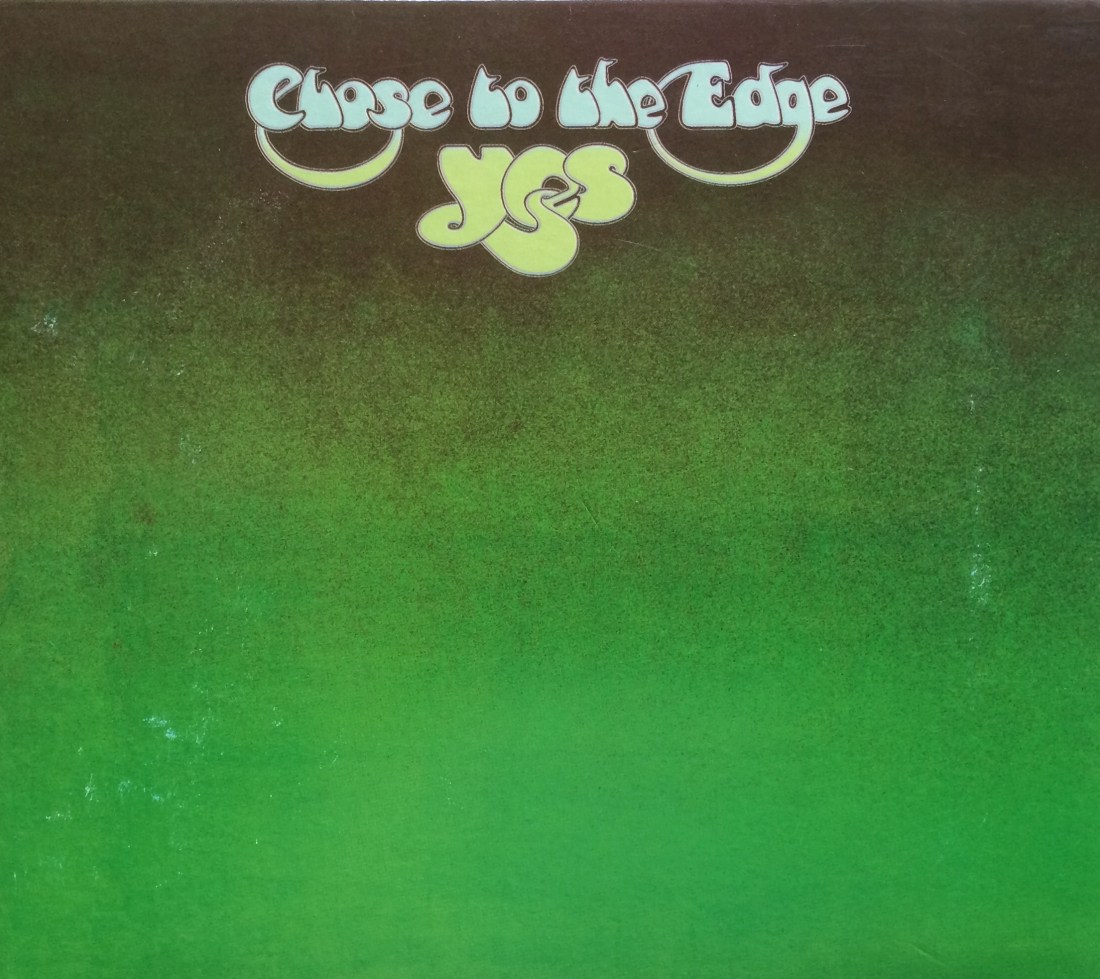
Rock Review: Yes, ‘Close to the Edge’ – Close to being perfect.

IMG_1685
The Classic 1972 Progressive Rock Album.

Probably my favourite all time prog rock album, ‘Close to the Edge’ (Elektra/Rhino CD) by Yes.

I was quite young when this came out in 1972 and didn’t actually hear it until later in the following year, when my elder brother brought it home. I think I had heard ‘Fragile’ by then too, the band’s 1971 release, which kicked off with ‘Roundabout’, one of Yes’ more ‘accessible’ numbers for a young boy. Nevertheless, I remember being pretty impressed by the whole album.

Spiritual sound

However, when my brother put ‘Close to the Edge’ on our family hi-fi, at first I wasn’t sure what to make of it. The slow start of planetary, naturalistic sound, the incredible weaving together of all the different movements of side one, took some time for me to appreciate, but now it’s like one epic poem, a vast spiritual movement of sound that is hard to describe, in words. It just has to be experienced, let it take you somewhere.

I still particularly like the ‘I Get Up I Get Down’ section, so beautiful, bringing together all the singing talents of the band, not just Jon Anderson, but also Steve Howe and Chris Squire.

Five virtuosos

Which leads me to a major point. Has there ever been a better example of five incredible talents working together, at the top of their game, producing such a masterpiece? I would doubt it.

Jon Anderson’s unique voice and inspirational lyricism; Bill Bruford’s peerless percussion; Steve Howe’s sheer virtuosity on six and twelve strings; Chris Squire’s uniquely lyrical bass and underrated singing; Rick Wakeman’s pure genius and dexterous flair.

It would prove to be a small window, sadly. Very soon, Bill Bruford would be on his way, followed soon after by Rick Wakeman. But what a beautiful, ornately made window it was. It was of its time.

Woven together

Side Two for me is equally impressive. I can still quite easily listen to ‘And You And I’ on repeat. I love the start, with Steve Howe hitting the harmonics on his twelve string, the way Rick’s synth plays over the top is so joyful, full of life. And like all Yes tracks, it’s difficult to envisage how they all put this together, so differing are the elements, but they come to together beautifully, woven by lyrics which are both hard to fathom, yet totally fitting – a Yes trademark.

And the final track, ‘Siberian Khatru’. Heaven knows what it’s about but if I had just one track to take to my desert island, I think it would be this.

Atmospheric

Great, catchy guitar riffs to start off and great rock playing by the whole band, but soon the wonderful group singing harmonies come in to play, adding a great atmospheric and naturalistic feel.

Then all the virtuosity of the band kicks in – indescribable. Especially, towards the end when they sing pairs of mysterious words with lots of reverb, which may, or may not, be related… but it works, it means something, though I don’t know what it is. And did I mention Steve Howe’s jazzy guitar on the outro?

Just how it should be, long reign the mystery.

copyright Leofwine Tanner 2019