Christian Confession! – Where Did All The Saints Go?

IMG_1285
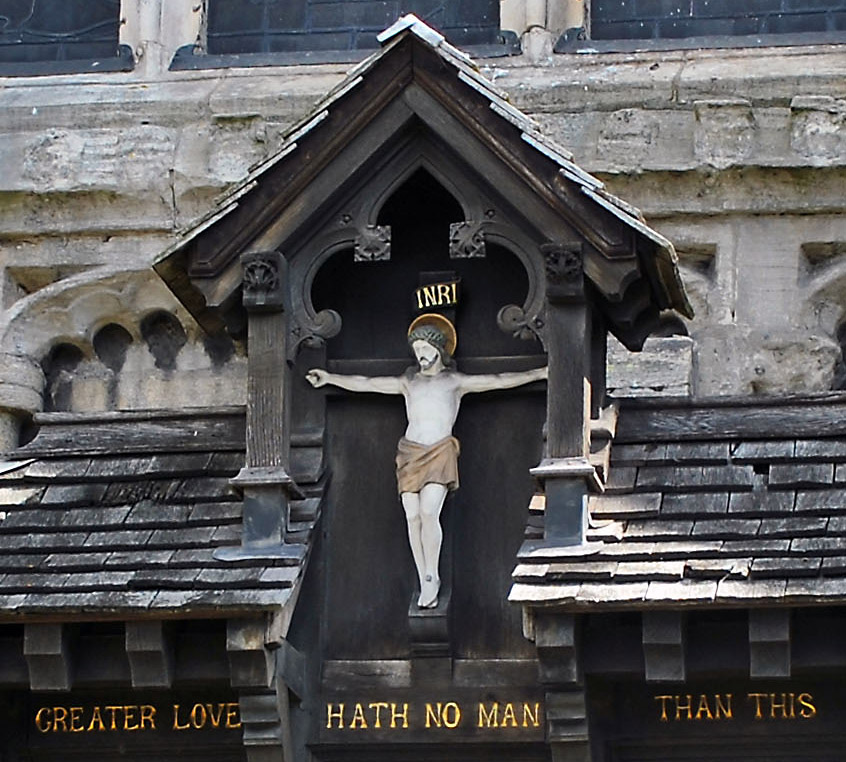
Which saint, one wonders, once stood here in this empty space?

The empty church spaces now vacated, were once inhabited by colourful saints, or other such noble individuals. These days it makes me sad.

I am not a Catholic, yet, somehow our culture seemed to be somewhat lessened by their disappearance during the Reformation.

I think we lost more than just colour and ceremony in our lives at the time; these events seriously hastened in the modern materialistic world, which despite its obvious benefits, has stripped us of all our innocence now.

Just like the monasteries, creators and supporters of communities, were dissolved and stripped of all their wealth which was then reduced to its base monetary value, we too over time seem to have been stripped to the core, spiritually.

That’s how I feel. I’m not saying I wish to convert – there are reasons why I would not – but we need to reclaim something from our past, to move one step back, if you will, before we can go two forward.

Sure it was a long time ago, I’ve never known anything different from bare stone and whitewashed walls – but just think how colourful our English churches once were, how rich the lives of the faithful must have been.

copyright Leo F. Tanner 2019

Lychgates – Signs and Symbols

IMG_1221 (3)

Lychgates, also sometimes called resurrection gates, are a curious English (though not exclusively) phenomenon.

The name derives from the Old English word lych, or lich, meaning body, referring to entrance to the churchyard though which the body of the deceased was carried. This was seen as the beginning of the path towards resurrection by being buried in holy ground.

In medieval times, signs and symbols carried a lot of weight as most of the population were illiterate. Nevertheless, it would be a mistake to think that signs and symbols don’t carry as much weight today. We just have to read and understand them.

Ecclesia 2

saint-2

A touching, moving churchyard memorial to some of the war dead of 1914 – 1918.

saint-2b

Soon after the conflict some viewed WW1 as the war to end all wars. So when this memorial was erected who could have imagined such an amount of horror, suffering and loss ever being repeated again..?

words and pictures ©copyright rp 2016

Poem ‘Hitch’

Hitch

A throbbing disco bass
callously pounding my chest,
turning symptoms of flu
into something feeling serious.
I’d dragged myself there
against good advice,
that trashy little down in Drab County
whose only claim to fame
was its fine timber spire,
which made historians
and architects alike, drool;
the sort of town which made
the English feel proud of their past,
even if the present bore no hope,
no prospect of colour. A future

And pride! What was I doing
knocking back gin like tomorrow
did not exist?
Barely able to stand—
but still lord of the dance!
But it was you who held the cards,
the full deck.
You knew what you wanted
and how to get it.
I was the hopeless case,
a clueless pawn in your set up
with worldly guys from the Smoke
who were waiting by the door,
(forever waiting by that door!)
deriding us country boys—

but
this
country boy
knew enough about language
of the body, its gestures.
The cold morning brought eerie clarity,
despite pain in my head
to match the dagger in the heart. Oh—
you could keep your magnanimous lift.
I was hitching back.
The full seventeen miles,
even if only the bravest of drivers
would dare stop to pick up
this jerk
in the sick stained jeans

poem and image © copyright df barker 2012

Poem ‘Pomegranates’

Pomegranates

They smile when I shut the heavy, creaking door,
from behind their neat wooden kiosks
stuffed with pamphlets and insipid books.
Smiles of recognition, a nodding
acceptance as if to say –
‘Oh, it’s you!’ Volunteer women serving Christ
better than those above them in Church.

I walk along the emphatic southern aisle under
über-Norman arches, at the far end of which
hangs a limp flag of Saint Andrew,
in honour of Mary Queen of France, Scotland
and some say of England, too.
Glancing to my left a young man kneels,
wringing hands beneath a life-size figure

of a crucified Jesus, hanging high in space.
He stares upwards, rocking gently back and forth,
as if imploring Him to be real,
to writhe, sweat, bleed, perhaps to save Himself
and then, somehow, to save him as well.
I’m here to light a candle outside
Saint Oswald’s shrine and to sit for a time

in silence inside the tidy chapel,
to pray for a poor boy in pain,
perhaps to ponder on those relics,
those bits of bodies and other things,
worshipped once and then dispersed,
despised in fractured minds,
to us now mostly objects of indifference.

Oswald’s arm must lie hereabouts,
known to someone who still believes
in its restorative power, like the monks
who consumed this place, where Domesday
came and went without event,
where the Chronicle of a people faded to grey
in an undrying ink. Still it awaits the next line.

In this fossil the dead are lucky.
They are dead but in faith, whereas I roam
restlessly among echoes and whispers,
a heartless void. I cut across through the choir
to find I’m not alone, where the true
Queen of Hearts lies. Letters of gold spell
her name to all, but for me she smiles

brighter than anyone alive,
a smile from scorched Iberian lands,
her fate to end up on this drab island
where fashioned pomegranates mark her spot,
from which she expects to rise
at some glorious hour, where, until then,
the anonymous faithful lay fresh fruit

and flowers to mark her special days.
I watch a tourist, a German tricolour sewn
onto his rucksack, as he reads
the commemorative words. A sudden,
unexpected pride washes over me
while he pauses on her ground to think –
where I was once intrigued.

Almost believing.

image and poem © copyright dfbarker 2012
*poem first published in poetry collection ‘Anonymous Lines’, available at amazon.com
**image from part of an historical reconstruction I did in watercolour of Spalding Priory, as it might have appeared in the fifteenth century.