Album Review: ‘For The Roses’ Joni Mitchell – A Sleeper Masterpiece

IMG_2913

Any album which followed Joni Mitchell’s groundbreaking 1971 album ‘Blue’, still considered to be her best by many, would have difficulty in competing with such brilliant, heartfelt songs and musicianship.

Predictably, Mitchell’s 1972 release of ‘For The Roses’ (Asylum), did indeed seem to underwhelm by comparison. Even the title of the album does not exactly inspire one as much as the emphatic ‘Blue’, unless you happened to be a gardener or a seeker of some bucolic escape. Nevertheless, I have to say I find this album something of a sleeper.

Unfair Comparisons

I, like many, first became aware of Joni Mitchell with songs like ‘Big Yellow Taxi’, songs which made you stop, listen and take notice. Then along came ‘Blue’ and the plaudits, rightly, went bananas. Then, at least to me at the time, a youngster barely in his teens, there seemed to be a bit of a lull. Suddenly it was 1974 and the wondrous ‘Court and Spark’ was released, another groundbreaking collections of songs. Somewhere in the middle of all that came ‘For The Roses’. It has only been over the last fifteen years or so that I have come to appreciate how good this album is.

And it turns out the album’s name and character did indeed indicate the singer songwriter’s partial retreat from the hurly burly of superstar life. So here are songs perhaps less intense than ‘Blue’, but reflective of a different inner life, the beginning of her more observational, anecdotal story telling songs which have become so much a trademark of her later career.

Retreat

The opening track ‘Banquet’ sets the tone firmly, yet gently, indicating her retreat from all the pandemonium, stepping down towards the shoreline and taking a wider philosophical look at life and all its absurdities. Here too I can sense the true beginning of her more jazz-folk inspired trajectory, followed up in the next acoustic guitar driven track, ‘Cold Blue Steel and Sweet Fire’.

If the first two tracks evoke a certain subjective melancholy, track three, the more upbeat ‘Barangril’, really brings out Mitchell’s great gift of taking an everyday snippet of daily life and turning it into a timeless masterpiece of modern Americana.

‘Lesson in Survival’ returns to the reflective melancholy, but beautifully so. Few songwriters, one would imagine, have ever been so well read. The wish for escape is overpowering. ‘Let the Wind Carry Me’ continues with the theme, but gives us more than a glimpse of parental influences, how they seem to us as we age when we realise Mum and Dad were not perfect either. I love the little jazzy flourishes with the voices and wind instruments in this song, something she would continue to perfect in later albums. In this song they evoke the whistles of steamers.

Wild Canadian Expanse

It has been said before (probably by me previously too) that Russian composers like Rachmaninov can’t help but sound like the vastness of the Russian Steppes. I think the same goes for more contemporary Canadian composers too, particularly Joni Mitchell and Neil Young. In ‘Let the Wind Carry Me’ I can hear the vast open plains of central Canada where she was brought up and also the equally wide Pacific Ocean off California.

‘For the Roses’, the title track, is an understated guitar song of exquisite guitar work and minimal arrangement, critiquing the lifestyle she has become accustomed to and which she is now eschewing. ‘See You Sometime’ is more straightforward, reflecting on former loves, their lifestyles, in a major key, leaving open the possibility of staying friends.

Transition Period

‘Electricity’ is a beautiful guitar track, spanning this transition period. ‘You Turn Me On, I’m A Radio’ might also have appeared on an earlier album, but served the purpose of being a catchy hit single from this album.

‘Blonde in the Bleachers’ definitely looks forward, another anecdotal snippet finding meaning: It transforms beautifully in the middle to a more soft rock number with sophistication. ‘Woman of Heart of Mind’ really does sound to me like it was composed a year or so prior to the album’s release – it is, nevertheless, beautiful and understated.

The final track, Judgement of the Moon and Stars (Ludwig’s tune)’, is probably the most sophisticated piano based track on the album, Joni leaving us typically with a philosophical view based on much reflection. The arrangement of wind and strings is also tasteful.

Overall, this is still one of my ‘go to’ albums. It helps me relax and reflect, probably the desire of the composer at this particular juncture in her life. It is generally understated and certainly not her best offering – yet it is still a great album in my view.

copyright Francis Barker 2020

Astrology – Our Nature In The Sky

silhouette of person standing on rock formation under starry sky
Photo by Suleyman Seykan on Pexels.com

The ancient art of astrology appears to be as old as human civilisation.

But from the 18th century with the beginning of The Enlightenment, there was a concerted effort among the so-called scientific community to discredit astrology (and other ancient holistic beliefs) as if it represented something outdated and superstitious, a hangover from the days when all cosmic models of the universe depicted a flat earth.

At various times the astrological community, if it can be called that, has also contributed to its own poor reputation. For example, to my mind in the present age the preponderance of Sun sign astrology has weakened and cheapened its standing. ‘I’m an Aquarian so I don’t get along with a Scorpio’ – this is often the kind of conversation you will hear.

So with the Enlightenment and its subsequent change of philosophy, which claimed to rely upon observation alone, scientists effectively became the new priests, a factor which we still see today when we read the news, especially where the word ‘scientists’, or ‘scientists say’ appears. This phraseology has become almost like a trigger to make us sit up and take note, like some new prognostication from a priest. If a scientist says so it must be true. In most cases this may well be true, but we also need to do our own research, rely and trust our own discernment.

Decrying the Sacred

And whilst scientists began to look intently out into ‘the heavens’ with an increasing disregard for its sublimity in regard to God, they also too decried the idea that the Sun, Moon and planets could have any significant psychological and spiritual effect upon us, either in a real, or symbolic fashion. The sky ceased to be sacred and the whole of creation gradually turned into the result of one big ‘happy accident’, beginning roughly 14 billion years ago.

Until around ten years ago, I would have generally concurred with the general scientific explanation for our existence. I do not anymore. Increasingly, I have come to realise that we do indeed live in a sacred space, where nature is the outward expression of the creator, otherwise called the Mind of God. As to the actual nature and age of the ‘universe’ I am not at all sure anymore. However, I do know that astrology works when applied correctly.

As Above, So Below

We need to get a true understanding of what astrology is and how it works. I believe the earth and all things within it do indeed resonate with the stars, the movements of the planets. Each represents a function within us, and depending on sign, house and aspect, describes how we work, what we may well have brought with us into this life, either by inheritance or perhaps from former lives.

Suddenly, astrology and the birth chart assumed a much more sacred significance for me. Everyone was the centre of their own universe, truly important and here for a specific reason. We are not irrelevant because we are told we inhabit this ordinary planet, in an ordinary solar system, on the outer limb of an ordinary galaxy, which, along with many others, is hurtling through a vacuum at an incredible speed as a result of the biggest explosion ever.

The Universe Within Us

In the final analysis, whatever the nature of reality and our universe, all of us can only experience life through our own senses. It was Christ after all who said:

“The kingdom of God is within you” (Luke 17:21)

We cannot take for granted that any other individual sees life in the same way. By that token, then the individual birth chart truly assumes a sacred importance: with accurate interpretation it can cast light upon who we are, why we are here – and perhaps, where we are going. With that in mind, every individual birth chart is a new challenge to explore. The greatest minority of all is the individual but together, in true understanding of our life’s purpose, we become a new transcendent whole.

copyright Francis Barker 2020

***If you would like your own birth chart interpreting, or perhaps that of a loved one, please feel free to contact me at: francisbarkerart@gmail.com

This May Not Be The Aquarian Age, but…

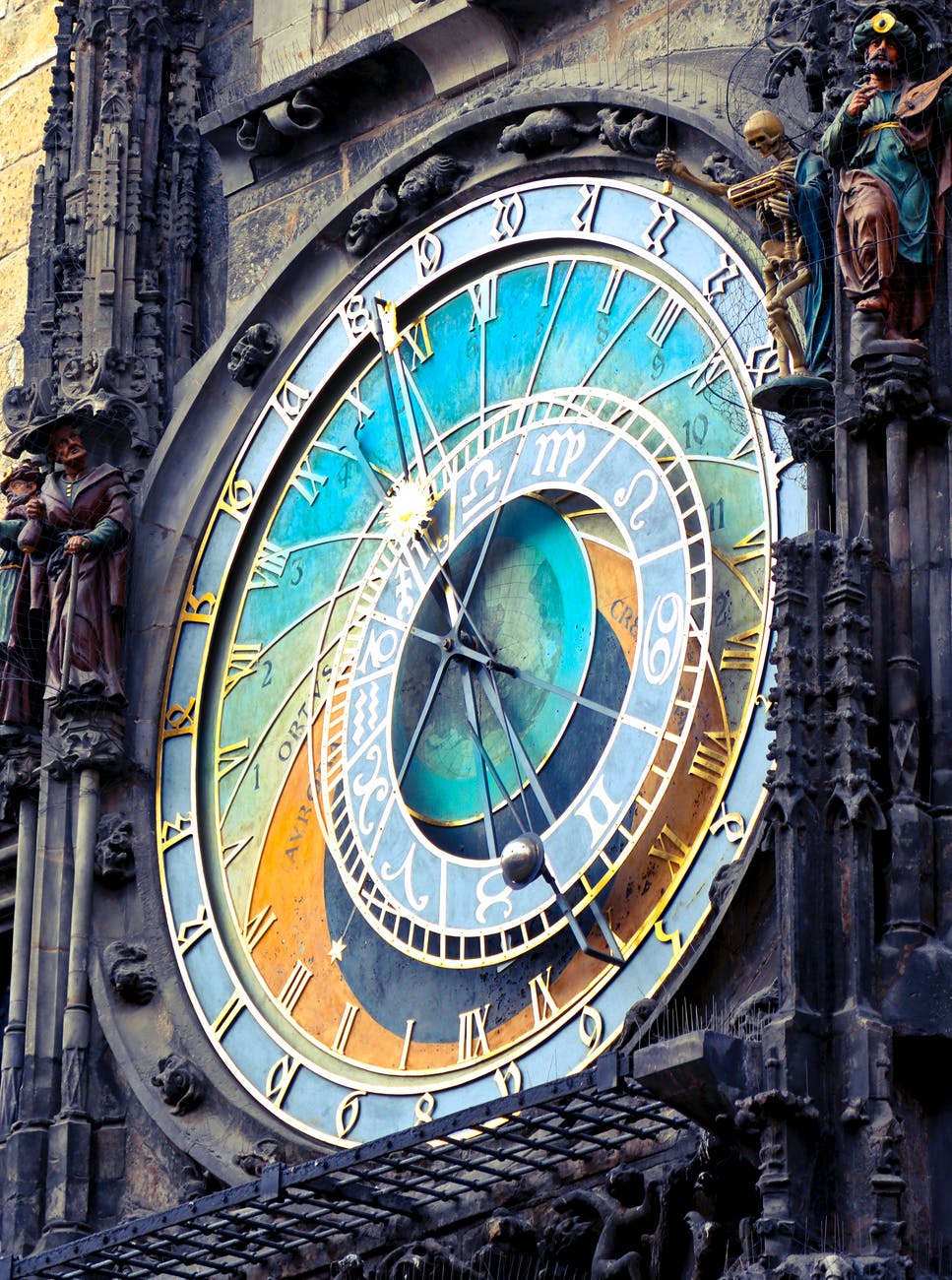
round analog clock
Photo by Andrea Piacquadio on Pexels.com

The older among us may remember the clarion calls of the late Sixties, the so-called cultural revolution, pronouncements that the New Age of Aquarius was dawning, an age of peace, love and freedom. So what happened?

Furthermore, speaking as an Aquarian sun native myself, although I strongly recognise certain accepted traits of the fixed air sign within myself, such as detachment and forward thinking, I have never felt comfortable with some of the more eccentric and bizarre character associations of Aquarius and this supposed Aquarian Age.

In reality, no one knows when this Aquarian Age will begin. Maybe it already has. The dates suggested have ranged from late medieval times to anywhere as far ahead as 2300 AD. Not so precise, is it?

What’s It All About?

And what is it all about anyway? It’s all to do with the phenomena called the Precession of the Equinoxes. Each zodiac sign is a thirty degree segment of the ecliptic, which is the apparent path of the sun around the earth. There is a zodiac sign behind the very slowly receding point of the Vernal Equinox around March 21 every year. This is all part of The Great Year, a period of time of almost 2600 years, where each sign takes a bit over 2000 years to recede behind this Equinoctal point. This is caused by the earth’s ‘wobble’ as the sky spins at an angle of 23.4 degrees around the pole star, from our perspective.

At this present time, we are said to be somewhere around the transition of the sign of Pisces, the fishes, into Aquarius, the male watercarrier. The past 2000 years of the Age of Pisces have been dominated by the sign of the fishes, Christianity. Christ has often been symbolised by the fish, ichthys in ancient Greek, where each letter encapsulates the divinity of the Saviour. The fish symbol was important to early Christians hiding from authorities who regarded them as a danger, even subversives.

Controversial

Naturally, such a supposition of astrological signs ‘affecting’ human culture is controversial. Admittedly, there were plenty of other events going on in the world over the past 2000 years that were not tied to Christianity. Considering this, and the massive time window given to the threshold of this Aquarian Age, I have long since been cynical about this particular astrological theory.

But I am willing to concede I may be wrong. I am a practising astrologer. I am also a realist. To make prognostications as to whether we are in, or are about to enter the Age of Aquarius, we should surely be clear as to what we should expect to see. Firstly, I do not agree with all people’s interpretations as to the character of the sign of Aquarius. Peace, love, freedom and understanding may be all fine ideals, but are they Aquarian? And have we seen any of this since the late Sixties, for example? I will let you be the judge of that.

Uranian Upheaval

One of the problems is that since around 1781, with the discovery of Uranus, most astrologers have come to put this outer planet at least equal to, or above that of Aquarius’ traditional ruler, Saturn. I think this is a mistake. I concur that Uranus certainly does have a revolutionary influence, causes sudden changes, often turning things upside down in the process. But is this in any way Aquarius, the Fixed Air sign? I strongly contend it is not.

So I don’t believe Uranus has ‘rulership’ of any sign and neither do Neptune and Pluto. They are generational influences because they move slowly through the signs, Pluto taking around 248 years, influences we have become consciously aware of since their discovery (or perhaps rediscovery).

The Two Faces of Saturn

For me Saturn has two sides. After all, apart from the sun and Moon, every planet down to Saturn was given rulership over two signs: Mercury rules Gemini and Virgo, for instance. So on one level Saturn may be Satan, the Greater Malefic, virtually evil personified as in the ancient myth of Cronos (Saturn) devouring his own children. On another level, he is the symbol of limitation, for ages considered to be the outermost planet and therefore symbolising a kind of barrier, the furthest reach, where all things are stopped, crystalised and slowly brought back. He is a kind of brake, bringing things down to solid earth so they can be accounted for. The latter I suggest is the Capricornian Saturn, a necessary function of life.

The other side of Saturn is the one which has rulership of Aquarius, the more ‘positive’ side. Aquarius is traditionally the sign of hopes, dreams and wishes, in other words objectivity as opposed to Leo’s subjectivity of sheer life enhancement. If Leo is artistic, Aquarius is scientific, liking to rationalise, codify. The same fundamentally materialistic Saturn, which is associated with the cardinal earth sign of Capricorn, shows this more ‘positive face’ in Aquarius. He is objective, the planner of the future, a practical idealist, as befits the fixed air sign of serious communication and association. Aquarius is fundamentally human. The outright eccentricity often tagged to Aquarius is wrong in my opinion. Strong aspects from Uranus to the planets or angles in a personal chart, would most likely explain any eccentricities of nature.

So, if this indeed be the case, any age of Aquarius would reflect the serious, objective and associative qualities of that sign. These are conspicuous by their absence at the present time.

The Grand Conjunction

That said, what we do have towards the end of this year, 2020, is the Grand Conjunction of Jupiter and Saturn occurring at 0 degrees Aquarius. The Grand Conjunction of these two planets represents a cultural correction point every twenty years, setting a general theme for the up and coming period. This on top of the ‘earth shattering’ Saturn Pluto conjunctions earlier in the year, so symbolic of the nadir of political and economic turmoil and you have a year of major significance, a year of historic transition and migration, if you will. I feel this has nothing to do with entering any new astrological age ruled by Aquarius, with all the ill defined thresholds of each sign within the Great Astrological Year of about 2600 years.

The occurrence of this Grand Conjunction every twenty years or so, invariably, although not necessarily wholly, migrates from one element to another every 150 to 200 years. For the last 180 years, apart from 1980/1, the GC has occurred in earth signs. From this year of 2020, it will be within the air signs of Gemini, Libra and Aquarius for around 140 years. This will be a major transition, marking a cultural shift, a probable explosion of philosophical and spiritual thought and technological progress, as befits the communicative and expansive air signs.

So from 2020 right through well into next century, we will undoubtedly undergo a vast, and, I truly hope, positive transformation, perhaps akin to what we are told about in the Renaissance. Precursing that time, during the 13th and early 14th centuries, there was a similar preponderance of Grand Conjunctions occurring in air signs.

Momentous Times

I believe that right now, in 2020, as we are currently living through one of the most momentous times in ‘history’. We are indeed at the threshold of a new age, a new cycle, which bears much renewed hope for humanity. At a time in the near future, we will be able to look back at this hiatus point with a bit more Aquarian objectivity.

What is more, bearing in mind that by the middle of this decade we will see all the outer planets in ‘positive’ signs too, the world of 2025 and beyond is going to feel wholly different than right now. By then, Uranus will be in Gemini, bringing great invention to technology and all forms of communication. Neptune will be in Aries and Pluto will move in Aquarius, both lengthy transits forever changing our ideas about humanity and spirituality, who we are as individuals and how we relate to the collective ‘universe’ – and revealing the truth as to what that universe and this reality actually are.

The Age of Air

What I don’t believe is that this is the much vaunted Age of Aquarius. If anything, we are entering the Age of Air Signs and everything to do with that element, which on the face of it is far more positive than all the earth energy we have been experiencing over the last 180 years, a truly extended period of denseness and negativity. The Saturn Pluto conjunction of 2020 represents the death knell of this ‘dark age’, where gross materialism has ruled outright and brought us literally to our knees.

The Grand Conjunction’s cycle in Air signs from December 21 2020, marks the beginning of the free – freer, more candid, fairer communication and justice as expressed through Libra; the rolling out of advanced technology for the benefit of humanity and the planet, as expressed through Gemini; and, firstly, a more planned, objective approach to administering the world and its resources, as expressed through Aquarius and positive Saturn. Let’s make it so.

copyright Francis Barker 2020

Rethinking Astrology: A Yearning for Simplicity

blue-blue-sky-beautiful-sky-puffy-clouds-4423022
Photo by franpics from Pexels

Whilst there are long existing schools of astrology, most astrologers tend to be very individual with their own particular nuances and practices.

I have been fascinated by astrology since my mum brought home a women’s magazine from the sad clear out of grandma’s house back in the 1970s. The publication contained one of those very basic sun sign forecasts which we are all familiar with. The slight difference with this one, was the little write up at the top of the piece regarding ruling planets. From that point I was hooked.

Thanks Grandma

I’ve often thought it was Grandma who led me down this winding path, even if it was through her death. I did go on to study astrology in many varied ways, with two schools and digesting countless books and manuals. However, it is true to say that especially in later years, I too have developed my own approach, which does bear certain similarities to other modern astrological trends.

Firstly, I have become more interested in ‘traditional’ astrology, which is largely based on Hellenistic or Ancient Greek astrology. The reason for this is the often confusing plethora of house systems on offer these days, the use of fixed stars, asteroids etc. I crave simplicity. This is not to say that various house systems don’t have relevance, or that fixed stars and asteroids have no place. All I’m saying is they are not necessarily for me.

Whole Sign System

So today I invariably use the Whole Sign house system, which is in fact pretty much the original house system. This means that if Aries, for instance, is rising, the WHOLE of that sign becomes the first house beginning at 0 degrees. From that point each house proceeds in 30 degree segments. The actual ascending degree, let’s say 15 degrees Aries, remains an important point in the chart within that first house, as will the the other angles in theirs.

Now I did say that I did not utilise asteroids or minor planets. That said, I have come to realise Chiron’s usefulness as the ‘wounded healer’, so I usually use him.

birthcharttemplate (7)

Similarly, the Moon’s nodes certainly are a strong karmic pointer. And I still use Pluto, even though he has been degraded astronomically to the status of minor planet. That said, with the three outer planets, Uranus, Neptune and Pluto, I do not regard them as serious rulers of the signs Aquarius, Pisces and Scorpio. I still tend to favour the traditional rulers, purely because of the beauty of the original system of rulership, from the intimacy of the Moon ruling Cancer, to the far out, impersonal Saturn ruling Capricorn and Aquarius on the outer limits.

Orbs

And as far as the orbs of aspects, I tend to restrict them to a few degrees. For the sun and Moon, no more than five and for the planets no more than three. After all, the tighter the aspect the more powerful and obvious it will be.

I generally use this approach for both individual interpretations and for events, such as general elections and their like. Once again, if other astrologers wish to explore the use of minor planets, fixed stars etc to much greater levels, then so be it.

I also like to produce (although not always) the square ‘medieval’ or Renaissance looking charts. I don’t know why but there is something artistically comforting in displaying the information this way, even though it may not be technically or visually as accurate as a round one.

You see, my own particular Aquarian mind yearns for more simplicity the older it gets, a life that’s stripped down and straight forward. That to me seems like a good pointer to the future.

copyright Francis Barker 2020

‘The Kissing Game’ Chapter 9, Short Story Serialisation, by Milly Reynolds

silhouettes of couple kissing against sunset
Photo by Snapwire on Pexels.com

Elena had taken herself off to the spare room, the very room where Michael had said she had sleep walked in to the previous night. One thirty and she still wasn’t asleep, she was simply too apprehensive, too much going on in her head. Once more she lay back and opened another book she’d borrowed from Mary. She came across a reference to the fact that most children were baptised within two or three days of birth, at least until more recent times. This was because of the much higher rates of child mortality. It made her think. With that thought in her mind, she lay the book down and closed her eyes. 

The room was dark, quite small. Long curtains were closed, just a peep of light came through a gap. Outside there were distant voices, so she opened the curtain a touch to see. It was the canal or river she had seen before, though there was less activity this time, as if it might be evening. As she turned away, she noticed a mirror with an ornate frame on the right wall. Keeping the curtains open, she looked at it. Elena had the clearest blue eyes, a smooth, ivory complexion. She brought a hand to her face, touching the soft flesh.

“I am… quite beautiful,” she whispered.

She recognised the room, the bed in the corner where someone was lying. Walking up to the bed, she recognised him, though he made no move, as if he was asleep. She peered more closely; then he opened his eyes, slightly.

“Elena,” he croaked, weakly, “you have destroyed me.”

She stepped back as he reached out, trying to touch her. “What’s the matter with you? Is it something I’ve done?”

“Elena, you have destroyed me.”

She felt a sudden unease. “What have I done?”

He tried to smile, though it seemed to be difficult. There was pain written all over his face, emotional as well as physical discomfort.

“Just… tell me who you are.”

His hand fell limply by his side, a weak gaze remaining fixed on her where she stood. 

“Don’t go!”

Kneeling down she put a hand in front of his face. There was no breath. She checked the pulse on his wrist: nothing. His candle had burned out. Elena closed his eyes, reached forward and kissed his cheek. Then she sat on the chair next to the bed. Tears began to well up in her eyes, though she wasn’t sure why. Did she know this man? And if so, how?

“I want to come out of this dream now,” she said out loud, wiping her eyes. Yet she remained in the room, apparently present in some time which may have been four hundred years ago. She began to feel queasy, quite strange in fact. So she stood, but had to sit down again, feeling quite faint. She bent down on all fours and was sick into the empty chamber pot by the bed. There was no cloth or tissue to use, so she wiped her mouth on the bed sheet. Suddenly without the strength to get up, she lay on the floor, closing her eyes.

Elena felt the gentle stroking of her hair. Opening her eyes, Michael’s concerned face was examining her own.

“It was quite a shock to find you lying here.”

“Where am I?”

“The toilet, I see you’ve been sick. Something you ate last night, was it?”

“No,” she said, faintly, “I don’t think so. What time is it?”

“Six o’clock. Have you been like this before, recently?”

Elena thought for a few seconds. “A little yes. I thought it was the lack of sleep.”

Their eyes met, instinctively, though neither dare ask that most pertinent question. Michael helped her to her feet and led her back to bed.

“Get some sleep, I’ll take the day off, it won’t matter.”

“I’m not sure I want any sleep.”

“Hm, because of him? This strange kisser fellow?”

“Maybe,” she said, laying down her head, “though I get the feeling that I won’t be seeing much more of him in my dreams.” 

“I like the sound of that. I’ll get you some water.”

copyright Milly Reynolds 2020

Buy Milly Reynolds’ ebooks and books