My Top 5 British Rock Front Men/Lead Singers

Photo by vectors icon on Pexels.com

These are my own considered three qualifications/prerequisites for this position, in British rock‘s top 5 front men:

  1. Stage presence, charisma, probably the key factor – is his character larger than life?
  2. Looks – the ability to turn all the heads in whatever way.
  3. Musical talent – can he contribute by playing an instrument as well sing?

These are my rules, so the guy has to be in a band, not a solo artist only. I shall state these in reverse, though ask me on any other day and I might have a different order.

5. Dave Coverdale lead singer of Deep Purple and Whitesnake. An archetypal front man with a great soulful voice, plus a great rapport with his audience.

4. Roger Daltrey, lead singer of The Who. Fantastic stage presence and looks with a powerful voice.

3. Robert Plant lead singer and a songwriter of Led Zeppelin. Powerful bluesy voice and front man with iconic looks.

2. Mick Jagger, lead singer of The Rolling Stones. Perhaps the original front man of British rock, commanding the stage with his unique antics. If longevity was the only proviso he’d be No. 1.

  1. Freddy Mercury, lead singer, keyboard player and a songwriter with Queen. Maybe not have been as classically good looking as the rest, but was simply peerless with his imperious stage presence, powerful and distinctive voice, sheer musical ability, as well as contributing on keyboards on stage – whilst retaining that great rapport with the fans.

Once again, these are only my opinions. There great names I have left out.

*Music has always been very important to our culture, so we must encourage new talent.

England’s Heritage, Peterborough Cathedral Part II – Two Famous Queens

IMG_1892 (1)

Peterborough Cathedral in the east of England is one of the country’s biggest and most beautiful churches, with an association with two famous queens.

The long nave is quite stunning, with a beautiful roof and with a modern golden image of Christ suspended high as a focal point.

IMG_1893

The cathedral is dominated by Norman and early English architecture, with numerous examples of Norman arches, such as these interlacing examples above.

IMG_1894 (1)
Catherine of Aragon, Queen of England, is buried here.

The cathedral is also notable for its association with two famous queens.

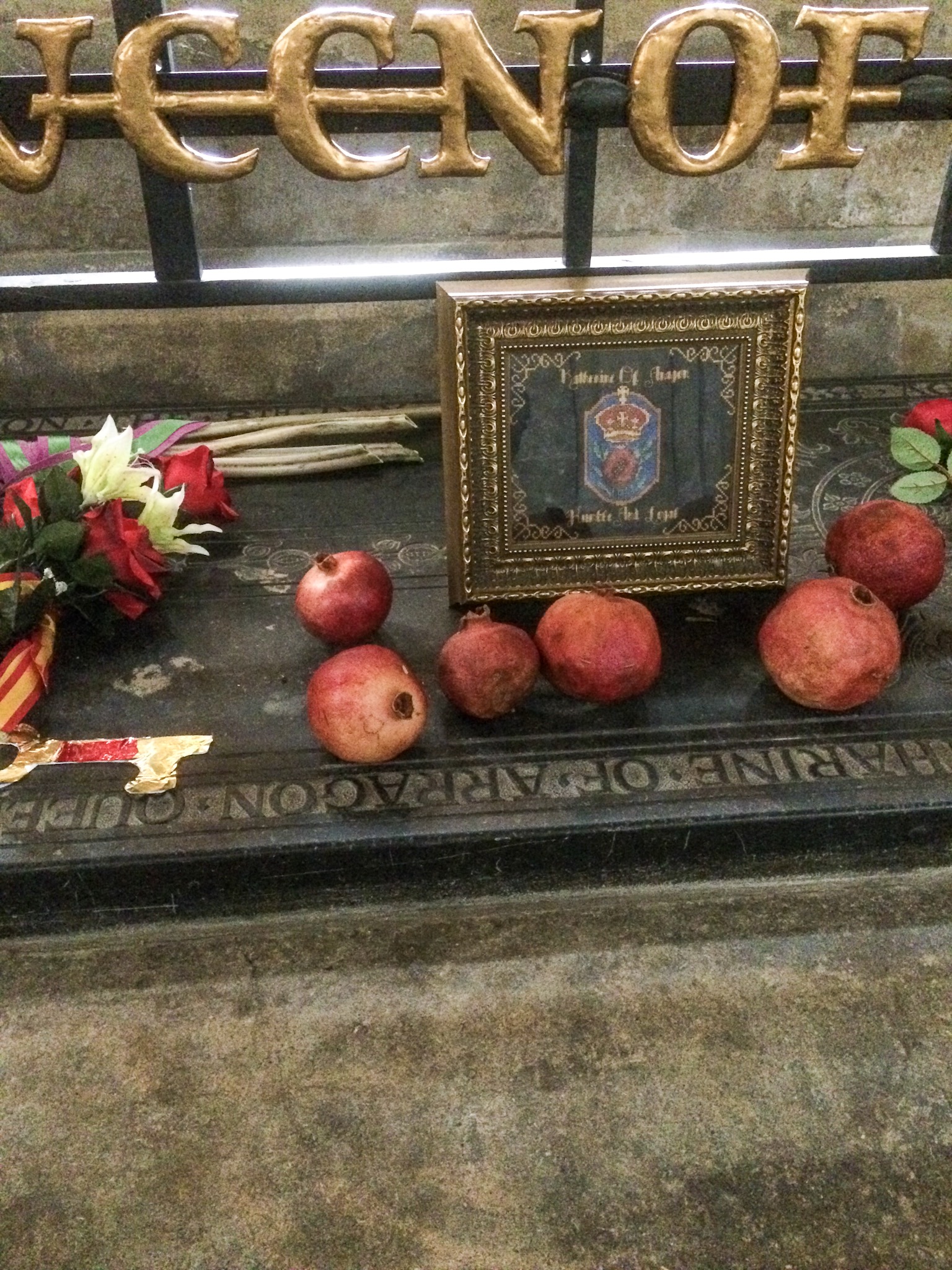
The first was Catherine of Aragon, Queen of England when she was married to Henry VIII. Catherine was buried here in 1536 and her tomb is still something of a shrine to her memory, with pomegranates very prominent as her symbol because the fruit appears on her badge. Pomegranates are an ancient symbol for fecundity and regeneration.

Catherine certainly suffered much during her husband’s long and protracted break with Rome, in which she was the innocent victim, her only crime it would seem was not being able to produce a living male heir for Henry to perpetuate the Tudor dynasty. This was how she was treated after being completely dutiful to the king, but Henry had to have his way. Her motto, which translates as ‘humble and loyal’, is a phrase she very much lived up to.

IMG_1895
There is a portrait of Catherine by her tomb.

IMG_1896 (1)
Pomegranates have had a long association with Catherine of Aragon.

The second queen associated with Peterborough Cathedral is Mary Queen of Scots.

Mary inherited the Scottish throne after only a few days of being born, thrusting her into a world of political intrigue and shenanigans which she was never able to control.

She essentially became a pawn of more powerful rulers and some despicable characters. However, in 1559 she duly became Queen Consort to Francis II of France, solidifying Scotland’s long alliance with France.

IMG_1900
Scottish symbols hang in honour of Mary who was initially buried here in 1587.

Sadly within 18 months the young kind died prematurely. Had he lived, Mary’s life would have turned out entirely differently. As it was, she became a teenage widow and a long series of political and personal disasters ensued when she returned to Scotland. Eventually she fled to England and came under Elizabeth’s control.

After many years’ imprisonment in England, during which the still substantial Catholic faction within England with aid from Spain continually conspired to depose Elizabeth and put Mary on the English throne, she was finally executed at nearby Fotheringhay Castle in 1587.

She was initially buried in Peterborough Cathedral, but her son, James I of England, had her remains transferred to Westminster Abbey in London.

words and photographs copyright Francis Barker 2019


Poem ‘A Letter’

A drawing of an envelope
(Photo credit: Wikipedia)

A Letter

I had a letter today,
an envelope neat and buff;
written in a fine, confident hand,
a nice final flourish at the end.
Evidently someone had time,
had taken the care
to place the Queen’s cameo
all square on the right.
Yes, a letter.
Two leaves folded and secure
and then “Dear”!
How good to see “Dear”,
and “faithfully” too.
Who is faithful now
in this swinging, shallow world?
As to the content
it escaped me—
I mean I forget.
I folded it, put it back
and sealed it as best I could,
laying it flush to the table’s edge,
and smiled

poem © copyright df barker 2012